
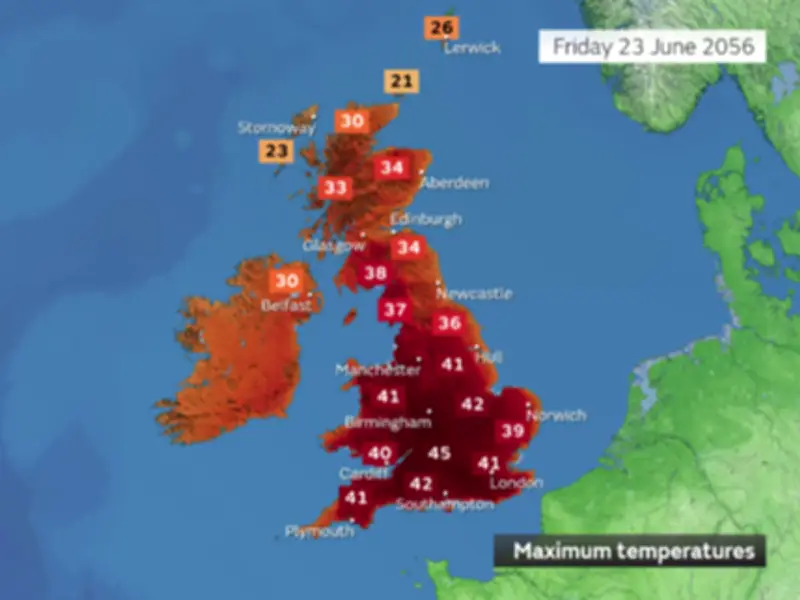
The Met Office has issued a stark warning that the UK could experience temperatures of 45°C within the next three decades, as the country braces for an extreme heatwave that is expected to break records. Temperatures are forecast to soar to 40°C in parts of England and Wales this week, prompting a rare red 'extreme heat' warning. The heatwave, caused by a 'heat dome' settling over western Europe, will bring high humidity and very warm nights, making it difficult for people to recover overnight.
Current Heatwave Could Break June Records
The current heatwave is likely to surpass the June record set in Hampshire in 1976 by several degrees and could approach the UK's all-time high of 40.3°C recorded in July 2022. Chief Met Office scientists have warned that such extreme heatwaves are becoming 'more likely and more intense' due to human-induced climate change.
Professor Stephen Belcher CBE, Met Office Chief Scientist, said: 'The heatwave this week will be a significant weather event, with a Red Extreme Heat warning issued. Human induced climate change has made events like this more likely and more intense. To see temperatures like this in the UK in June is sobering. Events like this bring home the implications of climate change, with very high temperatures and humidity bringing significant health implications from heat stress, as well as impacts to a range of sectors such as transport, energy and water supply.'
2056 Scenario: 45°C and Nine Days Over 40°C
To illustrate how a prolonged heatwave similar to the historic 1976 summer could evolve in coming decades, the Met Office developed a plausible '2056 scenario' based on around 2.5°C of global warming. The scenario shows that a heatwave like the one in 1976 would be much more extreme, with nine consecutive days where temperatures exceed 40°C somewhere in the UK.
Professor Belcher added: 'Weather is the national conversation in the UK and the summer of 1976 lives on in many memories. Since then, our climate has fundamentally changed, with average UK summers having warmed by around 1.4°C. Crucially extremes have changed too. By using data from Met Office climate projections, we can glimpse into what an event like the 1976 summer would look like in the 2050s. It is a stark realisation to see the maximum temperatures reach 45°C.'
Impacts of Extreme Heat: Wildfires, Infrastructure Damage, and Health Risks
Met Office meteorologist Aidan McGivern highlighted the potential impacts: 'When the UK first recorded 40°C in July 2022, it happened on just one day yet it still brought widespread disruption. Wildfires destroyed 18 homes in Wellington, rail tracks buckled, travel was disrupted and infrastructure, including the airport at Luton Airport, was damaged. The UK Health Security Agency issued its first ever level four heat-health alert and more than 2,400 excess deaths were recorded.'
The research also found that a heatwave like the 1976 event would already be around 3°C hotter in today's climate. Professor Ed Hawkins MBE, Professor of Climate Science at the University of Reading, said: '1976 was an extraordinary event, but it happened in a much cooler climate. As global temperatures rise, heatwaves like this are becoming more intense and more frequent.'
Red Weather Warning in Force
A red weather warning for extreme heat has been issued for parts of the UK, covering an area stretching from London to Swansea and Somerset to Birmingham. The warning is in effect from 9am on Wednesday, June 24, to 9pm on Thursday, June 25. These warnings are reserved for the most severe events, and the Met Office says this heatwave is expected to bring 'severe and significant impacts,' including widespread health risks for many, not just those normally vulnerable to heat, and even danger to life.




