Scientists Identify Ominous 'Red Flags' as Key Ocean Current Approaches Potential Collapse
Scientists have detected several alarming warning signs indicating that a crucial ocean current system may be nearing a catastrophic collapse. The Atlantic Meridional Overturning Circulation (AMOC), a vast network of ocean currents that includes the Gulf Stream as just one component, plays a vital role in regulating global climate patterns.
The Climate-Regulating Conveyor Belt
This immense system functions as a planetary conveyor belt, transporting warm water from tropical regions to North America and Europe, thereby maintaining relatively warm and stable climates across these continents. The AMOC's operation depends on a delicate balance where cold, salty water sinks in the Arctic, pulling warmer water northward to continue the circulation cycle.
However, new research from Utrecht University suggests this critical system could be approaching a breaking point. Scientists developed a sophisticated high-resolution computer model to monitor subtle changes in ocean circulation patterns. By gradually introducing fresh water into their simulation to replicate the effects of melting ice sheets—a process experts predict will weaken the AMOC—researchers observed alarming developments.

Warning Signs Already Emerging
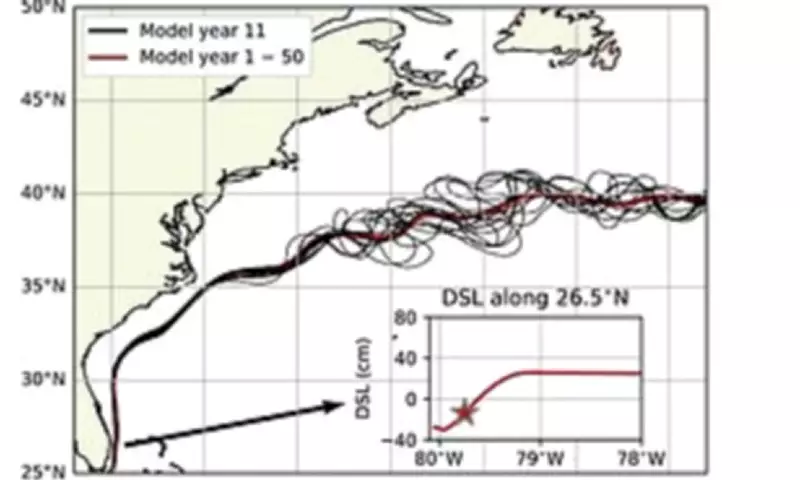
In their simulation, the Gulf Stream exhibited a dramatic northward shift of approximately 136 miles (219 kilometers) approximately 25 years before the complete collapse of the AMOC system. Most concerningly, researchers believe similar changes may already be occurring in the actual Gulf Stream.
Lead author Dr. René van Westen explained to the Daily Mail: "What is most important is that most AMOC reconstructions suggest that the AMOC is weakening under climate change, with the northward shifting Gulf Stream also being a sign for AMOC weakening."
The study, published in Nature Communications Earth & Environment, identified several specific red flags:
- The AMOC's strength has diminished by approximately five percent over the past decade
- The Gulf Stream has already begun shifting northward near Cape Hatteras in North Carolina
- Reduced water transport through the Gulf Stream system
- Warmer temperatures developing in northern ocean regions
- Concentrated ocean warming along the western edge of the continental United States
Potential Climate Catastrophe
Should the AMOC collapse entirely, the consequences would be severe and far-reaching. Northern Europe and the United Kingdom could potentially experience conditions resembling a new ice age, with dramatic temperature declines transforming regional climates.
Research indicates London might face winter extremes plummeting to –20°C (–4°F), with approximately three months annually spent below freezing. Similarly, Edinburgh could experience one-in-ten-year temperature extremes reaching –30°C (–22°F), with Scotland potentially enduring five and a half frozen months each year.
The Melting Ice Threat
The primary mechanism threatening the AMOC involves the massive influx of fresh water from melting ice sheets. The Greenland Ice Sheet alone releases approximately 2.5 million litres of fresh water every second into surrounding oceans. This freshwater dilutes the saltwater, reducing its density and weakening the sinking mechanism that drives the entire AMOC system.
Dr. van Westen's team compared their model predictions with thirty years of satellite data and deep-sea records dating back to 1965. While the researcher cautions that their model doesn't perfectly match real-world conditions, and that the Gulf Stream hasn't yet reached the collapse point observed in simulations, the alignment between model predictions and actual observations remains deeply concerning.
"If the real Gulf Stream is displaying this abrupt jump, it would indicate that we are close to the AMOC tipping point," Dr. van Westen stated, emphasizing that human activities appear to be pushing this critical system closer to potential collapse.
The research provides crucial early warning indicators that could help scientists predict when such a collapse might occur, offering a narrow window for potential mitigation efforts before this planetary-scale climate regulator reaches its tipping point.