Global Warming Accelerates Sharply Since 2015, New Study Warns
A groundbreaking study has revealed that global warming has accelerated 'significantly' since 2015, with the rate of temperature increase more than doubling compared to previous decades. Researchers from the Potsdam Institute for Climate Impact Research conducted a comprehensive analysis using five major global temperature datasets to track how warming trends have evolved over time.
Alarming Acceleration in Warming Rates
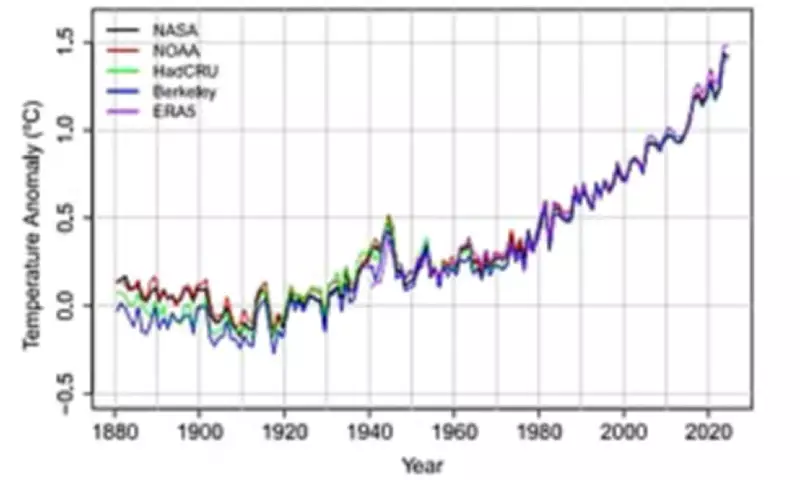
The findings indicate that from 1970 to 2015, Earth warmed at a steady rate of just under 0.2°C (0.36°F) per decade. However, over the past ten years, this rate has surged to approximately 0.35°C (0.63°F) per decade. This acceleration marks the highest warming rate recorded since systematic measurements began in 1880, underscoring a critical shift in climate dynamics.
According to the study, if this accelerated warming trend persists, it could lead to a long-term exceedance of the 1.5°C limit set by the Paris Agreement before 2030. Stefan Rahmstorf, the lead author of the study, emphasized the urgency of the situation: 'How quickly the Earth continues to warm ultimately depends on how rapidly we reduce global CO2 emissions from fossil fuels to zero.'

Methodology and Data Analysis
To ensure accuracy, the researchers compiled measurement data from five established global temperature datasets: NASA, NOAA, HadCRUT, Berkeley Earth, and ERA5. They filtered out natural influences such as El Nino events, volcanic eruptions, and solar cycles to reduce 'noise' and make the underlying long-term warming signal more visible. Grant Foster, a co-author of the study, explained that this approach allowed for a clearer understanding of the acceleration.
The analysis showed that the acceleration became apparent in 2013 or 2014 across all datasets, with 2023 and 2024 being the two hottest years ever recorded. Professor Rahmstorf noted: 'The adjusted data show an acceleration of global warming since 2015 with a statistical certainty of over 98 percent, consistent across all data sets examined and independent of the analysis method chosen.'
Implications for the Paris Agreement
The Paris Agreement, first signed in 2015, aims to limit global temperature increases to well below 2°C above pre-industrial levels, with efforts to cap it at 1.5°C. The study warns that the more ambitious 1.5°C goal is at severe risk if current warming rates continue. In their paper, published in Geophysical Research Letters, the researchers stated: 'Stopping this trend is in our hands: studies show that global warming will stop around the time humanity reaches zero CO2 emissions, but it can hardly be reversed.'
They highlighted that in the current political climate, warming may maintain its fast pace or even accelerate further, making immediate action crucial. The agreement's four main goals include reducing emissions to peak as soon as possible and undertaking rapid reductions based on scientific evidence.
Call to Action and Future Outlook
The study did not investigate specific causes of the acceleration but stressed that global warming will only cease when humanity achieves zero CO2 emissions. The researchers urged for urgent measures to curb emissions, noting that the path forward depends on collective global efforts. With millions of homes potentially at risk from rising sea levels and drier conditions affecting up to 25% of the world, the stakes have never been higher.
As the planet faces unprecedented warming, this study serves as a stark reminder of the need for decisive climate action to safeguard our future.