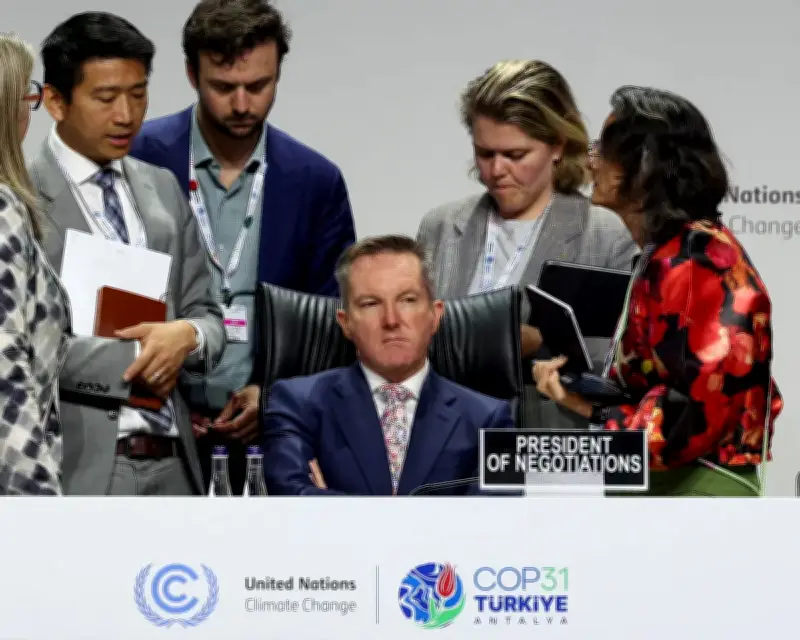
The UN climate summit in Antalya, Turkey, ended on Sunday without agreement on the Antalya pact, after countries could not bridge differences over how to refer to fossil fuels. Australia's climate change minister, Chris Bowen, who served as president of negotiations, said the red lines were "unbridgeable".
The talks, which became the longest UN climate summit ever, were meant to drive investment in renewable energy and electrification, boost finance for developing countries, and acknowledge the world is exceeding the goal of limiting global temperature increase to 1.5C. Many negotiators raised a "red line" that any agreement must refer to the need to "transition away from fossil fuels", previously agreed at talks in Dubai three years ago. Others, including Saudi Arabia, did not want the words "fossil fuels" mentioned at all.
Compromise rejected
A compromise proposed in the final drafts, drawn up by Bowen and Cop31 president Murat Kurum, suggested countries would "recall" the Dubai decision "in its entirety" without saying fossil fuels directly. The European Union, Panama, the Marshall Islands, Vanuatu, Norway and Belize were among those that said no. Ireland's climate minister, Darragh O'Brien, called the omission "unconscionable".
Bowen left the plenary stage late on Sunday afternoon when it became clear too many countries could not accept the text. He told journalists that "Australia left nothing on the field" but the red lines were "unbridgeable". Some countries said they could not support a pact that did not mention a transition away from fossil fuels, while others "insisted if it was mentioned, they would veto". Bowen said he "would have been happy with transition away from fossil fuels being in the text, but that was not going to get support".
Process under scrutiny
Despite the breakdown, Bowen said "in the real world" the transition away from fossil fuels was inevitable and irreversible. A promised electrification target, that 35% of final energy will come from electricity by 2035, had the backing of more than 90 countries and was not a deal-breaker.
The talks did not collapse entirely; many less controversial elements of the convention's processes were passed. But the failure to agree the Antalya pact has led some to question the Cop process. Luke Menzel, chief executive of the Energy Efficiency Council, said "this process has been fracturing for a long time" and "it turns out Antalya is where the conference finally fractured". Former US vice-president Al Gore called it "an outrage" that "a handful of petrostates have veto power over any mention of fossil fuels", concluding "it has been clear for years that the Cop process is in need of significant reform".
Mixed reactions
Some campaigners criticised Australia's role. Denise Cauchi, chief executive of Climate Action Network Australia, said Australia had "failed to broker an agreement" and "caved" to lobbyists pushing for carbon capture and storage technology. But in the final plenary session, Fijian climate change minister Lynda Tabuya told Bowen: "You have tried your utmost best, and we have seen it. Your door has always been open." She added: "The failure here is not yours to carry. It is the responsibility of all parties."