It might occasionally feel as though the days are stretching out longer than usual, but this sensation is not merely a trick of the mind. Groundbreaking research from the University of Vienna and ETH Zurich has confirmed that the length of days on Earth is increasing at an unprecedented pace, directly linked to human-induced climate change.
Unprecedented Slowing of Earth's Rotation
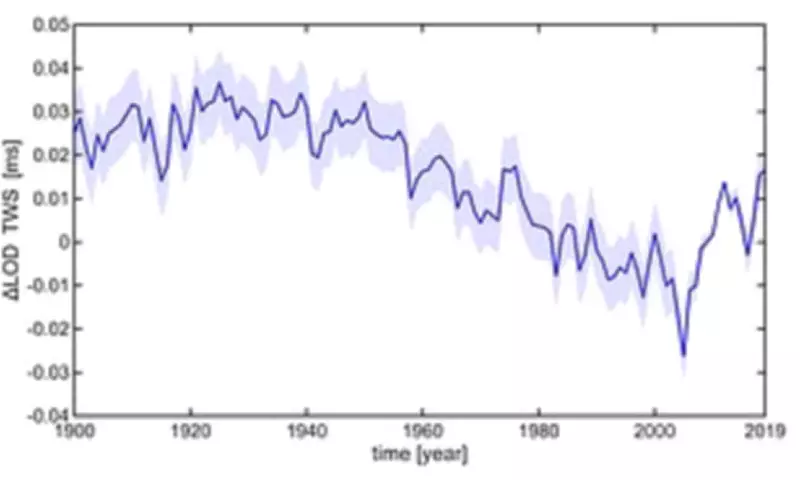
According to the study, days are now growing longer at a rate of 1.33 milliseconds per century. This rate of change surpasses any observed in the last 3.6 million years of Earth's history, marking a significant departure from natural cycles. The primary culprit is the accelerated melting of polar ice sheets and glaciers, driven by global warming.
The Figure Skater Effect
Professor Benedikt Soja, a co-author from the University of Vienna, explained the phenomenon using a vivid analogy. "Like a figure skater extending their arms to slow a spin, water from melting poles flows toward the equator, shifting Earth's mass away from its axis of rotation," he told the Daily Mail. This redistribution increases the planet's moment of inertia, resulting in a slower spin and consequently longer days.

While natural factors such as lunar gravity, deep Earth processes, and atmospheric changes have historically caused minor fluctuations in day length, human activities are now exerting a more powerful influence. Professor Soja emphasized that the current rate of change, fueled by human impact, stands out starkly in climate history. Only around two million years ago, during a period of high CO2 levels when Greenland was ice-free and forested, did the rate approach comparability, but it never matched the rapidity seen from 2000 to 2020.
Implications for Precision Systems
Although the changes amount to mere milliseconds, they pose potential disruptions to systems reliant on exact timekeeping. Professor Soja warned that even these tiny shifts could affect space navigation, GPS, satellite systems, and the synchronization of atomic clocks. As climate change progresses, researchers anticipate this deceleration will intensify, with projections indicating that by the end of the 21st century, climate impacts could outweigh the moon's gravitational pull on day length.
Historical Insights from Fossil Records
To gauge the scale of these changes, scientists analyzed fossilized remains of benthic foraminifera, ancient single-celled marine organisms. Dr. Soja noted, "From the chemical composition of their shells, we can trace past sea-level fluctuations and derive changes in day length over millions of years." Using a physics-informed machine learning model, the team reconstructed day length variations over 3.6 million years, revealing that no natural force has slowed Earth's rotation as rapidly as contemporary human-caused climate change.
By the 2080s, days could lengthen by 2.62 milliseconds per century, underscoring the profound and accelerating impact of greenhouse gas emissions on our planet's fundamental rhythms.