
Oil prices soared on Thursday after US President Donald Trump vowed to hit Iran “extremely hard” over the coming weeks, dashing hopes of a near-term end to the Middle East conflict. Brent crude jumped as much as 8% to $109.74 a barrel before easing to $106.40, up 5% on the day, following a report that Iran and Oman are working on a protocol for marine traffic in the Strait of Hormuz.
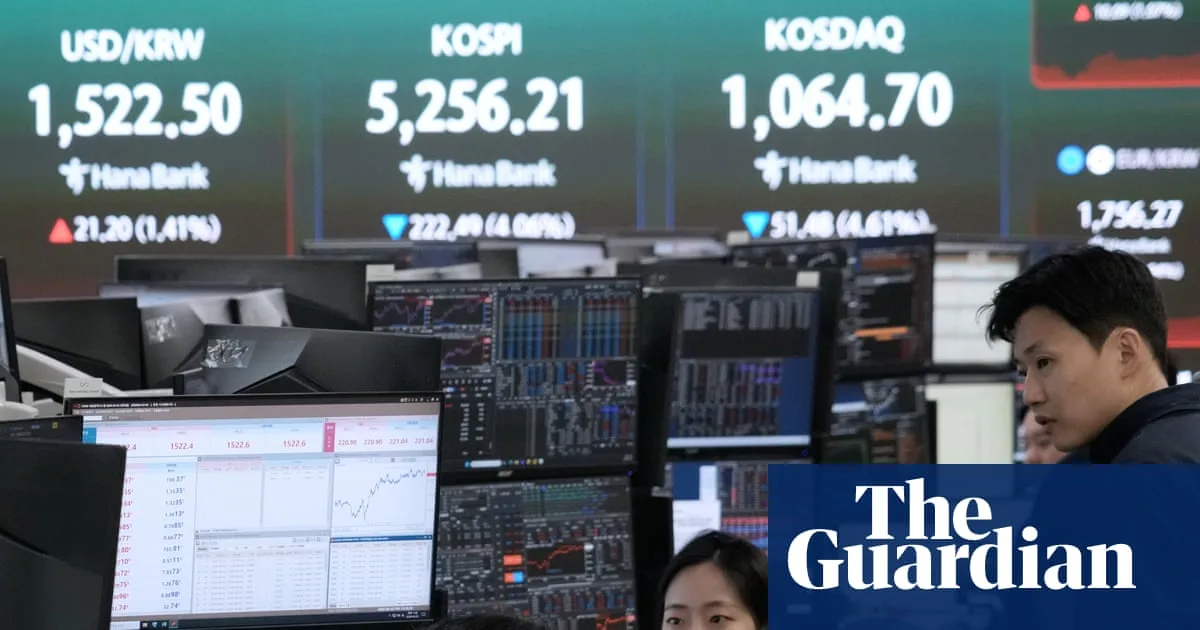
Asian stock markets suffered heavy losses, with Japan’s Nikkei falling 2.4%, China’s CSI 300 dropping 1.36%, and South Korea’s Kospi tumbling 4.8%. European markets saw mixed results: Germany’s Dax fell nearly 1%, France’s Cac 40 and Italy’s FTSE Mib both dropped 0.2%, while London’s FTSE 100 reversed early losses to rise 0.7%, boosted by BP and Shell climbing about 3%.
Government borrowing costs rose, with the yield on 10-year UK gilts up four basis points to 4.886% and the two-year yield up six basis points to 4.36%, reflecting fears of inflation from higher energy costs. The US dollar gained 0.6% against major currencies as investors sought safe havens, pushing the pound down almost a cent to $1.321.
Chris Beauchamp, chief market analyst at IG, said markets were pricing in long delays to oil supply deliveries from the Gulf after Trump failed to provide an endgame. “Instead of ‘no more war’, we got ‘no, more war!’… markets are back to pricing in economic catastrophe,” he said.
The market turmoil is already hitting consumers. The Bank of England warned that 1.3 million more homeowners may see mortgage payments rise due to the Iran conflict. Meanwhile, the RAC reported that petrol prices jumped by a record 20p per litre in March, from 132.83p to 152.83p, surpassing the previous record set after Russia’s invasion of Ukraine.




