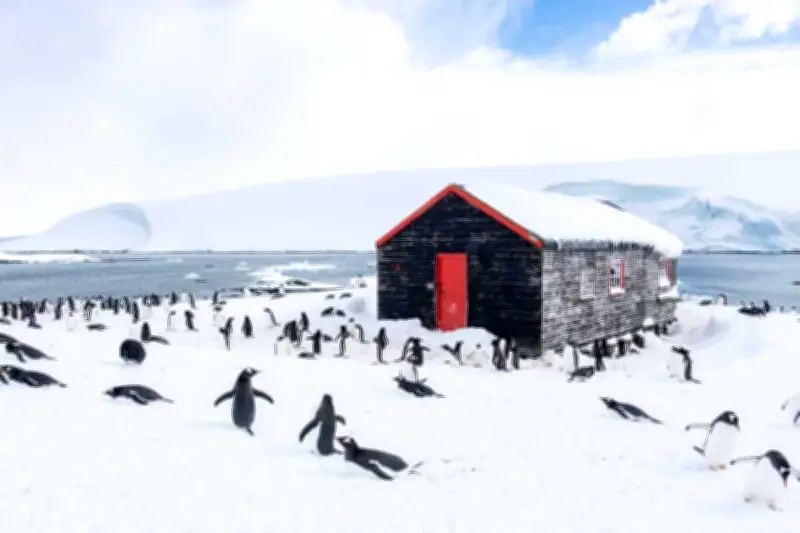
A new team is being deployed to Antarctica to protect a historic base from climate change on the icy continent. UK Antarctic Heritage Trust (UKAHT) is in year two of its three-year mission to conserve Britain’s first permanent scientific base there, Base A in Port Lockroy on Goudier Island.
It serves as a designated heritage site and is home to the world’s southernmost office and museum, as well as a colony of more than 1,000 gentoo penguins.
Five-month deployment
An eight-person crew will spend five months there this year and, for the first time, UKAHT is also dispatching people to the home of Antarctica’s second longest continuous climate recording, Wordie House.
Teammates selected for the remote job roles include a health and social care worker turned carpenter, an RAF veteran and a mountain rescue volunteer. Recruits will share a bunk room and withstand no running water or flushing toilets, while working in almost constant daylight and sub-zero conditions.
There will be no creature comforts but a small box is on its way containing the crew’s treat selection: Cup A Soup, Dairy Milk chocolate bars and mini watercolour painting sets. Conservation carpenter Kate Walford has sent presents and cards to open on her January birthday.
Climate change challenges
Conservation lead and chief executive Camilla Nichol, who will be at Wordie House, said in a statement: “This is a huge year for us as we meet the growing challenges of climate change.
“Since Wordie House’s records began in 1947, the Antarctic Peninsula has become one of the fastest-warming places on the planet and we see the impact every year on the wildlife and special places in our care.”
A group of six specialists will conduct the first comprehensive survey of the British heritage site, which is south of Base A, to assess its condition, structural integrity and carry out digital mapping. The more than 80-year-old Base A site needs significant repairs due to its age and environmental factors such as increased rainfall, water flow and snow loading.
Surveying Wordie House
Travel medic and former Port Lockroy base leader Lisa Ford is guiding the team to Wordie House, which started its records 80 years ago in work continued by the Ukrainian Vernadsky station on Galindez Island. She will be joined by conservation carpenter Sven Habermann, artefacts conservator Sophie Rowe, XR producer Lesley Johnston and conservation engineer Maggie Cook.
Ms Cook said: “Most of the buildings I work on were built to last for centuries. These were never meant to last at all, and yet they’re still standing decades on. Working out how to keep them standing, without changing what they are is the kind of problem I love.”
Ms Rowe, who is visiting Antarctica for the fourth time, said: “I’ve spent much of my career caring for polar objects in museums, but it’s very different working with them in the place they were used. The objects inside Wordie House are still where people left them, and recording each one is how we make sure the stories behind them aren’t lost.”
Meanwhile the team on football-pitch-sized Goudier Island will run the world’s most southern post office, museum and gift shop, and monitor the penguin population. They will also install up to six beams on the roof and 30 steel and timber props in the floor to help it withstand increased precipitation and snow.
For former health and social care worker, Ms Walford, it is her first time in Antarctica. She will work with fellow carpenters Hugh Arnold, who has worked on Westminster Hall, and Jo Oliver, who was at the base last year. RAF veteran Carole McCullough will run the site with shop manager Kath Wibemer, who volunteers with mountain rescue and search dog teams. They will be joined by wildlife monitor and museum manager Alice Parr, who works in museum fundraising.
Postmaster George Clarke is returning for a third season and said: “I’ve really fallen in love with the Antarctic wilderness, as well as the penguins and can’t wait to get back there.” Recruits have had first aid training, a sea survival course, talks on penguinology and Antarctic history, and learned the strict environmental protocols and standards.