
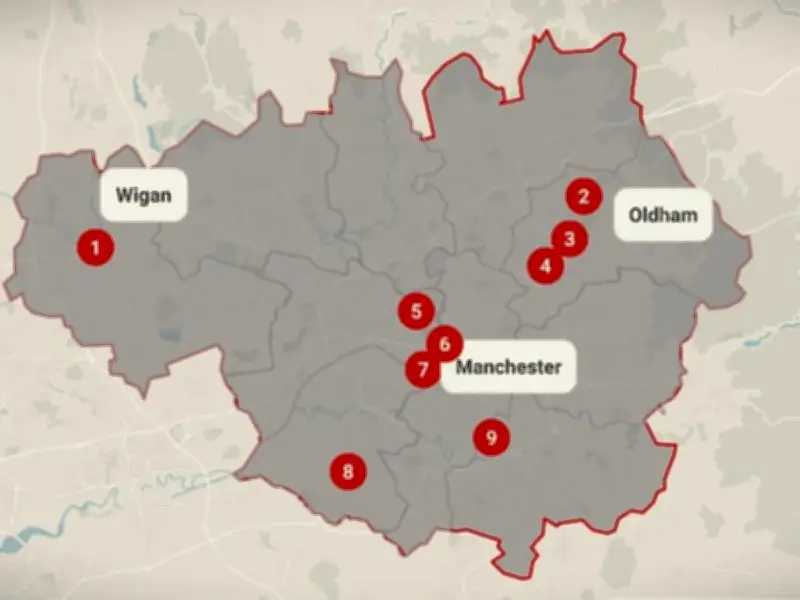
Nine pieces of Greater Manchester history have been added to SAVE Britain's Heritage Buildings At Risk Register, including Barton Arcade, the Racecourse Hotel in Salford, and a Victorian villa in Stockport. These sites span from a Georgian canal warehouse to an Art Deco bar, all facing potential loss.
Barton Arcade: A Victorian Shopping Gem in Decline
Barton Arcade, completed in 1871 by Corbett, Raby & Sawyer, was inspired by Milan's Galleria Vittorio Emanuele II and the Crystal Palace. It stretches 226 feet wide and 53 feet tall under a striking glass and iron roof, named after developer John Hope Barton. Early tenants included Stephenson's Glass & Chinaware, which remained for nearly 100 years until 1967. In the late 1870s, it housed the Humane Society for the Hundred of Salford, and in 1908, hosted the founding meeting of the Catenian Association.
During the Manchester Blitz in 1940, the glass dome was damaged. Modifications in the 1970s eroded original features, but it gained Grade II* listed status in 1972. A 1980s revival restored ironwork, galleries, and glass roofing, with a grand reopening by Joanna Lumley in 1990. Today, retail occupancy is declining due to rising rents, and concerns about roof repairs persist. SAVE notes potential for offices, entertainment, retail, and an apartment with a rooftop terrace.
Racecourse Hotel: A Pub Losing Its Patrons
The Racecourse Hotel on Littleton Road, Salford, built in 1930 next to Castle Irwell racecourse, is now boarded up after nine years vacant. Designed by Charles Clegg and Son in Tudor-revival style, it was funded by Groves and Whitnall brewery. The racecourse closed in 1963, severely impacting the pub. It operated under Oakwell Brewery until 2013, then Samuel Smith Breweries renovated it in 2015, but it closed soon after and now sits vandalised.
Harry's Bar in Oldham: Art Deco at Risk
The former Artizans Rest, later Harry's Bar at 67–69 Yorkshire Street, Oldham, was built in 1937 in Art Deco style with sculptural reliefs by William Hargreave Whitehead depicting craftsmen. These panels were removed in 2019. The building is structurally sound but vacant, and the council acquired it in 2025 with plans to demolish it for regeneration. SAVE argues the loss would erode Yorkshire Street's historic character.
SAVE's Heritage Engagement Manager, Amy Popham, said: “SAVE received a record number of nominations for our Buildings at Risk register this year and one of the standout themes was the number of pubs nominated. Pubs have been struggling for some time and it’s only getting tougher, with staggering numbers of closures over the past decade.”
Georgian Canal Warehouse in Broadheath
The former canal warehouse, also known as Bridge Works, adjacent to Coal Wharf on the Bridgewater Canal in Altrincham, was built in 1833 as a Grade II-listed goods warehouse. Converted to industrial use by 1935, it ceased operation in the late 20th century and has been vacant. A 2023 planning application to convert it into 32 apartments was accepted in principle, with amendments through February 2026, giving hope for its salvation.
Essence Factory in Old Trafford
The Essence Factory on Chester Road, built in 1896 in Jacobean Revival style by Briggs and Wolstenholme, is described by Pevsner as "an uncommonly stately office building." Formerly Duckworth's Essence Distillery, it operated for 118 years until taken over by Cargill in 2003. The Church of Scientology purchased the site in 2007 but plans stalled due to asbestos discovery. The building remains unused.
Former Midland Bank in Shaw
The former Midland Bank on Rochdale Road, built in 1898 for the Oldham Joint Stock Banking Company, is an elegant Neo-Classical design by Thomas Taylor. It later became Legends bar, closing around 2013, and has been vacant since. SAVE suggests conversion to cultural or hospitality uses or residential property.
Leader Building in Wigan
The Leader Building on King Street, built in 1874 for solicitor William Leader, housed commercial offices, a Masonic Lodge, and later the Turnkey Restaurant and Jumpin Jak's nightclub. A major fire in November 2025 caused severe roof damage, leading to emergency stabilisation. Much of the structure remains, but vacancy and exposure place it at risk.
Music Rooms in Werneth Park, Oldham
The Music Rooms were built in 1848 for John Platt of Platt Brothers & Co, the largest textile machinery maker. They served as a private pavilion until the mansion was demolished in 1902. The building was a public concert venue until September 2001 when budget cuts closed it. It has remained derelict behind security fencing. In December 2025, Oldham council backed a community-led regeneration plan.
Fern Cliff in Heaton Moor, Stockport
Fern Cliff, a Victorian villa built around 1869, was used as the Lyons family home in the 2019 TV series Years and Years. It features Gothic Revival detailing and was home to Sir James Hoy, Lord Mayor of Manchester (1901–1902). Sold in 2017 and listed for £1.6m in 2018, it is now in disrepair with overgrown gardens. Potential uses include private residential restoration or a care home.




