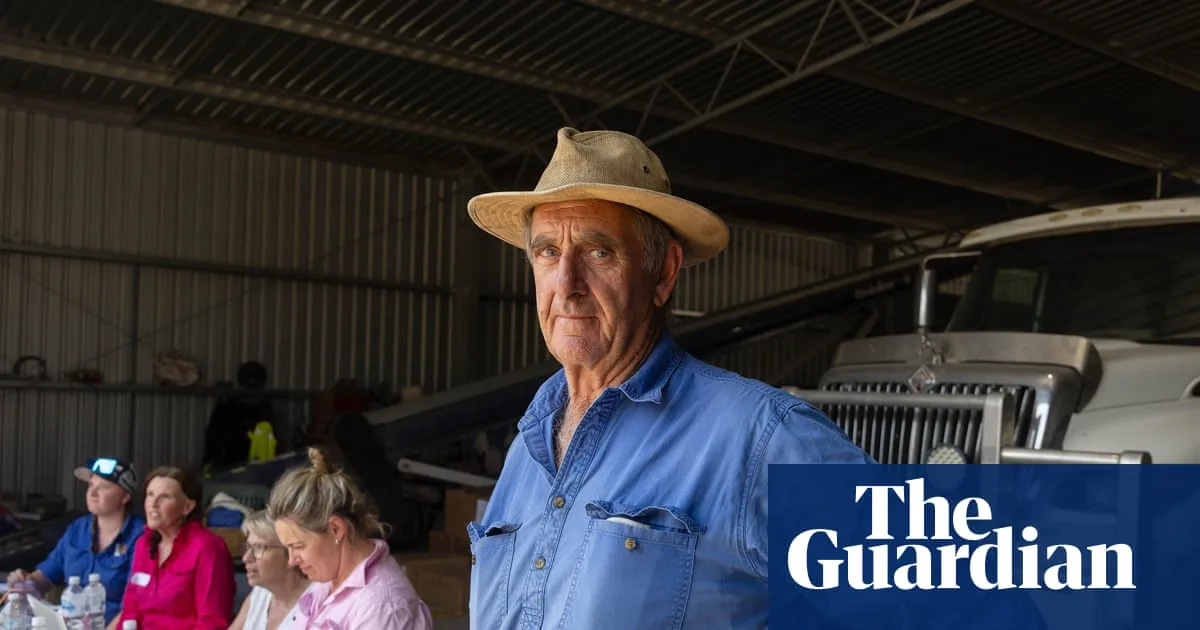
After battling devastating bushfires over the weekend, Victorian farmer Neil Tubb has turned his property in Longwood into a makeshift food distribution centre for livestock that survived the blaze. Stacks of hay now cover the dusty farm, with spray-painted signs directing generous locals to drop off or pick up supplies for farmers in need. Inside a large shed, volunteers coordinate donations on spreadsheets, passing around slices of watermelon.
“The adrenaline is still flowing for 95% of us,” says Tubb, 70, whose family has owned the property for five generations. “If we were doing 16 hour days or 18 hour days at our normal work, we’d be legless by now.” The bushfires have swept across parts of Victoria, leaving one person dead, hundreds of homes and structures lost, and thousands of hectares burned. On Monday, 12 large fires were still burning across the state.
The fires have also killed thousands of animals. The Victorian Farmers Federation reported more than 15,000 livestock had died, with the number expected to grow. Some surviving animals are so badly injured they will need to be euthanised, while others are starving as their food supplies have been burned. Tubb, a Country Fire Authority volunteer who fought the Black Saturday and Ash Wednesday fires, says he knows of a young manager who has already shot 900 sheep. “There is going to be some suffering, but you can just do your best and do it as quick as you possibly can,” he says.
Tubb reports that more than $200,000 worth of hay has been donated in less than two days, coming from as far as New South Wales and Gippsland. “We had a fellow with an old Toyota ute and a handled trailer with small square bales, chocker block, and a mate with a truck, chocker block, who turned up here yesterday afternoon, and they had driven from Lardner Park in Gippsland,” he says.
Annabelle Cleeland, the local MP for Euroa, says road closures have been the biggest obstruction to starting the recovery. “There should be those resources right now, where there’s recovery commenced. Get it going. Let’s not delay the suffering of humans and animals any further,” she says. Cleeland, who was helping at the hay depot with her three young children, says her family had “lost everything” on their property except their house, which is not habitable. “My husband is having to euthanise 1,000 livestock himself. And our story is everyone’s story.”
Cleeland says people have opened their homes to those in need, and many volunteers have gone straight “off the fire truck and on to the hay truck” without a break. “It’s constant, but this is why we survive. This is why we can rebuild, and this is why we live here – because we love our community despite all of the risks,” she says. Tubb adds that the community prides itself on being “really close-knit”, noting that many friends and locals on the other side of the highway have lost everything.