
As Donald Trump launched a war of aggression against Iran nearly five months ago, he insisted Washington would achieve a decisive victory within weeks. Trump and his advisers scoffed at any suggestion that they were breaking repeated campaign promises not to start new conflicts, and to end America's legacy of forever wars, especially in Afghanistan and Iraq.
Trump's promises and the collapse of the ceasefire
In early March, a week into the war, Trump declared he would only agree to "unconditional surrender" by Iran's theocratic government. He vowed to destroy much of Tehran's military, called for a popular uprising and touted the overthrow of the regime that rose to power after Iran's 1979 Islamic revolution. In November 2024, in his election night victory speech from Florida, Trump confidently told Americans: "I'm not going to start a war. I'm going to stop wars." Now, the ceasefire he negotiated with Tehran has collapsed and Trump risks dragging the US into yet another forever war – in Iran.
The interim deal and its collapse
In mid-June, the US and Iran reached a memorandum of understanding that included reopening the strait of Hormuz, through which a fifth of the world's oil and liquid gas supplies transited before Iran shut it during the war. That agreement was effectively a 60-day extension of a ceasefire that was reached in early April, but did not lead to reopening the crucial waterway because Trump imposed a naval blockade against Iranian ships in the region. Trump said the memo "achieves everything we set out to accomplish", even though it had deferred the most difficult questions – including limitations on Iran's nuclear program and Tehran's potential control over of the strait of Hormuz – to future negotiations.
"Ships of the World, start your engines," Trump wrote on social media when he announced the interim deal last month. "Let the oil flow!" But each side had divergent interpretations of the agreement, and the deal collapsed after less than a month.
Renewed hostilities and casualties
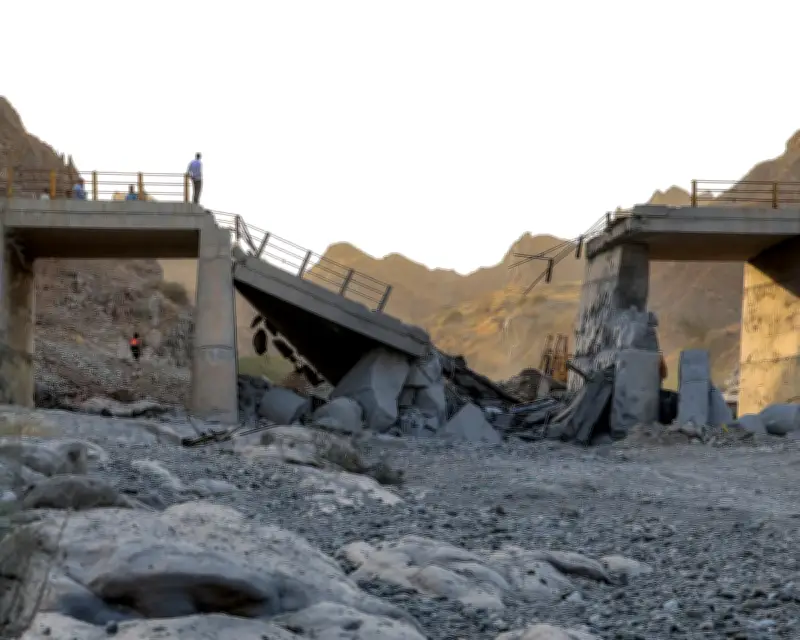
Over the past 10 days, tit-for-tat attacks have lurched the region back towards an all-out war. Iran fired on oil tankers that passed through the strait near the coastline of Oman in the waterway's southern corridor, which the US military has encouraged vessels to use to avoid Iran's control. The Pentagon has launched daily waves of airstrikes against what it described as Iranian command centers, missile and drone launch sites, air defense systems and communication networks. In recent days, the US also bombed bridges across southern Iran – and Trump has threatened to destroy Iran's power plants and other civilian infrastructure, which would probably constitute a war crime.
Tehran has retaliated with missile and drone strikes against US military bases across the Middle East, and it threatened to renew attacks on the energy infrastructure of its Gulf neighbors. Trump reimposed a blockade against Iranian shipping, and traffic through the strait of Hormuz has slowed to a trickle. The price of oil reached its highest level in a month, passing $90 a barrel, and once again disrupting the global economy. On Friday, Iranian ballistic missiles struck an airbase in Jordan, killing two US military personnel, with a third missing in action. The Pentagon said another service member had been killed on Saturday in northern Iraq, where the US has bases. Since the war began, 17 US service members have been killed and about 430 wounded.
Iran's resilience and leverage
For its part, the Iranian regime survived the assassination of its top leaders and withstood weeks of intense bombing by the US and Israel, two of the world's most powerful militaries. On 28 February, in the conflict's early hours, joint US-Israeli airstrikes killed the supreme leader, Ayatollah Ali Khamenei, and more than 30 other top Iranian officials. The regime's surviving leadership quickly installed Khamenei's son, Mojtaba, as the new supreme leader. He is supported by hardline generals of the Islamic Revolutionary Guard Corps, the country's most powerful military and economic force.
Iran's leaders emerged more emboldened and with greater leverage than they had before Trump's ill-fated war. They realized Tehran could hold the world's economy hostage by deploying a weapon that is far more effective than its missiles and drones: control over the strait of Hormuz, which allows Iran to disrupt shipments of not just oil and liquified gas, but also key agricultural products such as fertilizer.
Potential wider conflict
And Iran has more economic leverage it could deploy if Trump decides to resume an all-out war. Tehran could pressure the Houthi militia, its ally which controls large parts of Yemen, to disrupt international shipping through the Red Sea, which would further destabilize global energy supplies. After Israel's invasion of Gaza in 2023, the Houthis began firing missiles and drones at vessels sailing around the Bab el-Mandab strait, where the Red Sea comes closest to Houthi-controlled areas of Yemen. Shipping companies rerouted hundreds of vessels around South Africa, increasing insurance premiums and adding thousands of miles to a freighter's journey between Asia and Europe.
For now, the Houthis have not fully entered the conflict, but on Monday the militia announced a blockade of Saudi Arabia's ports and ships. This could put more pressure on energy prices because Saudi Arabia has been exporting millions of barrels of its oil through the Red Sea route, so that it could circumvent Iran's shuttering of the strait of Hormuz. Tehran can disrupt energy markets in other ways: it could widen its attacks on oil and natural gas infrastructure in its Gulf neighbors, including Kuwait, Qatar, Saudi Arabia and the United Arab Emirates.
All of these scenarios would probably cause energy prices to soar, and could trigger a global recession. And yet Trump shows little sign of pulling back from the brink of a wider war with Iran, which could involve the deployment of US ground troops and spread into neighboring countries.




