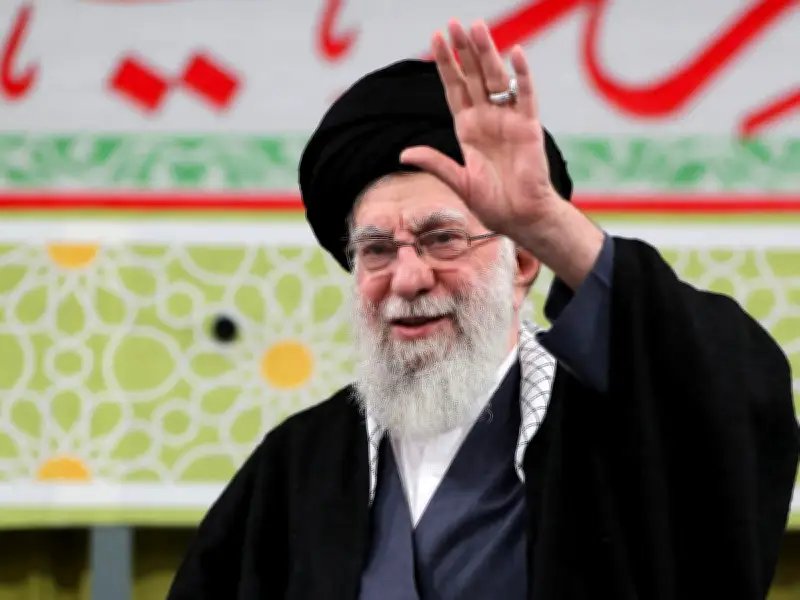
Millions of mourners are expected to flood the streets of Iran and Iraq this week as the country prepares an enormous send-off for assassinated former supreme leader Ali Khamenei, in what officials claim could become the biggest funeral the modern world has ever seen. Four months after the Iranian leader was killed on the first day of bombardment that began the US-Israeli war on Iran, the Islamic Republic is staging a spectacular week-long farewell stretching across five cities in two countries. The seven-day long event will attract colossal crowds and will see the Islamic Republic put on a military-scale security operation so vast, officials say it is unlike anything else the Gulf nation has ever attempted.
Despite years of crippling economic hardship in Iran, as well as the devastating cost of its recent conflict with the United States and Israel, Iranian leaders are pulling out all the stops to honour the country's former supreme leader. The huge funeral also overlaps with celebrations marking the 250th anniversary of US Independence Day, adding another layer of political symbolism to the event.
Khamenei's Legacy and Transnational Impact
Khamenei, whose 37-year rule was punctuated by stubborn defiance and a deep skepticism of the West, will be farewelled in a sort of victory parade across three Iranian cities and two holy sites in neighbouring Iraq. The mass fanfare demonstrates to supporters of the Islamic Republic that the leader and religious cleric is not lost to them, even in death. Officials in Iraq, which is home to one of the world's largest Shiite Muslim populations, have predicted millions will line the streets to pay their respects, according to CNN reports.
Iran's parliamentary speaker and the man leading negotiations with the US, Mohammad Bagher Ghalibaf, said in a message widely shared by Iranian state media: "We must rise and raise the cry for the nation’s blood to the world so that the world knows that the honourable and noble nation of Iran does not remain silent in the face of oppression… and will not let go of the blood of its Imam (Khamenei)." He added, as per CNN: "An epic feat that will show the greatness of a nation’s spirit to the world."
Senior nonresident fellow at the Centre for International Policy Sina Toossi said that the inclusion of Iraq is designed to reinforce Iran's influence across the wider Shiite Muslim world. "His religious following extended into Iraq, Pakistan, Bahrain and other Shia communities, which is why planned processions in Najaf and Karbala are so significant. They deepen the sense that this is not just an Iranian state funeral, but a transnational moment." He added that Khamenei's death has transformed his legacy: "The assassination has made Khamenei far more powerful symbolically in death than he was in life. Khamenei is now being framed as a martyred religious authority, akin to revered Shia saints who were martyred, whose worldview was vindicated by the manner of his death."
Scale of the Funeral
Iran has only witnessed two funerals on a similar scale before — those of Islamic Republic founder Ayatollah Ruhollah Khomeini in 1989, and military commander Qassem Soleimani in 2020. Both ceremonies descended into chaos after deadly crowd crushes. Tehran is bracing for an unprecedented influx of millions of mourners as Iran prepares this staggering, week-long multi-city state funeral. The massive operation will kick off at 6am on Saturday (July 4) at the capital's vast Imam Khomeini Mosalla mosque complex, where Khamenei’s coffin will lie in state on a raised platform. With soaring temperatures expected — 33°C on Saturday as per time of writing — authorities have installed more than 6,000 overhead sprinklers to keep the colossal crowds cool.
Tehran Shutdown
The sheer scale of the event is set to bring the Iranian capital to a virtual standstill. Tehran's airports will completely shut down during key stages of the funeral, and major roads will be blocked off. Private vehicles have been banned from large swathes of the city, with officials scrambling to set up 700 temporary parking zones on the outskirts. An astonishing 50 million loaves of bread are being baked to feed the masses, supported by 16 mobile bakeries deployed across the city.
Emergency Response and Mega-Shelters
Fearing a public health crisis in the crushing crowds, emergency services are launching a military-grade response. A fleet of 2,500 ambulances, 21 helicopters, and 100 drones will monitor the streets, while over two dozen hospitals are on high alert. Medical stockpiles include a staggering 500,000 litres of IV fluids. With hotels completely booked out, authorities have converted 20,000 school classrooms, sports halls, mosques, and parks into makeshift shelters. The government has even taken the extraordinary step of ordering families across the city to open their doors to passing pilgrims.
Khamenei's Final Journey
The Ayatollah’s final journey will span multiple days and cross international borders before he is finally laid to rest. On Saturday, funeral ceremonies begin at Tehran's Imam Khomeini Mosalla mosque complex, with Khamenei’s coffin lying in state from 6am. From Saturday to Sunday, public mourning begins in earnest, with millions of people expected to file past the coffin over two days in Tehran. On Monday, the capital will face its biggest disruption yet as the coffin is carried in a massive funeral procession across Tehran from east to west. The procession will then move on to the holy city of Qom for further religious ceremonies. The body will be flown across the border into Iraq to visit the Shiite holy cities of Najaf and Karbala. Finally, Khamenei will be flown back to Iran to be buried at the Imam Reza shrine in his birthplace of Mashhad, bringing the week-long funeral to a close.