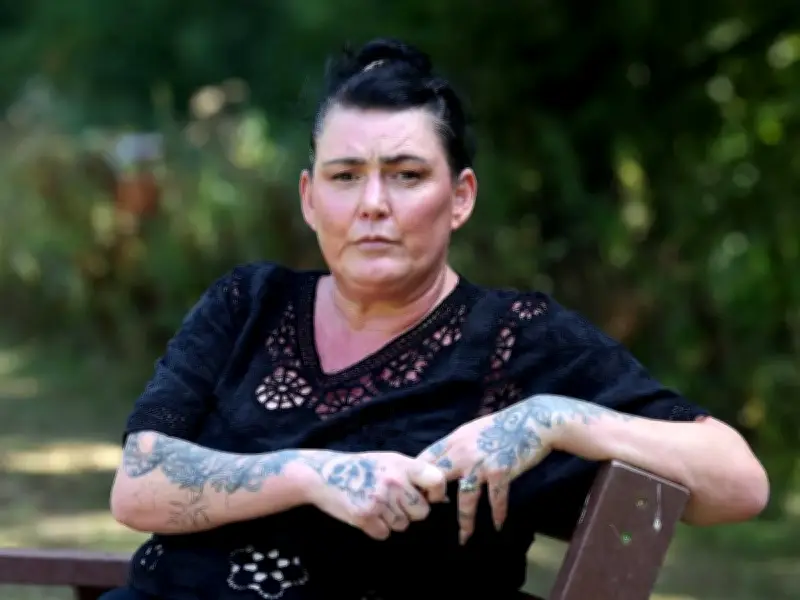
Sarah Clark, now 46, was born after her father had already become unwell from infected blood products. Peter Dudley Clark and his brother, Francis Robert Clark, received Factor VIII injections to replace clotting proteins missing from their blood from birth. From 1978 to 1985, the pair were given infected blood, which gave them HIV, hepatitis B and hepatitis C.
Sarah, from Mawdesley, near Wigan, said: "By the time me and my brother were born, my dad had started suffering with very big symptoms and by the time he died, he only had half a lung left, he was always suffering. It wasn't just the hep B and the hep C, or the HIV, it was all the problems that came alongside it like pneumonia and arthritis."
Sarah says her parents were not warned not to have any more children after the diagnoses. Her brother, Duncan, came along later.

Carer from age 14
From around the age of 14, Sarah became an on-and-off carer to her dad, which continued into her adult years. Her life changed completely to accommodate his needs, including giving up work and financial stability.
Sarah was tested for HIV, hepatitis B and hepatitis C up until the age of 12, when testing stopped as doctors assumed they "would have known by now." "When you walked into a bedroom, knowing you were going to have to call an ambulance because they were having a bleed or they had pneumonia or whatever else might have been going on, there was a lot of bodily fluids everywhere," she said.
"Being put in such an awkward position, you didn't always have gloves or stuff that you could use... People don't realise we're the ones that were left and we've cleared up bodily fluids and blood. I'm currently testing for hep B and hep C myself because I never thought I had to."
Deaths of father and uncle
In one instance, Sarah gave up work as a funeral director to care for her dad, who was put into a four-month induced coma at St Thomas's Hospital - a coma she was told he would never wake up from. "We would be pulled out of bed at three in the morning to say goodbye. We probably said goodbye about 25 times, because they just didn't know how to deal with what they had. It became a long-running joke in the family," she said.
He eventually woke up, but in 2011 Peter Dudley Clark passed away at the age of just 53 from multiple organ failure, with HIV cited as the cause of death on his death certificate. He also lived with pancreatic cancer towards the end. Sarah said: "My dad was the proudest man you'd ever meet. He had a mobility scooter but he didn't want to get out of bed to use it. In the two months at the end of his life, dad was on palliative care. He was too weak to even hold his own body up."
She added: "It's probably my most devastating memory. I was 31 asking the doctors to give him something to help him go. I don't think anyone of any age should have to give that OK."
Francis also died, in 2000 at the age of just 38. He found out about his conditions in 1985 after having his spleen removed. His wife, Denise, said the couple only got married the year before finding out, but both Peter and Francis were "so friendly and happy, despite their situation." She added: "Every day it makes me angry and it makes me angry that no one has been held accountable. He [Francis] was such a gentle character, if he got drunk he would laugh or giggle. He was amazing, he was absolutely amazing, he did everything he could for people."
Campaigning for recognition
Sarah says the conditions affected the families of the infected too, including social stigma at the time. "The social impact of it is the worst, we'd have hairdressers that would refuse to cut our hair. We'd stop getting invited to parties, people would cross the street from us. My brother would have been around four and I was seven, but we didn't know what was going on. We were like, what have we done wrong?" she explained.
Sarah now works to support other people within the "infected blood community" affected by the scandal, particularly if their loved ones were infected or died as a result. She says she "rallied up to create a campaigning group," along with co-founders Nicky Gregory and Ste Walls, called the Infected Blood Support Family Network (IBFSN).

The group's main aims are recognition, equality, accountability and justice. They say there is no recognition for family members that have passed, as well as no award for bereavement or for caring. Sarah says the group has been writing for "months and months and months" to people, including MPs and Lords, but they are "getting the same replies" and templated letters. She said: "Nobody is listening to us. It's like the inquiry happened and the infected living got their time in the press. Now it's our time and nobody wants to know us... We will not stop until we've got death recognition."