Simon Stone's adaptation of Aeschylus' Oresteia at the Bridge Theatre is a thrillingly stripped-back and bloody take on the classic Greek tragedy. The production, which runs three-and-a-half hours, transforms the ancient trilogy into a modern family drama set in a glass cube, a opulent modernist mansion designed by Lizzie Clachan.
A Modern Gothic Tableau
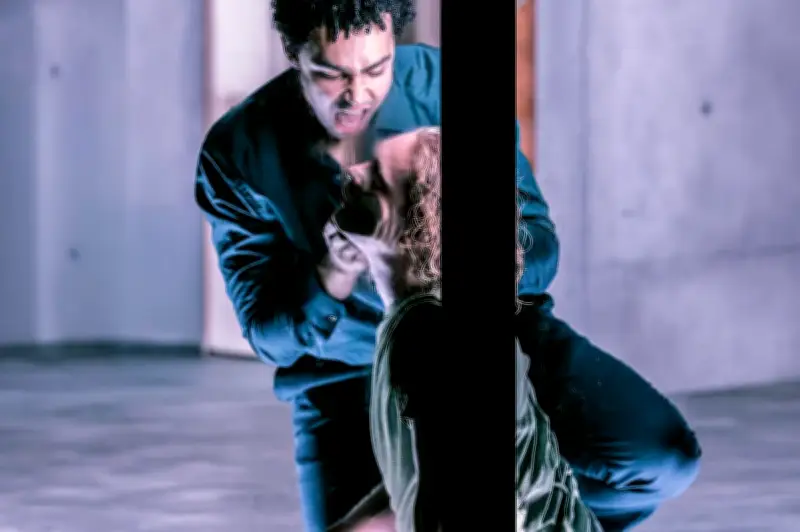
The play unfolds within a glass cube, lit from within by Nick Schlieper, turning each scene into a modern Gothic tableau. Stone has played loose with the foundation text, flensing the trilogy of tragedies that revolve around the house of Atreides. The adaptation homes in on the play as a cluster of family murders – matricide, suicide, and other -icides – each one a stacked domino in a cascade of revenge that seems never to end.
The Middleton Family
Populating the cube are the very privileged, very troubled, very unlikeable Middleton family. Dad Christopher and brother Melville run a company that manufactures things they shouldn't for people they shouldn't. Mum Monty is arranging the 21st birthday party of twin daughters Isabel and Alice. There is also younger son Augustus plus cousin Jerome and his son Lorenzo. The audience is thrown into the raucous bickering of their world, every other word a swear word in this ultra-modern script full of overlapping chatter.
Stunning Stage Talent
Stone has stuffed some stunning stage talent into his cube. David Morrissey does what he does pre-eminently, i.e. gruff patriarch battling demons. It's a joy to see Mary-Louise Parker bring her ironic half-smile to Monty, and even more so to watch her descent into grief and bitterness and finally a dead-eyed despair. But it's the younger generation that really astonish. Rosie Sheehy is a walking mood swing as Alice, with a Chelsea drawl and mile-a-minute monologues. Tom Glynn-Carney holds the latter two-thirds of this double-intervalled production together as increasingly unstable Augustus, brutalised by his family as much as by a tour in Afghanistan.
A Powerful Mapping
It is a powerful mapping of the new play onto the old one. Where Agamemnon and Menelaus were kings who started wars over a woman in the Aeschylus original, here they are arms dealers in thrall to money, never having to get their hands dirty. Three-and-a-half hours whip by, crowned by a coup in the epilogue: suddenly Stone reminds us that all this juicy violence we've been enjoying as spectacle – bloody hand-prints on the pristine glass, Stanley knives shoved into guts – stands in for the scenes of brutality playing out in the world's many war zones. That visceral thrill turns to a queasy sucker punch. House Middleton becomes a metaphor for any race of people stuck in a cycle of retributive violence. No deus ex machinas here. It's all too painfully human, a reminder that we're the sowers of all this violence, and the reapers too.