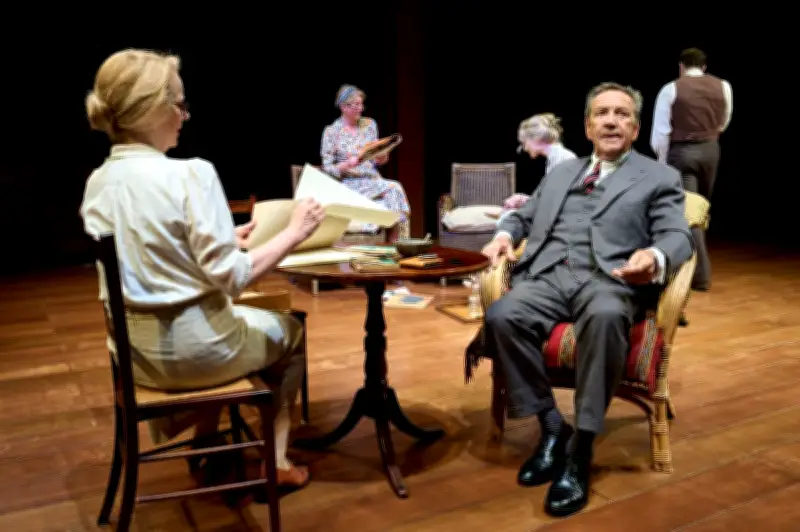
Contemporary parallels are hammered home in Richard Nelson's laboriously low-key drama about George VI's meeting with Franklin Roosevelt at the president's titular home in 1939. This was the awkward start of the fraught 'special relationship', necessitated by imminent war. Then as now the US was isolationist regarding conflict in Europe. The British royal family was at a low ebb due to an embarrassing brother - the abdicated Edward VIII, married to a glam American divorcee and pally with Hitler. Both men have impediments – a stutter, polio – and wives who are uncomfortable playing merely loyal, supportive roles.
Human frailties under the spotlight
Nelson wants us to see the human beings behind a pivotal moment in history so repeatedly underlines the central quartet's frailties and foibles. Bar one farcical moment, the tone is muted, the pacing monotonous. Stanley Tucci was originally supposed to direct this show but dropped out and Nelson himself took over, at which point the buzz around it dropped by approximately 90 per cent. The action is mounted on a forestage, with a yawning void behind – a metaphor of sorts. Solid, understated performances by Robert Lindsay and Jemma Redgrave as Roosevelt and his wife Eleanor fail to lift it above the level of the humdrum.
Nostalgia for a bygone era
The play is suffused with both nostalgia and amusement for an era when a president could live with his domineering mother in the family's 'dismal', folksy, thin-walled home on the Hudson, 85 miles north of NYC. And when the media and the public turned a blind eye to his disability and the wider oddness of his living arrangements. While the Roosevelts present a united domestic front – detailed in Eleanor's six-day a week syndicated newspaper column - they live semi-detached lives. He defrays the cares of office with cigarettes, cocktails and the embraces of an acknowledged, live-in mistress. She lives largely apart, in a nearby cottage with two female furniture makers who 'like each other'. ('Furniture-makers' will be my favoured euphemism for 'lesbians' from now on.)
Royal discomfort and cultural clashes
The stammering King 'Bertie' (Andrew Havill) and the petulant, sunburned Queen Elizabeth (Rebecca Night) are nonplussed by this bizarre and informal household. There are mocking caricatures on the wall and no breakfast tea. What's more, the hostile staff leave magazines around, open to articles opining that Wallis Simpson would be a better and more glamorous consort. There's endless debate over whether a planned photo op, a picnic meal of hot dogs and entertainment from singing 'Indians', is designed to humanise or humiliate them. Everyone addresses them as 'your highness' rather than 'your majesty': I don't know if this is meant as a deliberate, passive-aggressive diss or if it's just an error of Nelson's. As the makers of The Crown noted, an authentic rendition of historic Royal accents and mannerisms can sound dated and absurd today. And so it proves here with this stilted pair and their bitten-off syllables.
Performances and age discrepancies
There's a mildly amusing scene where they ring their daughters Lilibet and Margaret and manage to make them cry. Otherwise they're just endlessly discomfited and whiny. Half of the roughly 8,000 references to the strangeness and symbolism of hot dogs could be cut. Lindsay's FDR is affable and paternalistic, contemplating with wry sagacity the looming threat of war and a necessary friendship with the old colonial oppressor. It doesn't matter that he's dapper and luxuriously coiffed where FDR was moose-jawed and balding with a sack-of-potatoes build. It does matter that both he and Havill are 20 years too old for the characters they play. Someone remarks that Bertie looks young to be a king and you think: no, he bloody doesn't. Night's bleating Elizabeth seems like a child-bride beside him.
Casting and direction issues
Eileen Nicholas, playing Roosevelt's mother, is (and looks) four years older than Lindsay. The roughly age-appropriate Redgrave brings a nice balance to Eleanor's affection for and exasperation with her husband. But she's required by Nelson to sound a single note of harassed weariness throughout. I'm afraid Hampstead Theatre will think I've got some sort of vendetta against them. I honestly haven't, though it's increasingly hard to travel there with optimism in the heart. This is the latest in a long string of productions at a once-vital venue that feels undercooked and misconceived. To 25 July, hampsteadtheatre.com.