Keira Knightley brings star power to Robert Icke's stage adaptation of the Oscar-winning Stasi film at the Adelphi theatre, London, but the production struggles to match the subtlety of the original. The 2006 German-language romantic thriller, about Stasi surveillance and suppression of art in the former GDR, is reworked as a stage drama with plenty of suspenseful stagecraft.
Star Power and Adaptation
The production features high-prestige screen actor Keira Knightley, alongside Luke Thompson as writer George Dreyman. Knightley plays Christa-Maria Sieland, a stage actor and the object of jealous lust for venal government minister Hempf, played by Andrew Woodall. Stephen Dillane plays Stasi captain Gerd Wiesler, who secretly changes sides while spying on the couple.
Icke, known for his fast-moving, suspense-filled work on canonical material, chooses a difficult story to adapt. Much of the power of Florian Henckel von Donnersmarck's Oscar-winning film lies in its subtlety, conveyed through inference and suggestion. On stage, this takes on the feverish nature of a melodrama.
Cast and Performances
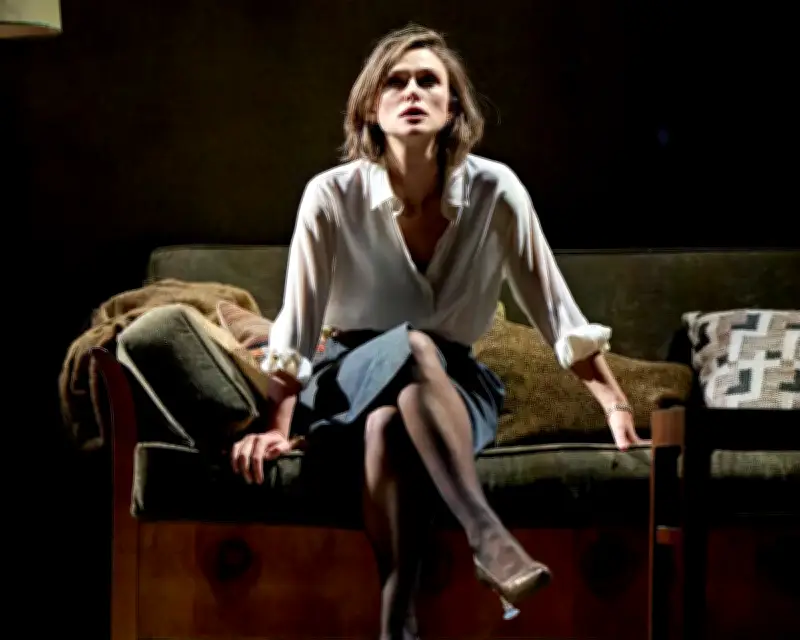
Luke Thompson seems too puppyish in the role of George Dreyman. Knightley gives a committed performance, but the character feels overheated and underwritten. She wears glamorous dresses with cinched waists and coiffed hair, looking like a woman who could be from wartime Berlin rather than 1980s East Germany, and quotes lines from Romeo and Juliet which hang oddly.
Dillane's Wiesler sits listening to the couple's secrets after their apartment has been bugged. He also weaves physically between them, a theatrical way of showing the intimacy and intrusion building in his surveillance. But where the film delivered Wiesler's interiority through lingering closeups, there are fewer ways of opening up his inner world on stage.
Stagecraft and Set Design
Wiesler stays largely silent, although he interacts with his boss Grubitz, played by Paul Higgins. His inner change is portrayed too subtly and not subtly enough. He lies curled and sobbing when he hears Dreyman playing the piano, after the news that his artist friend has hanged himself. The sobbing suggests a new appreciation of the arts but does not feel enough for his dramatic shift.
Icke makes a good decision to centralise the drama so that much of it is enacted from Dreyman's apartment. The production excels in raising suspense through stagecraft, especially the thuds of sound, lighting and whirl of movement. The face of the stage sometimes becomes a camera shutter, expanding and contracting threateningly. Hildegard Bechtler's set design transforms from interrogation room to the couple's revolving home with diaphanous screens that leave all secret activity exposed.
Impact and Verdict
Small threads in the plot do not contain Icke's signature meticulousness. A penultimate scene features a TV interview with Dreyman, who explains the entire story, twist and all, to his interviewer. It is a coda we shouldn't need.
At Adelphi theatre, London, until 9 January 2027.