Concert at Bergen-Belsen
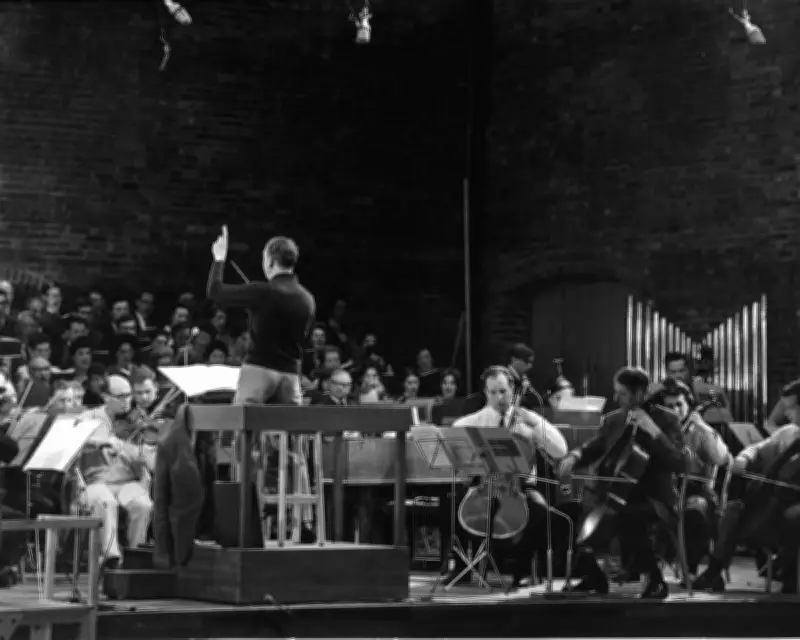
In July 1945, three months after the liberation of Bergen-Belsen, violinist Yehudi Menuhin gave two recitals in the camp's cinema. Nineteen-year-old cellist Anita Lasker, a survivor, was in the audience. She later wrote to her cousin, describing Menuhin's 'slovenly' attire and 'faultless' playing, and noted her 'transfixion' by the pianist—whom she later learned was Benjamin Britten.
Lasker-Wallfisch's Encounter with Britten
Decades later, as a member of the English Chamber Orchestra, Lasker-Wallfisch performed with Britten at Aldeburgh. In 1969, she showed him her letter about the Belsen concert. Britten was fascinated and borrowed it. The next day, after the Snape Maltings concert hall burned down, he returned the letter, prioritizing it despite his losses.
Britten's Response to Belsen
Britten rarely spoke of the Belsen experience, but Peter Pears reported that it 'coloured everything he had subsequently written'. This influence is evident in works like The Rape of Lucretia, which questions suffering and hope, echoing themes from the Nuremberg trials.
Lasker-Wallfisch's View on Justice
Lasker-Wallfisch testified at the Auschwitz commandant's trial, which she called a 'huge farce' in her memoir. She questioned whether conventional law could address such incomprehensible crimes, a sentiment that resonates with Britten's setting of Brecht's Children's Crusade in 1968.
Enduring Power of Music
Menuhin described the Belsen concert as 'a ray of light in the darkness', while Lasker-Wallfisch affirmed that 'music cannot be destroyed'. For author Philippe Sands, music offers solace in the face of atrocity.