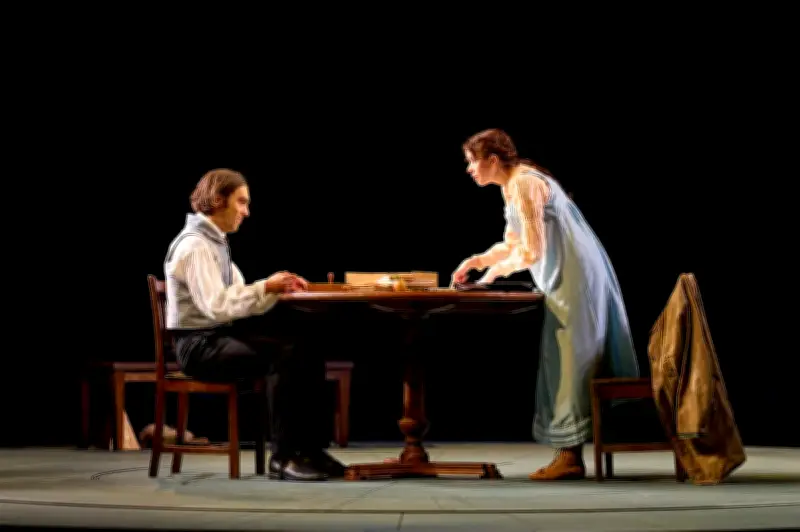
Carrie Cracknell's acclaimed production of Tom Stoppard's modern classic Arcadia has transferred to the Duke of York's Theatre, offering another dazzling delve into science, history and sex. The production, which originally wowed audiences at the Old Vic, arrives at the venue that will soon be renamed the Tom Stoppard Theatre, adding a layer of poignant synchronicity.
A Play of Synchronicities and Ironies
An apocryphal story has it that, when Harold Pinter sounded out Tom Stoppard to see if he'd support the campaign to rename the Comedy Theatre after him, Stoppard replied: “Wouldn’t it be easier to change your name to Harold Comedy?” It would surely have tickled the witty, brilliant winner of a record seven Standard Theatre Awards that, eight months after his own death, it was announced the Duke of York's would be renamed the Tom Stoppard. Neatly, the announcement came the day Carrie Cracknell's excellent Old Vic production of his modern classic about sex, literature and the heat death of the universe reopened there.
By chance, the Duke of York's was where the first major London revival of Arcadia was staged in 2009, in a production starring Stoppard's son Ed: I interviewed Stoppard there, on the balcony overlooking St Martin's Lane, so he could smoke. As always with this writer, synchronicities and synergies abound, as well as ironies. Stoppard was born Tomáš Straüssler in Czechoslovakia, and his stepfather Major Kenneth Stoppard once accused him of bringing the English family name into disrepute with his theatrical shenanigans.
Stoppard's Embrace of Englishness and Science
By the time he learned his heritage was wholly Jewish and most of his family had died in the Holocaust – in 1993, the year Arcadia first opened at the National Theatre – Stoppard had already embraced a sort of platonic ideal of Englishness. Like Pinter he loved cricket, but he also loved country houses, history, the landscape, the way flirtation and insults are coded in politeness, and of course literature and the theatre. Many of these things feature in Arcadia, with Stoppard's other great fascination – science – taking the place of cricket.
The play interweaves two timelines in a single room in a Derbyshire stately home, Sidley Park. In the early 1800s, 13-year-old science prodigy Thomasina Coverley (Isis Hainsworth) makes inspired leaps about the molecular makeup and gradual cooling of the universe, under the amused and then amazed gaze of her clever-dick tutor Septimus Hodge (Seamus Dillane). In the 1990s, academic Hannah (Nikki Amuka-Bird), researching the conversion of Sidley Park's gardens from a classical to a romantic landscape, discovers Thomasina's writings.
Complex Characters and Intertwining Plots
Bumptious Byron scholar Bernard Nightingale (Oliver Chris) – who wrote a bilious review of Hannah's revisionist biography of his hero's lover Lady Caroline Lamb – becomes convinced that Byron, who was at Harrow with Septimus, killed minor poet Ezra Chater in a duel at Sidley Park after slating his work and shagging his wife. (As a side note, Stoppard denied that the arrogant Bernard was in any way based on the Times's gentlemanly theatre critic in the 1990s, Benedict Nightingale.) Meanwhile Thomasina's distant relative Valentine (Angus Cooper), a scientist clearly on the autistic spectrum (his “genius” brother Gus is entirely non-verbal), is researching algorithmic patterns in nature through the records of game shoots on the estate. He is also in love with Hannah.
Arcadia is about the wonders and mysteries of art and science, about writers and their reputations, about belief and proof and about what is discovered and what is lost. (Thomasina weeps over the burning of the library of Alexandria – another debatable historic happening.) But it is also about sex. Septimus enjoys carnal embraces with Mrs Chater, flirts with Thomasina's mother (Yolanda Kettle) and edges towards intimacy with the daughter on the eve of her 17th birthday. Bernard sleeps with Valentine's sister, flirts with her mother and tries it on with Hannah. It was the 90s: the sexual politics are admittedly icky now.
A Monument to Stoppard's Intelligence
But Arcadia stands as a magnificent, living monument to Stoppard's questing intelligence and wit. That said, Cracknell's production has suffered some entropic cooling since it dazzled at the Old Vic. The in-the-round staging fits less well in what will soon be a bricks-and-mortar monument called the Tom Stoppard Theatre. Alex Eales's design, with Aristotelean spheres above and a central circular table where props (a Newtonian apple, tortoises called Plautus and Lightning) accrue, feels less eloquent. While Amuka-Bird and Chris bring new crackle and energy to the rivalry between the academics, Hainsworth, Dillane and Cooper seem fractionally muted as they reprise their roles.
I still found delight and new ideas in the play, not least the way it holds opposites in balance. Science and art are vital but it ultimately doesn't matter if great discoveries are lost, misattributed or misunderstood: “It's wanting to know that makes us matter”. One thing one could say about the late, great Stoppard is that he wanted to know. To 12 Sept, arcadiawestend.co.uk