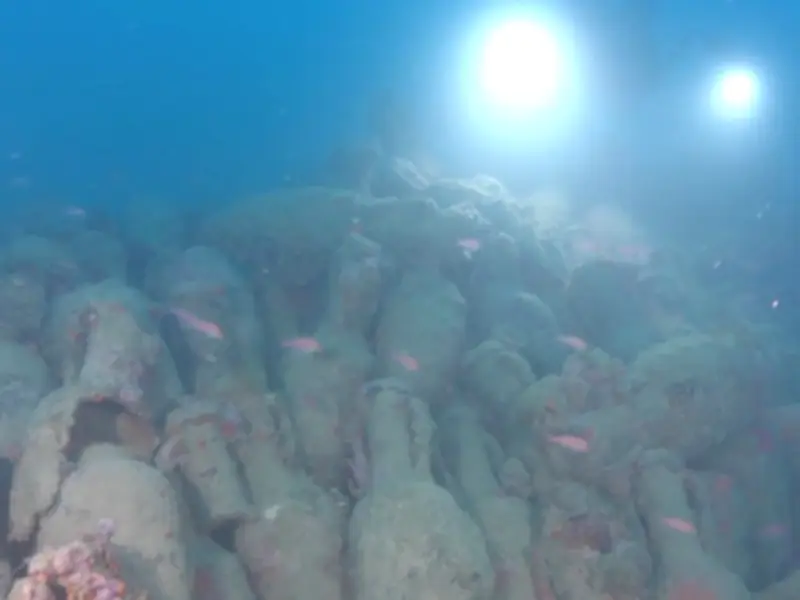
Divers have discovered an ancient Roman shipwreck over 2,000 years old off the coast of Italy. Hundreds of well-preserved ancient two-handled amphorae jugs, believed to have been used to transport wine, were found inside and strewn on the seabed around the ship.
Discovery and significance
The find, located two miles off the island of Sicily, was hailed by Italy's Culture Minister Alessandro Giuli as "one of the most important underwater archaeological discoveries of recent years." The shipwreck is thought to date from the 1st or 2nd century AD.
The underwater site will now be closely guarded before work begins to carry out a full archaeological investigation of the ship, which aims to reveal more about where it came from and who was using it.
How it was found
Underwater fishermen Giacomo De Mola and Igor Bisulli stumbled upon the wreck while on a trip two miles from Sicily. Mr De Mola said in an Instagram post: "Visibility wasn't the best... I got closer. And my heart stopped. Below me was a vast expanse of amphorae."
The day after the fishermen's surprise discovery, the Italian police's Cultural Heritage Protection Unit (Carabinieri) explored the underwater discovery with the help of scuba divers and underwater cameras.
Details of the wreck
The ship was found on the seabed three miles off the coast of Mazara del Vallo, in Sicily, about 150 feet below the surface. The wreckage is 69 feet long and 20 feet wide, according to reports in local media, making it one of the largest discovered in the Mediterranean in recent times.
The seabed surrounding the ship is covered with hundreds of intact and broken terracotta amphorae jugs. Archaeologists have identified them as 'Dressel 1A' type amphorae, which were large, heavy ceramic containers primarily used by the Romans to transport wine. These types of containers were not produced beyond the second century AD.
Additional finds and future plans
Alongside the cargo of ancient Roman wine jugs, divers discovered two large lead anchor stocks (the crossbars of ancient wooden anchors) and another unidentified lead structure. It's hoped these additional finds will help researchers reconstruct the size and identify the type of the merchant vessel in their future investigations.
Finding a nearly intact collection of hundreds of amphorae jugs lying in the shape of the sunken ship is a rare feat. Because the wreck is 150 feet deep, it rested mostly undisturbed by modern fishing trawlers, wave action, or looters, providing a near-perfect "time capsule" of commercial activity in the late Roman Republic.
Official reaction
Italian Minister of Culture Alessandro Giuli said in his statement: "I congratulate the Carabinieri, with its specialised units, and the Sicilian Regional Superintendence of the Sea for the expertise and dedication that made this achievement possible. The sea continues to reveal precious fragments of our history, and the Mazara del Vallo shipwreck tells us about the people, the routes, and the trade that made the Mediterranean a crossroads of civilisations. Research will continue to uncover its history and share it with the public."
Context
Many similar ancient shipwrecks are thought to be scattered across the Mediterranean seabed. In 2023, a 1st or 2nd-century BC vessel carrying hundreds of amphorae was discovered northwest of Rome. In 2018, a 2,400-year-old Greek merchant ship was found resting on its side off the coast of Bulgaria, hailed at the time as the world's oldest known intact shipwreck.