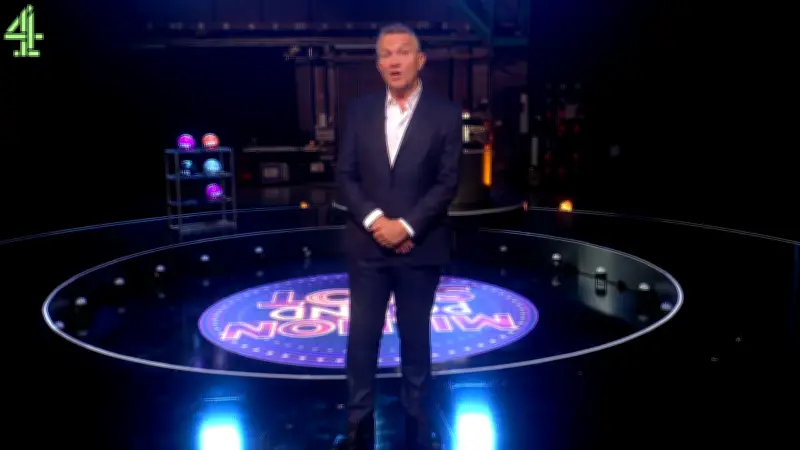
Bradley Walsh's brand new Channel 4 gameshow sparked horror on Sunday evening as a young contestant gambled away £6,000 of his own money, prompting shocked audience members to leap out of their seats in fury. However, seasoned gameshow host Walsh, 66, interrupted the show to reveal that it was just one big TV hoax.
Experiment Disguised as Quiz Show
Scepticism over the true nature of the gameshow was rife prior to airing after its marketing was shrouded in mystery. Billed as a “UK first”, the government-owned channel promoted the show as a "nail-biting brand-new one-off quiz event in which three plucky contestants step up for the chance to win up to £1 million".
In reality, it was an experiment to show the concerning techniques that gambling companies use to persuade people to bet more and more money.
“I feel strongly about this, which is why I’ve taken part in the show,” Walsh told the studio audience. “I wanted to show you how dangerous this industry could be.”
And the host’s true feelings were plain to see as Walsh was tearful by the end of the show.
“We talked a lot about the twist of contestants playing with their own money, but the actual twist was that this wasn’t a real quiz show whatsoever,” Walsh explains to the Mirror. “The purpose of the programme was to demonstrate the, entirely legal, techniques gambling companies use to draw people in and encourage them to keep spending.”
Actor's Story Inspired by Real Gambler
At the centre of the quiz show was contestant Reece, played by an actor, who said that he was struggling financially but would be able to spend a maximum of £1,700. But as the stakes got higher, he bet more and more money and gambled over three times that amount.
While the character was fake, he was inspired by a real man, teacher Patrick. Speaking on the show, he revealed that he started gambling while at university when he placed a £2 bet on a roulette machine. He ended up winning £72 and recalled it replicating the rush he felt when he played sport.
For the following 13 years, a day didn’t go past when he didn’t bet something. But it was after university that he began gambling online and said it “became like a drug”.
“When it’s online, the money doesn’t feel real,” he admitted. Patrick had no idea how much money he lost and at one point had 76 different online accounts.
He met his partner Charlotte in December 2016, during which time he was still gambling. At that point in his life he was up to £300,000 in debt from loans and credit cards. His gambling spiraled so much that he began approaching the parents of pupils he taught for money, giving a variety of excuses. An investigation was launched and Patrick desperately tried to gamble his way out of the problem.
“I did it all day and all night,” he said. After some luck, he won £78,000 and bet it on one horse at the Cheltenham Gold Cup in 2018 and if it didn’t win, he told himself he would kill himself. The horse lost.
“I was broken and numb,” he recalled. “I was also terrified, because it suddenly felt real.”
Patrick told his partner that he was in big trouble and that he didn’t want to be here anymore. Thankfully, she managed to get him to open up and speak about what had been going on.
He no longer gambles, but admits he has a “huge amount of debt”.
“The gambling industry has a lot to answer for,” his partner Charlotte said.
Patrick added: “Gambling is everywhere, there are too many gambling ads everywhere. One of my biggest concerns now is actually my children and what it means for them.”
Walsh was clearly impacted by Patrick’s story and was close to tears after watching the interview.
Techniques Exposed
Among the techniques used by gambling companies, as shown in the ‘quiz show’ was using “bet balls”. Psychologist Dr Steve Sharman explained that the “bet balls” were used in the same function that poker chips are used in a casino or credits in a slot machine which distance an individual from their money.
“When you place some psychological distance between the individual and their money by tokenising it, people using the tokenised money end up spending more money,” he explained.
Other techniques used include losses disguised as wins, the illusion of control and free bets. Over £1billion is spent on gambling advertising each year, and the experiment used phrases frequently used in ads in the show.
Among them was “I’ve got a good feeling about this”, used in Sky Bet’s ad featuring Roy Keane and Micah Richards.
“It’s quite extraordinary actually,” Walsh said. “You see the ads everywhere. In fact, even on this and every other commercial channel you watch. So it’s everywhere.”
Will Prochaska, a campaigner of Gambling Reform, added: “Our children are watching that. Why are we grooming the next generation into thinking this is normal?”
“That’s a sobering thought,” Walsh admitted.
Speaking further about why he wanted to be involved, Walsh says: “So many people in the UK have been affected by gambling, whether being impacted directly by addiction or maybe having a friend or family member who has lived with it. It’s a huge and difficult issue, and I hope this programme shines a light on how the industry works.”
Industry Response
In response to the programme, the Gambling Commission say they have implemented a wide range of consumer protections in recent years, including tightening rules on free bets. They say all operators are required to look out for and act on the warning signs of harm.
While a Betting and Gaming Council spokesperson said: "Our members operate in one of the most tightly regulated gambling markets in the world, with strict rules on advertising, customer protection, promotional offers and game design.
“These protections have been strengthened significantly in recent years. Practices such as losses disguised as wins have been banned for years, while operators are required to stop marketing to customers where strong signs of harm are identified.”
Entain, which owns Coral and Ladbrokes, say customers only receive promotional offers if they have opted in to marketing, and that it blocks marketing where it identifies safer gambling concerns, even if a customer has opted in. It strongly rejects any suggestion that Coral deliberately targets customers showing signs of gambling harm with free bets. They say all games on Ladbrokes are certified to the regulator’s technical standards, which ban games from celebrating a return less than or equal to the stake.
Evoke, owners of William Hill, say they strongly reject any suggestion that they disregard consumer protections to keep customers playing regardless of the potential risks. They say their approach to restricting marketing and take-up of new bonus offers is informed by the Gambling Commission’s requirements and their own assessment of indicators of gambling harm. They say they have invested in specialist teams to identify potential signs of gambling harm and take appropriate action, including stopping customers from gambling.
Flutter UKI, which owns Paddy Power & Sky Bet, say they operate in a legal, licenced and highly regulated market and they take their obligations incredibly seriously. They say advertising is a benefit of being part of a regulated market. They say like any other business, their brands offer promotions to attract customers and free bets are part of that offer.
If you're struggling and need to talk, the Samaritans operate a free helpline open 24/7 on 116 123. Alternatively, you can email jo@samaritans.org or visit their site to find your local branch. If you are struggling with a gambling addiction, advice and support can be found at GambleAware. If you need to talk, call The National Gambling Helpline on 0808 8020 133 for free 24 hours a day, 7 days a week for free information, support and counselling.