A Pulpy and Lurid Series Packed with Twists
Stan's whacked-out new murder mystery series, The Killings at Parrish Station, is one of those shows that made me think: this is a bit silly, this is a bit ridiculous, this is getting out of hand … but stop watching? I cannot.
Pulpy and lurid, the series is loaded with twists and turns, with creator/co-writer Ben Jenkins and director Daniel Nettheim (whose credits include The Tourist, Black Snow and Line of Duty) embracing the modus operandi that it's better to be loud and bumpy than slow and boring. Sometimes it felt like an episode of The X-Files on steroids, with a juicy mystery reaching in various directions: paranormal phenomena, conspiracies, rituals and some splashes of biblical symbolism.
The 1987 Massacre and a Sole Survivor
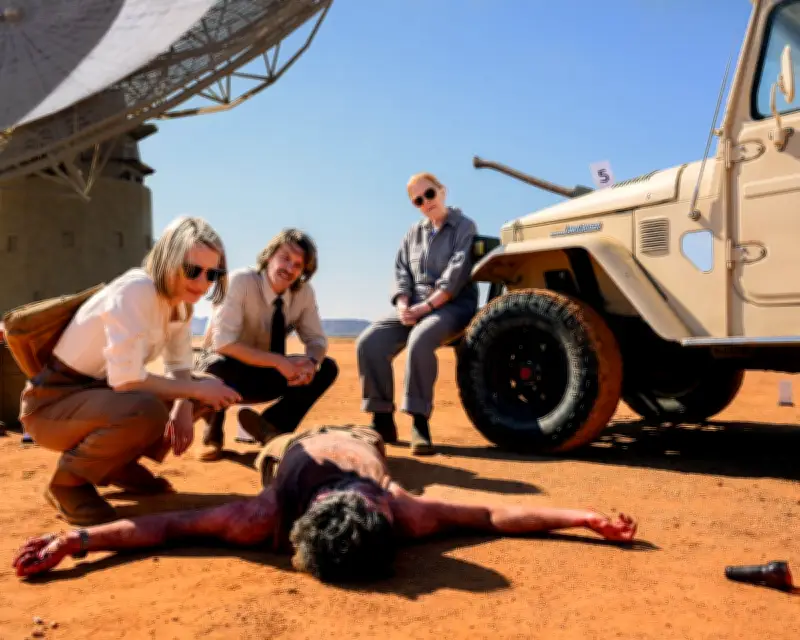
It begins in 1987 at a space research location situated beyond the black stump, deep in remote desert. Something a mite unpleasant has just gone down: a spate of killings in which four scientists met a grisly end. Detectives Georgia Cooke (Mia Wasikowska) and Michael Thorne (Xavier Samuel) arrive by small plane, the former noting that “it happened slowly enough, they managed to get a distress signal out”. This line helps tick the box marked “visual storytelling”, preceding a bird's eye view shot revealing that “SOS” has been written in the dirt.

There's a sole survivor, Kate Reynolds (Alex Malone), though she's in a state of delirium and being less than helpful. Before long the timeline jumps forward several decades, to 2024, with two podcasters chatting about what's now known as “the Parrish station massacre”, which remains unsolved: “The deeper you go, the weirder it becomes.”
Jumping Timelines and Cultural Commentary
This kicks off a lot of jumping between timelines, which works well, the podcasters delivering expositionary and contextual elements without it feeling too laboured. Perhaps they're also vehicles for some cultural commentary: a message about how today's tragedy becomes tomorrow's true-crime obsession – grist for the content mill, repackaged to satisfy our appetite for marketable narratives.
We learn, as the plot thickens, that the Parrish station massacre was such a strange case – so mind-bogglingly weird – it effectively hospitalised Cooke, who's been in a psychiatric facility for 37 years. Jenkins and his co-writers (Tim Pye, Catherine Smyth-McMullen and Yolanda Ramke) demonstrate some flair for juicy dialogue that, while a whiff contrived, deepens our interest in the story. For instance when the older Cooke (Heather Mitchell) reminisces on how she became mentally stable only when she “accepted that every single conclusion that I reached was wrong”. I could almost see the writers smiling when an unexpected Casablanca hat-tip lands late in the piece (“We'll always have Parrish”).
A New Case with Eerie Similarities
Present-day Cooke won't remain in the facility for long because, as these things tend to go, the past will come-a-knocking, jangling some skeletons in the closet. Cooke's former protege, Millie Farah (Doris Younane), enlists her to help on a new case with eerie similarities, a bunch of recent murders appearing to be recreations of what happened at Parrish. Are these copycat killings or is something else at play: some sinister force connecting these incidents?
The plot is injected with lots of offshoots and potential turning points. You can never predict exactly where it's headed, even if many scenes feel broadly familiar, informed by countless genre exercises. You don't bat an eyelid when, for instance, the younger Cooke is hauled over hot coals by her boss, told that “now you've jeopardised our entire case!” Nor is there anything surprising about references to the Tower of Babel or the discovery of a mysterious book called The Bone Gospel – these elements feel more like familiar ingredients than outright cliches.

Performances and Atmosphere
Individually, Mia Wasikowska and Xavier Samuel's performances are captivating enough, though as a pair they lack chemistry; there's no electrical currents or smouldering tension between them. They also feel very much like TV detectives, effective within the mechanisms of drama but lacking edge and grittiness. The ever-reliable Heather Mitchell is the standout performer – that glazed, distant look in her eyes feels haunted, but not in the cliched ways.
Atmospherically the series (this review encompasses all six episodes) impresses, with an eerily polished varnish, often slick but sickly, presenting a world that has been poisoned from the inside. Ultimately, however, it's Parrish Station's momentum and sheer kookiness that kept me engrossed. The pacing utilises its many outre elements so well I almost wanted more of them: another spicy, plot-thickening element to add to an already wild broth.
The Killings at Parrish Station premieres on Stan on 24 June.