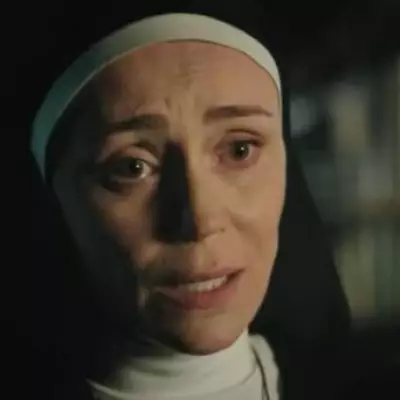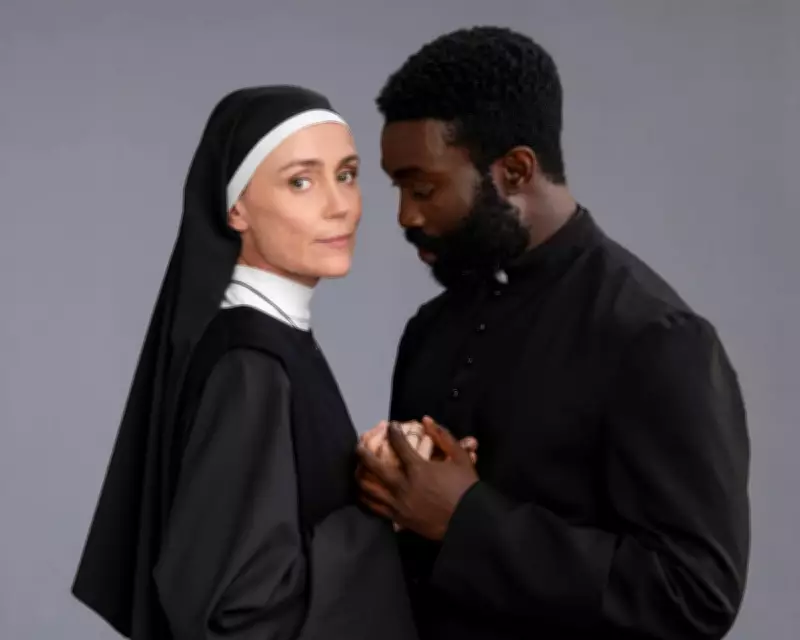
In a surprising shift from his acclaimed work on Adolescence, writer-creator Jack Thorne presents a romantic drama titled Falling, which explores a forbidden love between a nun and a priest. Stars Keeley Hawes and Paapa Essiedu open up about researching a love so controversial that the church could not allow it.
A Nun's World
The story is set in the convent garden of a closed order of nuns, somewhere in the UK with a maelstrom of social problems. Keeley Hawes plays Anna, a nun who is not self-righteously cloistered; she makes regular forays into the real world to do good works at food banks. However, she is not of this world. She moves with unobtrusive poise that reminds one of obedience—Bride of Christ. She wears her faith lightly; in the walled garden, she grows cabbages rather than praising God's creation, yet she radiates peace, and her vegetable patch reflects that back at her.
Hawes, known for her roles in period dramas like Wives and Daughters and Our Mutual Friend, channels a range of gorgeous guileless expressions in Falling. She describes the challenge: "That was the most difficult thing—to play as someone of my age [50], but with no experience of any of the life that someone of my age would have lived. She just went in at 18. And that has been her life. But I wasn't aware I was pulling a face."

The Hot Priest
Paapa Essiedu plays David, a priest who is younger and far more worldly. The character has his demons, as did Essiedu's breakthrough roles in I May Destroy You and Gangs of London. While David is an outlier priest—with a distinctly desperate boredom as he hears confessions—there is a burning purity to him, as there is to Anna. Essiedu notes that it is deeply unfamiliar territory to see humanised people of the cloth: "Sometimes their cars break down. Sometimes they need to go and buy socks."
David arrives at the nunnery with a social purpose: to get a teenager out of an abusive home to stay there. He is thrown off course by the rules that keep the machine turning, and Anna makes him an omelette. Their hands touch accidentally, and then all hell breaks loose. Essiedu says, "There's something passionately and violently present within them that's both drawing them together and pushing them apart, which is really fruitful."
Researching the Roles
Neither Hawes nor Essiedu were raised Catholic. Hawes spent time with an ex-nun, researching the role. "She is my sort of age, and had had the same experience of what they call jumping over the wall," says Hawes. This phrase refers to the hard decision to leave the convent and rejoin a world that has changed. Hawes asked all the funny little questions: "How do nuns come by sanitary products? How do you find things out if you can't use Google?"
Essiedu had his own real-life hot priest for a mentor. "He was so fit. I felt like I knew that type of person—fusty, respectably grey-haired, dull-voiced, the vicar that I remembered from chapel. This was a guy who was the same age as me [35], who had incredible style, who took his jack russell with him wherever he went, and who was just cool. Incredibly charismatic. Really up for talking about the contradictions he came up against, both in his faith and in his work."
The Drama's Unique Atmosphere
Everyone in the drama other than David and Anna is fully in the world—abusive husbands, good fiances, sisters, Sisters, congregants, AA meetings, parents, friends. It is recognisable as society, yet you cannot completely place it in time. It is not because the protagonists do not have smartphones, nor because nobody watches the news. It is more that the protagonists are in a quandary between the now and their eternal souls, so whether it is 2010 or 2020 feels unknowable, unimportant. Essiedu says, "I think it's quite good that it sits in this slightly liminal, adjacent world."
The sheer niceness of the surrounding cast, the wholesomeness of their exploits—churchgoers close-harmonising on a coach trip, David's deaf sister Susan who reads facial expressions—is a high-wire act dramatically. Sophie Stone, the first deaf student admitted to Rada in 2005, gives a magnetic, grounded performance that contributes to the atmosphere: good but not wet.

A Love Story or a Romance?
Anna starts with ardent certainty; she has felt a thing for a man, and that is destiny. She has "a kind of naivety, like a teenager, she thinks this is how it works," Hawes says. David is wide-eyed with horror that he has turned a nun. "She puts him in a position where he's almost playing catchup with his own feelings," Essiedu says. All their actions drive towards the question of what love actually is, whether it means enough to trump duty, whether duty means anything without it.
Essiedu suggests, "It might not be a romance story at all, but a love story—filial love, the love a priest has for their flock, the love within the sisterhood, the love one must show in order to forgive one's mother before her last rites are read." Hawes adds, "And the love of God." Essiedu jokes, "Well, if you'd just let me finish, for the love of God!"
Falling starts on Channel 4 on 19 May at 9pm.