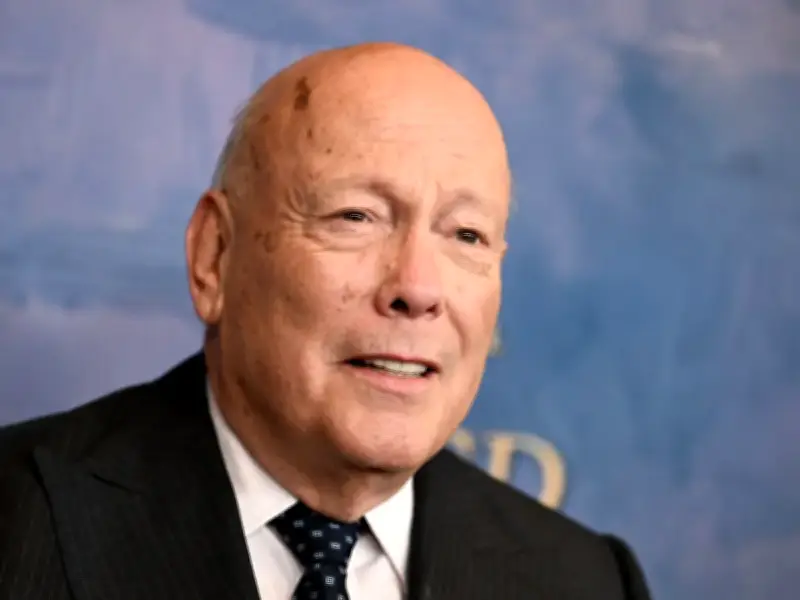
Downton Abbey creator Julian Fellowes has said he has yet to convince himself that the colour blind casting in rival period drama Bridgerton is a good thing. The Netflix show, which returns early next year, has faced criticism for featuring black actors portraying royalty and landed gentry in the 1800s.
Critics have claimed that historically there would not have been anyone from an ethnic minority background in the aristocracy, and it has been pointed out that slavery was not abolished until 1833.
Fellowes on Bridgerton's casting
Asked what he thought about Bridgerton, Fellowes said: "I'm not sure about it because the whole thing of this colour blind cast thing… you see it works on the stage. I mean if you went to a play and Hamlet was black or whatever, you wouldn’t mind at all. It'd be perfectly fine.
"But it's how much reality you expect from film that you don't expect on the stage. And that I can't quite decide what I think about it. Anyway, good luck. I'm not their enemy!"
Bridgerton boasts a cast including Golda Rosheuvel playing Queen Charlotte, Regé-Jean Page as The Duke of Hastings and Adjoa Andoh as Lady Danbury. By contrast, Downton, set in the early 1900s, had actor Gary Carr portraying its only main black character, jazz musician Jack Ross.
Rivals and Downton's origins
Fellowes also claimed he had not had the chance to catch the Disney+ adaptation of Jilly Cooper's Rivals, which stars David Tennant, Emily Atack and Danny Dyer. He added: "I mean to watch Rivals. I loved Jilly Cooper. We knew a bit and she was a really nice woman and always very encouraging. When you have a big success, not everyone is charming, and she was always absolutely lovely. So I will make an effort to watch Rivals."
Fellowes, who is 77, started out as an actor in Monarch of the Glen and Our Friends In The North, before becoming a writer for Downton Abbey and The Gilded Age on TV, as well as the films Gosford Park and Vanity Fair, adapting Mary Poppins and School of Rock as stage musicals, and serving as a member of The House of Lords.
The award-winning Downton, which ran for six series on ITV and spawned three big-screen spin-off movies starring Hugh Bonneville, Elizabeth McGovern and Michelle Dockery, almost never happened. He had been working on a drama with TV producer Gareth Neame for the BBC, but it fell through, and the pair had a farewell dinner together.
Over their three courses, Gareth sowed the seeds for a new project and ended up being its producer. Fellowes explained: "Gareth said to me 'Have you ever thought about going back to the Gosford Park era for television?' And I hadn’t really and I was rather reluctant to be asking for a second helping really but I thought about it and said to him 'It has got to be less dark than the film' because Gosford is quite a dark film and everyone in it either upstairs or downstairs is unhappy for some reason or another. I didn’t think you could come back with that or make them even more unhappy than they were last time. It has to be sunnier than that."
He was reading a book at the time called To Marry An English Lord, a social history of wealthy American heiresses who married British aristocrats in the Victorian era. He said: "And I thought 'What would it be like 30 years later when you have got all these English children and living as part of a system that was quite alien to Americans and I guess in a way what I didn’t realise was I had started thinking about Cora Grantham.'"
"Now at the time people thought period drama was dead but the producer at ITV Peter Fincham thought this was wrong and he was looking for a period drama and so we went to him with a synopsis of what would happen in the first series and that’s how it started."
Writing control and The Gilded Age
Fellowes admitted it was never his plan to pen the whole series himself, but after hiring two writers, they did not follow his brief, so he ended up taking total control. He explained: "I didn't intend to write every episode but we got these two writers in and they were both very nice, very hard working, very successful and we said 'Now in this show the family will be gracious and charming and the servants will be comic'.
"Now if it had been made in the 1990s, the family would have been mendacious and cruel and the servants would be helpless victims. But we don't want any of that. This is just a group of people born into different circumstances and pretty well all of them are just doing their best. They might be some individual baddies but as a principle there is no group that is bad. So they both wrote scripts and handed them in. All the family were mendacious and cruel and all the servants were victims.
"And I realised it was so deeply ingrained in them now that all achievement is suspect and anyone rich is horrible. And I came round to the fact that it was easier to do it myself. Of course I didn't know at the time we’d run for six series and three films."
Fellowes said he has been lucky to work with great talents over the years, singling out the late Dame Maggie Smith, who appeared in Downton Abbey and Gosford Park, as one of the most exceptional. He told The Dorchester Literary Festival: "There are actors who can make you laugh and ones that can make you cry. For example Maggie, who was in the whole of Downton, she's very unusual in many ways but a wonderful actress.
"But what she could do is she could make you laugh and five minutes five later she could make you cry without turning into someone else. Some actors when they switch to comedy or drama they become different but what you want is them to be the same people all the way through and I thought she was marvellous at that.
"But you adjust to the situation in hand. Of course sometimes if an actor has been cast who is hopeless you know you've got to deal with that too. But I think I have been lucky in both Downton and The Gilded Cage."
His latest success, The Gilded Age, which airs on Sky Atlantic and features Carrie Coon, Morgan Spector, Louisa Jacobson and Taissa Farmiga, returns for its fourth series on November 2. Fellowes has plans for a fifth season but is not sure if it will go to a sixth like Downton. He added: "I was nervous at the beginning because Downton had done quite well and I didn’t want the next thing I did to be a flop. I think I can relax now."