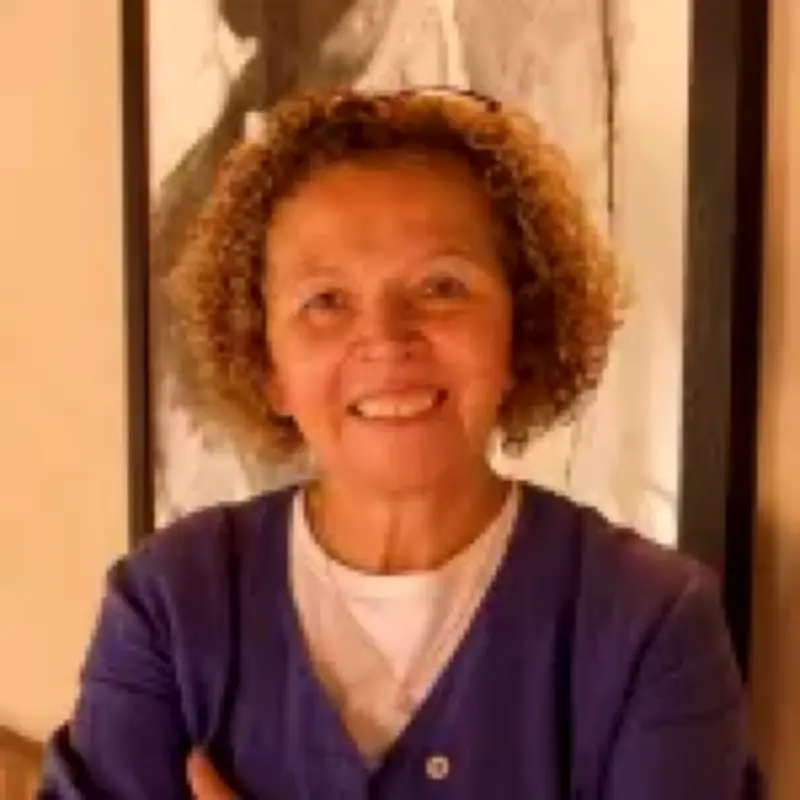
Carol Reay was at her mother's house when she learned the man she had grown up believing was her dad was not her biological father. Her mother told her that her father was a Jamaican man Carol had never met.
'It was an extremely visceral feeling of shock,' Carol recalled. She remembers feeling sick, leaving the room, and running out of the house. She was 21, and until that conversation she had believed both her parents were white. Discovering the truth about her parentage and that she was mixed race felt like a 'punch in the gut', she says.
Childhood comments about her appearance
Looking back at her childhood, Carol remembers plenty of comments about her appearance that her mum would respond to rather defensively. At the time, she was growing up believing she was white.
'I grew up with everyone always saying, "Oh, isn't she dark?" And my mother always being very defensive about it,' she said. There were experiences at the hairdressers too, where she remembers 'everyone saying my hair was just impossible'.
But learning the truth did not immediately send Carol looking for answers. Instead, she spent the next decade or so trying to ignore the revelation, building a career in advertising and starting her own family. 'I felt ashamed of it, as if I somehow wasn't fitting in in some way,' she said. 'I felt like I couldn't just be open about it. I went 10 years like that.'
A son's words prompt a search
With her own children, Carol was determined that she would not conceal the truth about her lineage. When talking to her son about his grandparents, she had explained that 'mummy doesn't know her real father'. One evening, while her husband was away for work, her son told her that something was sad as she put him to bed. Carol assumed he was missing his dad. But he meant something else: 'Sad, you don't know your real daddy.'
His words prompted her to acknowledge the feelings she had kept bottled up. 'I remember sort of putting him to bed, leaving the room, leaning against the wall, and crying for the first time, thinking it is sad.' Carol spoke to her mother, who agreed to help her find her biological father. All she had to work with was his name and the year he had lived in London.
She contacted the Jamaican embassy, which could not help with the search. However, a 'lovely person on the phone' suggested she place an advert in The Gleaner, a newspaper serving the Caribbean diaspora. Three phone calls followed, although the first, from someone in Yorkshire, turned out to be something of a dead end. The second caller was her father's cousin. The third was her father himself.
A reunion and a memoir
Carol discovered that he had always known about her and had wanted her mother to go with him to America. Recalling what he told her, she said: 'In fact, he said, "I always knew you'd find me".' He had spent years living in New Jersey but was now retired and back on the farm in Jamaica where he had grown up.
Carol travelled to Montego Bay with her family and met him for the first time in a hotel lobby. She and her husband had agreed they would not photograph the meeting because it would be an emotional moment. Yet when the film from their trip was developed back home, Carol discovered a 'perfect picture' of her meeting her dad. Her husband had not taken the picture. Their four-year-old son Alexander, whose words had prompted Carol's search, had photographed the reunion from a corner of the room. She described it as 'completely a full circle moment'.
Now 70, Carol lives in Denston, near Bury St Edmunds in Suffolk, and is a grandmother and trained counsellor. She has written about her experience in a memoir, Soul Secret, a project that took her nine years to complete. Carol says the book had been 'always on my inner to-do list', but she struggled to work out how to tell the story. Writing it meant returning to the difficulties she had experienced as someone who was mixed race but had been brought up believing she was white.
A friend suggested opening with the moment she learned the truth, then going back to her childhood. Once Carol started writing, she completed the book in just a year. Holding the finished memoir felt 'amazing', she said. 'I felt, there it is. It was grounding, truthful. I just felt so right having written it.'