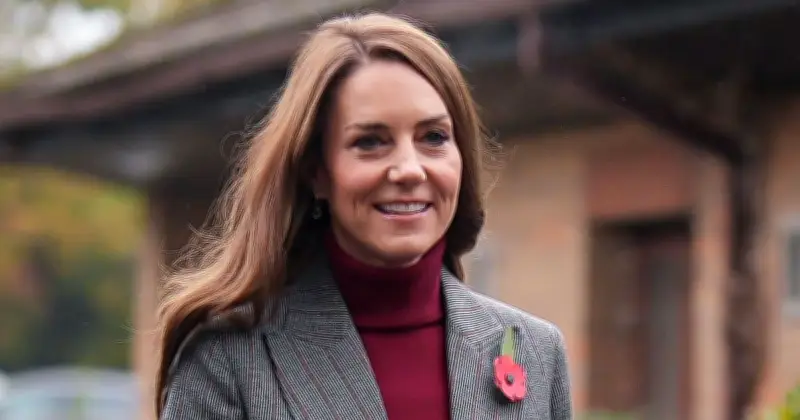
The Princess of Wales visited Chase Community Hospital in Bordon, Hampshire, on Wednesday, hours after opening up about her cancer recovery in a rare interview for a magazine guest-edited by her husband, the Prince of Wales.
Catherine spoke at length about how spending time in nature has been her “sanctuary”, giving her comfort, perspective and connection as she continues to navigate life post-cancer. In a personal conversation with acclaimed author Robert Macfarlane, known for his writings on landscapes and the living world, in the latest edition of Country Life, the future Queen explained how she instinctively turned to spending time outdoors after she received her cancer diagnosis at the start of 2024.
Nature as a Sanctuary
Echoing remarks she has previously made about her cancer journey, Catherine said: “I was told in hospital that my recovery would not be linear. There will be good days and bad days, that it will take time. This is the same in nature. It shows us that periods of rest, reflection and renewal are equally as important as moments of growth.”
Following six months of chemotherapy and entering remission, Catherine has developed a far deeper connection with the great outdoors and it has become a key theme of her work. She has incorporated it into her early years passion project and explored the importance of giving children opportunities to spend time outdoors during her visit to Reggio Emilia in Italy in May.
Asked by Macfarlane where she finds hope, Kate replied that she did so in the lessons taught by nature “that, despite the challenges life may throw at us, we are not alone and that we’re interconnected with something bigger than ourselves”.
“Nature offers something unique,” she added. “It doesn’t ask anything of us. It doesn’t judge us or expect us to be perfect. It simply allows us to be. It really has been my sanctuary and a place I’ve instinctively wanted to go.”
She also praised Mind Over Mountains, a charity offering professional mental fitness support by combining walking in nature, mindfulness, and time with experienced wellbeing counsellors.
Childhood Love of the Outdoors
The Princess went on to tell the author that her love of nature started in childhood as she found spending time outdoors gave her a sense of freedom “that is hard to find elsewhere”.
As a parent to Prince George, 13, Princess Charlotte, 11, and Prince Louis, eight, she encourages them to play outside “to give them freedom to explore, rather than constantly telling them what to see or what to think”.
Catherine’s interview in the magazine coincides with her husband’s guest editorship. In the 300-page bumper edition, William recalls growing up at the King’s Gloucestershire retreat, Highgrove, his fondness for a trip to the pub and how their children love to get out and explore.
Hospital Visit Highlights Early Years Project
As the magazine hit the shelves on Wednesday morning, the Princess visited a community hospital in Hampshire and was in her element, playing with babies, as she heard that her project to help families better understand social and emotional development was already changing lives.
Visiting the Chase Community Hospital in Bordon, Hampshire, to see firsthand how a project funded by her Royal Foundation Centre for Early Childhood is being expanded, the Princess got down on the floor to play with babies. Dangling ribbons, passing rubber teething rings and helping with infant jigsaw puzzles, she entertained three babies between five-and-a-half and nine months old as she talked to their mothers.
She was visiting to hear feedback about an “ADBB” trial, an observational tool called the Alarm Distress Baby Scale (ADBB), to help flag up early social withdrawal in youngsters aged zero to 24 months. Healthcare and childcare professionals use the approach to focus on babies’ eye contact, facial expressions and activity levels during check-ups to help understand their social behaviour and withdrawals that may need more support.
The project has already had two pilot phases across ten NHS sites, with the Centre providing a further £250,000 over three years to support its expansion.
Alison Morton, CEO of iHV, told the Princess it had all come from her “germ of an idea all that time ago”. The Princess replied that it was “amazing to see the progress”, adding “please spread the word” of how the tool can help.
“I hope that it’s adding something rather than feeling like it’s another thing or another burden,” she said, of the workload of health visitors she described as the “glue” which holds the system together from birth to education.
Catherine joined Amy Raynsford and her six-month-old baby Enid as a healthcare professional observed her play and interactions. Wearing a red dress and booties, baby Enid held on to the Princess’ finger and, smiling, accepted the toys and ribbons she passed over. Ms Raynsford, from Farnborough, said her baby Enid was referred to the programme after being born prematurely, and it has really helped her read her cues.
In a second room, nine-month-old Ruby made the Princess laugh by crawling under a chair during a long conversation. As five-and-a-half-month-old Enze cried, the Princess reassured his mother it was just “as babies do!”.
At the hospital, Kate also joined discussions with NHS and healthcare staff, including trusts interested in using the approach in their regions.