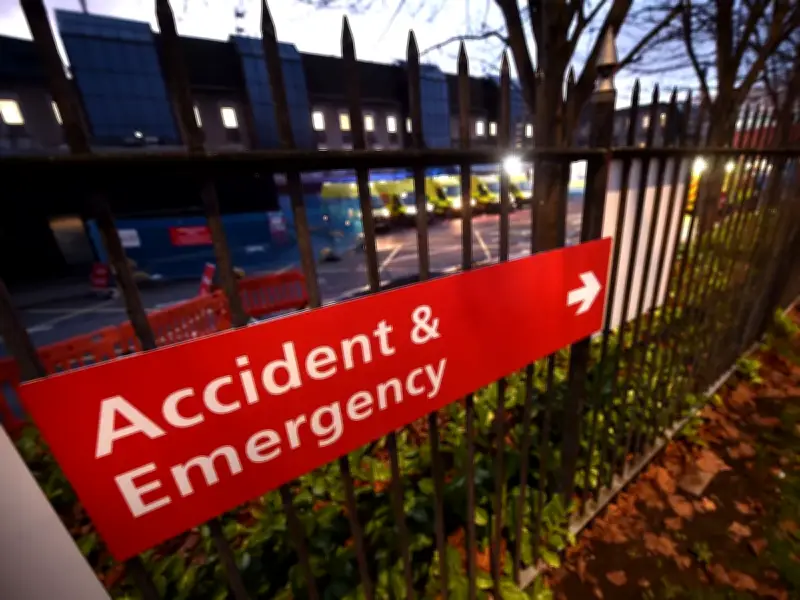
Emergency departments across the UK are heading into winter in "big trouble," with acute care doctors warning that hospitals are entering the busiest season with 1,000 fewer beds than last year due to cost-cutting measures.
Appearing before MPs on the Commons Health and Social Care Committee, healthcare leaders warned that emergency care is being severely compromised as NHS trusts prioritise hitting financial targets over operational demand.
Doctors warn of unsafe conditions
Dr Ian Higginson, president of the Royal College of Emergency Medicine, implored ministers to reopen beds in struggling hospitals to alleviate mounting pressure, telling MPs that money has become the primary driver for hospital leadership. Recruitment freezes and ward closures have left departments operating in conditions Dr Higginson described as "actively unsafe with staff that are pretty broken."
"To me, it feels like money is the key financial driver, with performance either equal or a close second," Dr Higginson said, warning that winter planning across the NHS remains a "triumph of optimism over reality."
Matthew Hopkins, from the NHS Alliance which represents NHS trusts, said there is a "significant trade-off" where "money and hitting financial targets" was having an impact. He told MPs: "There is a significant trade-off at the moment, where money and hitting financial targets is impacting on the ability to do what Ian's described would be short-term measures that could help, which is the focus on reducing staffing numbers, the focus on where you can make appropriate savings."
Mr Hopkins continued: "To close a 30-bed ward probably saves you about £2 to £2.5 million recurrently, those are big numbers, and obviously the opposite is true of reopening a ward for winter pressures, particularly if you're going to need to use temporary staff, which again is another measure that the NHS is being pushed to reduce the dependence on bank and agency staff."
Record A&E attendances
Latest NHS data suggest that September was the busiest on record for patients attending A&E, with 2.44 million people seeking help from emergency departments.
Dr Emma Rowland, executive director for performance and delivery at NHS England, told MPs: "So there's no doubt we have less beds open this year versus last year, and as you alluded to, that's for a variety of reasons, including the intention to try and move patients closer to home and get the care.
"However, the counter argument for that is exactly as you've alluded to: that we've got increased attendances in A&E with increased complexity and an increased frail population," she added. "So there is a risk that we potentially could and should have more beds."
Government defends approach
Health minister Karin Smyth said: "In some places where you've got 27% occupancy by 'no criteria to reside', then it's absolutely right to resolve that issue primarily for the patient who wants to be at home with their families or their loved ones. And so, you know, adding beds into that system would not be a good use of taxpayers' money or efficiency."
Meanwhile, Dr Higginson said a poll of leading A&E doctors found two-thirds said their emergency department was fairly or very unsafe and almost nine in 10 said they were under greater strain now than last year.
"We are going into winter with our departments in big trouble already, and many on their knees," he said. "Our patients are still in corridors. We know that about 16,000 of our patients in England are dying in excess of that expected, linked to long waits in our departments."
Dr Higginson told MPs that only a small number of hospitals are doing well on corridor care, while "the vast majority are in trouble." "There are islands of excellence in the midst of a sea of doom," he said.
In an effort to curb hospital admissions, the Government announced it is repurposing £40 million in GP funding to help family doctors identify and provide targeted care to high-risk patients. However, Dr Higginson argued the move is "too late to make an impact this winter."
Health Minister Karin Smyth defended the government's approach, pointing out that in some regions, 27% of hospital beds are occupied by patients with "no criteria to reside" who are waiting for discharge back home. "Adding beds into that system would not be a good use of taxpayers' money or efficiency," Smyth stated, noting that winter preparations had been underway since May.
To mitigate the impending crisis, emergency medicine leaders are calling on the government to take immediate action by reopening all available hospital beds immediately, lifting recruitment freezes on essential emergency care staff, and extending critical community services, such as pharmacies, to operate 12 hours a day, seven days a week.