King Charles has completed the first day of his Caribbean tour, arriving in the Bahamas to a loud and enthusiastic welcome at a Youth Rally just 90 minutes after touching down. His arrival at Clifford Park for his first public-facing engagement was met by a small group of protestors holding placards reading 'Pay us what you owe' and 'Reparations now'.
King acknowledges 'great suffering of the past'
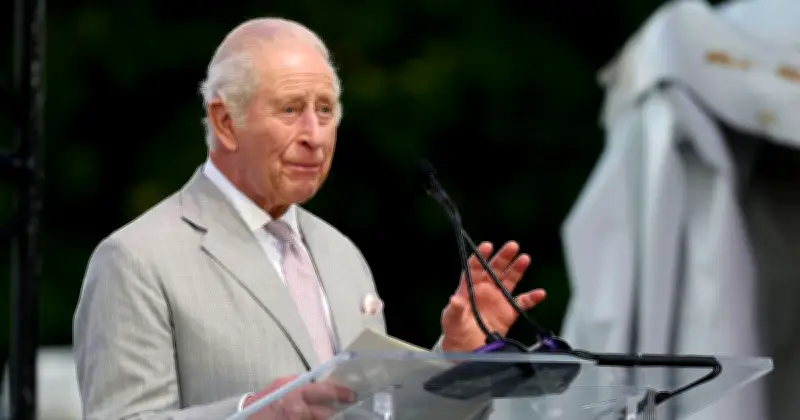
In a speech at the gathering of hundreds of young Bahamians, the King confirmed Commonwealth leaders will discuss the legacy of slavery at a summit next week and said some of the nation's culture was 'born out of darkness'. His visit to the Bahamas, Guyana and Antigua and Barbuda risks being overshadowed by fresh demands from Caribbean nations for reparations and an apology for Britain's role in the transatlantic slave trade.
Acknowledging the issue head-on on the first day of his trip, the King said: "Some of what is best in Bahamian culture today, the most joyful, the most hopeful, the most bright, was born out of darkness. It is only right that we should acknowledge the great suffering of the past in these islands and beyond, even as we rejoice in the successes of the present and build new opportunities for the future."
Youth Rally at Clifford Park
Hundreds of screeching schoolchildren greeted his arrival at The Future Bahamas Youth Rally and Exhibition at Clifford Park, the historic site where The Bahamas officially gained its Independence in 1973, which was elaborately decorated with the country's flag. Having arrived in convoy, the King was met by Deputy Prime Minister Isaac Cooper, who is also the Minister for Education, Science and Tech. He also chatted with Mario Bowleg, Minister for Youth and Sports, Sandena Neely, director of Youth, Ramona Wells, Education Office and two students, Avery Davis, 11, and Alyssa Bain, 13.
Heading inside a large marquee, he spent 15 minutes viewing four exhibitions. At the FEMStem Bahamas, a youth-based non-profit organisation dedicated to empowering high school girls in The Bahamas through science, technology, engineering and maths, the King was shown a device to help visually impaired people judge distances - made from recycled plastics.
Cultural performances and speeches
The other stands included the Doctor's Hospital Bridge to the Future Stem Program, a community outreach program open to students from 10-12th grade interested in S.T.E.M; the Young Innovators Club, an eight-week youth innovation program for ages 15 to 25 focused on solving real world community challenges through S.T.E.M. and entrepreneurship; and Gold Medal recipients of the Governor-General's Youth Awards, which is The Bahamas' delivery of The Duke of Edinburgh's International Award, providing a personal development programme for young people aged 14 to 24.
The King then took a seat to view a cultural performance, stopping to shake hands and greet people as he made the short walk to the pavilion. There he smiled, clapped and tapped his leg as he watched the performances and chatted warmly with the Prime Minister sat beside him. The lively performances included a Choral Prayer by Combined National Youth and Children's Choirs, a Combined Youth Rake & Scrape Performance, showcasing the traditional folk music of the Bahamas, and a Spoken Word Song & Cultural Presentation.
When the Tiny Tots took to the stage to welcome the King to the Bahamas he smiled and chuckled as the youngsters delivered a special message. The King continued to chat animatedly to the Prime Minister as members of the Royal Bahamas Defence Force Rangers, Royal Bahamas Police Force Cadets, and National Youth Guard paraded onto the Rally site carrying all the flags from the Family Islands.
Avery and Alyssa then walked with the King onto the red carpet as they stood for the National Anthem, before Charles walked onto the stage to loud cheers. Less than 10 seconds in he had to pause as the crowds whooped and cheered, and his joke about Junkanoo prompted noisy laughter. But when he acknowledged the colonial era, not a sound was made by the crowds. The rest of the speech, ranging from climate change, the country's impressive sporting record and his previous visit in 1973, was warmly received and he left the stage to more rapturous applause.