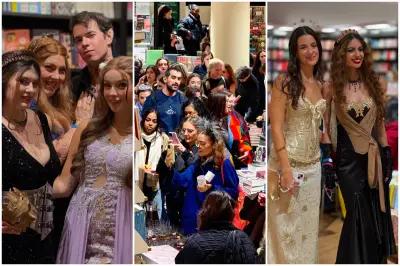
King Charles joined the traditional Junkanoo street festival in the Bahamas on Wednesday, dancing down Bay Street with handbells as a small group of protesters gathered nearby demanding reparations for slavery.
The King watched much of the lively parade from the sidelines before carnival dancers encouraged him to take part. Armed with Bahamian bells, he danced surrounded by performers in feathered costumes and was soon lost among the dozens of dancers.
Protesters demand apology and reparations
A small group from the Bahamas National Reparations Committee gathered at Parliament Square with placards reading “Pay us what you owe us” and “Run us our money.” One sign read: “BRIT: Belongers, Receivers, Investors, Traders of Slavery.” Shortly after the King arrived, local police were seen pulling down the placards.
Noelle Nicholls, chair of the committee, said: “At the National Reparations Committee we want to make sure that both the Bahamian government and King Charles, as the head of state of the Bahamas, understand that we have not forgotten that he represents a crown that was responsible for one of the gravest crimes against humanity.”
“And so we're here to say that you may be on the Bahamian territory as our head of state, but you are still a symbol of that atrocity that was perpetuated against our ancestors. We are demanding an apology for those crimes, and reparations for the harm that was done. So we think it's important to be present, so that amidst the pomp and pageantry of the celebrations, which are for some people a celebration, are for us also a sombre occasion. Because this is the King returning in a way that has still not atoned for the sins of the past.”
When asked about the palace view that Charles cannot apologise for the UK’s historic role in the transatlantic slave trade because it is a matter for government, Dr Niambi Hall Campbell-Dean, a campaigner, said: “He is a part of our government too, he’s the head of it. The King of the Netherlands has apologised. And so we think that the King has the power and the authority to make a statement as our head of state or, you know, in his position as the head of the legacy of this family.”
King tours conservation park and makes poignant remark
Earlier in the day, the King toured Bonefish Pond National Park to learn about climate resilience and environmental restoration work carried out by the Bahamas National Trust. He walked along a wooden boardwalk as he was shown how the Park’s unique wetland ecosystem is being conserved and used to educate the public about conservation.
As he watched schoolchildren searching for spiny lobster and shrimp in the water, he heard about efforts to conserve fish such as grouper, snapper, and Bonefish. “I remember years ago when I used to go to Eleuthera, the creeks there were full of them,” he said. Told the juvenile fish take shelter in the mangroves, he said: “Then they swim out.”
The King watched as another group of children kayaked through the wetlands as part of an educational programme. “I remember when I had to learn to roll [in a kayak]. You can put the paddle on the bottom, that’s the great thing.”
Bonefish Pond National Park, one of 33 managed by the Trust across the Bahamas, was created by clearing a former rubbish dump and restoring the 1,235-acre mangrove forest, tidal creeks and seagrass habitat, which is home to fish and shorebirds. The mangroves serve as a buffer to rising water levels and capture and store carbon, protecting against storm surges and supporting fisheries.
After walking the boardwalk, the King unveiled a plaque to commemorate his visit and planted a silver buttonwood, sometimes called a ‘silver mangrove’, which is indigenous to the Bahamas coastline, shovelling soil over the roots and giving the branches a gentle shake with his hand to “wish it luck”. Told it could reach full height within 20 years, the King replied: “If I’m still alive I hope to see it grow into something bigger.”
King pays respects to fallen marines
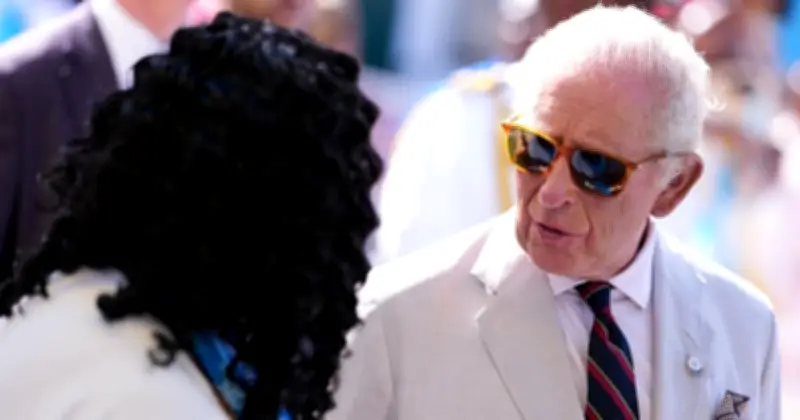
Earlier on Wednesday, the King made a solemn start to the day by paying his respects to the fallen and inspecting the troops of the Royal Bahamas Defence Force. Wearing a set of medals and his sunglasses in the bright heat of Coral Harbour, he spent an hour with the RBDF, speaking to hundreds of servicemen, women and veterans. He laid a wreath at the ‘Flamingo Monument’, which commemorates the four Bahamian Marines who died in the sinking of HMBS Flamingo on 10th May 1980.
The King then stepped onto HMBS Lawrence Major, a 56 metre ‘roll on/roll off’ vessel whose primary duty is response to natural disasters. He later headed to the Bahamas Boxing Academy where he laughed as he was presented with a t-shirt of a cartoon version of himself with rippling muscles and wearing boxing shorts, gloves and a crown.