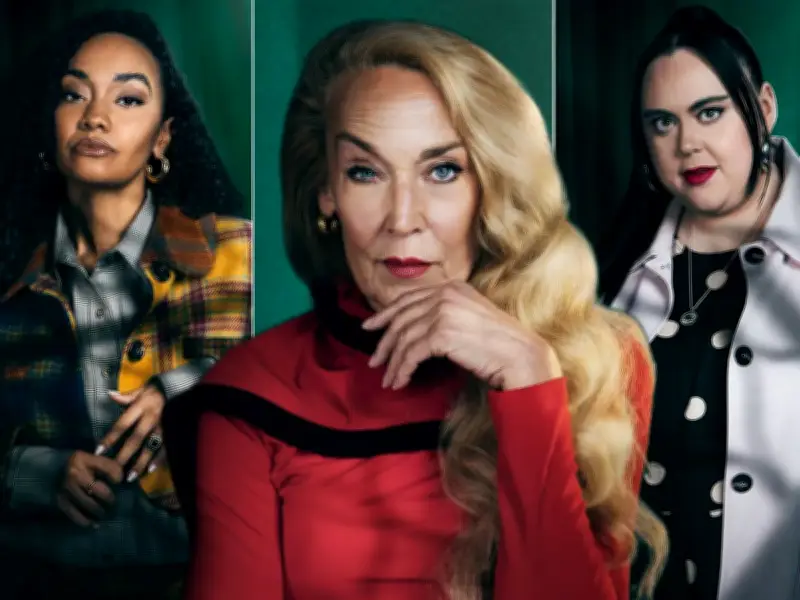
The latest episode of Celebrity Traitors saw Jerry Hall eliminated, Leigh-Anne Pinnock face fresh suspicion, and Sharon Rooney become a target after investigating Ross's murder, with a psychologist explaining the group dynamics behind each move.
Over 10.3 million viewers watched the episode, which featured a mission allowing the Traitors to secretly sabotage the Faithfuls and add to the prize fund. The Traitors bungled the opportunity, and James Acaster opted out entirely. Sharon Rooney drew attention after revealing the perfume bottle used in the murder in plain sight.
Natalie Buchwald, founder and head therapist at Manhattan Mental Health Counseling, spoke exclusively to The Mirror about the psychology behind the show's biggest moments.
Jerry's downfall and the fundamental attribution error
Jerry Hall left the show after her "confusing contributions and unpredictable approach" made her a target. Buchwald explained that the cast's reaction illustrates the fundamental attribution error: "explaining someone's behaviour through their character while overlooking the situation surrounding them."
"Inside a game built around suspicion, confusion can be an understandable response. Yet it can also make someone an easier target than a player who appears composed," she said. "The everyday equivalent is assuming a colleague's muddled explanation means they are hiding something. Communication can be frustrating without being dishonest."
James Acaster's self-preservation and Leigh-Anne's distraction
James Acaster refused to move during the mission, positioned between Michael Sheen and Sebastian Croft. Maya and Kenny were forced to move around the room and take the pieces, putting themselves at risk. Buchwald suggested self-preservation as one possible explanation: "avoiding an action that could expose him, even though participating could benefit the group financially."
Leigh-Anne Pinnock, known to viewers as a Faithful, faced suspicion after Michael Sheen questioned whether teaching Miranda Hart the "Touch" choreography had provided a distraction for the murder. Buchwald noted this illustrates confirmation bias: "giving more attention to information that supports an existing suspicion than information that challenges it." She added, "The useful question is: would someone innocent also do this? If the answer is yes, the behaviour alone cannot establish guilt."
Herd mentality and suspicion on Sharon
Michael Sheen's influence at the roundtables drew speculation, with the group struggling to settle on a consistent explanation before voting for Jerry. Buchwald described this as informational social influence: "people look to others for guidance when the situation is unclear." She warned that "several people repeating one uncertain theory can sound like several independent discoveries."
Sharon Rooney investigated whether perfume was involved in Ross's murder, but James Blunt questioned whether her detective work was performative. Buchwald explained the bind: "asking questions can look calculated, while staying quiet can look evasive." She added, "Once someone is under suspicion, even helpful behaviour can be absorbed into the case against them."
The Traitors' wrong move and its fallout
During the challenge, the Traitors could secretly take pieces from the Faithfuls' shields to build their own gold shield and add £9,000 to the prize pot. At the final opportunity, Maya suggested taking a piece from Michael's completed shield, but she and Kenny held back to avoid detection. Their decision left Michael, Joanne, and James Blunt protected from murder, while James Acaster completed a shield despite being a Traitor. The remaining Faithfuls were left without shield protection, and the group earned no money from the mission.
Buchwald attributed the Traitors' hesitation to "avoidance of an immediate threat," noting that "holding back protected their position in the game." For the Faithfuls, the outcome offered little clarity, as a completed shield did not establish innocence and an incomplete shield left someone vulnerable without revealing who interfered. The challenge captured the episode's central problem: "players had to make decisions from what they could observe, while the motives behind those actions remained hidden."