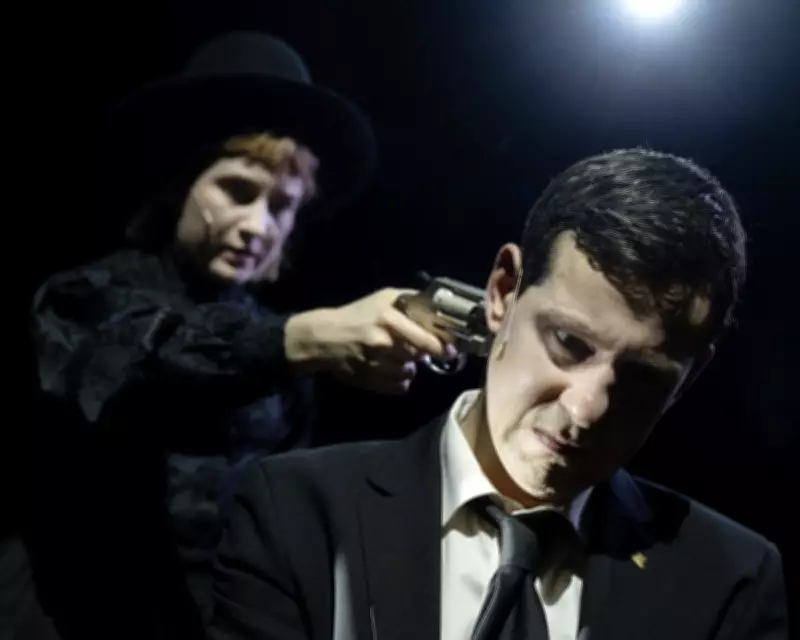
German Theatre Erupts in Violence During Anti-Fascist Play Performance
A German theatre production exploring the theme of fascism descended into violent chaos over the weekend when audience members shouted down an actor, pelted him with fruit, and attempted to storm the stage. The disturbing incident occurred during the German premiere of Portuguese playwright Tiago Rodrigues's award-winning work Catarina, or The Beauty of Killing Fascists at the Bochum Schauspielhaus in North Rhine-Westphalia.
Provocative Play Triggers Extreme Audience Reaction
The provocative play, which first premiered in 2020 and has won multiple international awards, tells the story of a family with a macabre annual tradition. To avenge the murder of real-life resistance martyr Catarina Eufémia - who was shot and killed in 1954 during Portugal's Salazar dictatorship - the family kidnaps a "fascist" each year to execute during a family feast. The narrative explores generational conflict between bloodthirsty parents and their more squeamish adult daughter about what means are justified to defend democracy.
During the final act, actor Ole Langerpusch delivered a 15-minute monologue in character as a far-right party functionary, laying out a nightmarish extremist agenda. As Langerpusch launched into the incendiary speech, the audience became increasingly agitated and hostile.

Stage Invasion Attempt and Audience Outrage
Theatre spokesperson Alexander Kruse described how the situation escalated rapidly. "At first, people began whistling and heckling, insulting Langerpusch and urging him to stop," Kruse explained. "An orange was thrown at the actor, narrowly missing him. Furthermore, two spectators mounted the stage, apparently with the intention of dragging the actor off the stage, which was prevented."
Kruse condemned the assault as "completely unacceptable" and noted that despite the hostile reaction, Langerpusch persevered and managed to deliver his chilling final line: "The future belongs to us."
Director and Critics React to Theatre Violence
The play's acclaimed Slovenian director, Mateja Koležnik, expressed shock at the audience's behavior while praising Langerpusch's professionalism. "For me it was quite a shock - we did expect people talking back, even shouting back, because, of course, the last monologue is a provocation," Koležnik said from Ljubljana. "But I was astonished by the stupidity, really. I never ever thought - nobody did - that somebody from the audience would jump on stage and try to hit the actor."
Koležnik emphasized that her production aimed not to make "liberal, petit bourgeois society in Europe feel good" around condemning intolerance, but rather to leave audiences genuinely scared. "The next wave of fascism, there will not be monsters. There will be normal, nice people," she warned.
Culture critic Martin Krumbholz, who reviewed the performance for Nachtkritik.de, placed blame squarely on the spectators. "Parts of the Bochum audience, which one would have thought to be among the most theatre-savvy in the country, are apparently too stupid, to put it bluntly, to distinguish between fiction and reality," he wrote.
Subsequent Performance and Public Response
Following the violent incident, the theatre implemented enhanced security measures for subsequent performances. Deputy director Angela Obst appealed for calm before the next show, which proceeded without incident according to reports on the theatre's Instagram page.
Audience members expressed mixed reactions to Saturday's events. One spectator noted being "shocked how disrespectful some people can be in the theatre" when "the actor was just doing his job." Another commenter called it "scary" when "supposedly anti-fascist theatregoers storm the stage and attack the actors. This is basically a fascist attitude towards art and theatre and, in my opinion, should never happen."
Critic Christoph Ohrem of regional public broadcaster WDR, who attended the premiere and released audio recordings of the tumult, noted that Rodrigues's piece often triggers intense audience responses. He described the play as taking spectators out of their comfort zone and concluded it was "truly astonishing that a play can still elicit such reactions in 2026."

The play has received significant critical acclaim, winning several awards including best foreign performance at Italy's Ubu awards and the equivalent prize from the French Critics' Union. Rodrigues has previously stated he intended the work to cause a stir and provoke discussion about contemporary political extremism.