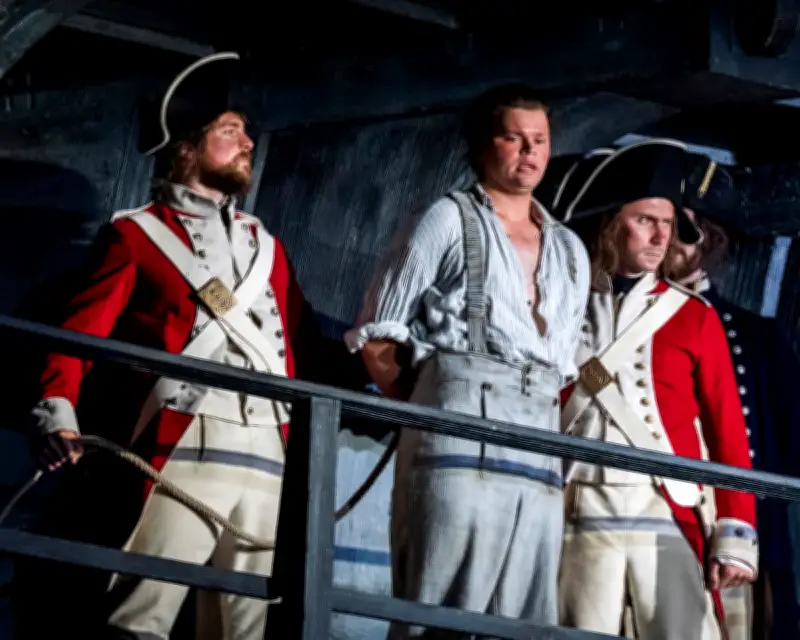
In Michael Grandage’s revival of Britten’s Billy Budd at Glyndebourne, the HMS Indomitable looms as a brutalist grey structure with a gently curved deck. Half-skeleton, half-cage, the ship creates a relentlessly claustrophobic atmosphere, softened only by coils of rope, hammocks, and Paule Constable’s painterly lighting. The male bodies in spotless Napoleonic uniforms and grubby workwear carry a palpable charge—visceral, violent, and erotic. Christopher Oram’s set, with its curved deck, makes those centre-stage appear as if through a fish-eye lens or an officer’s telescope, emphasizing the scrutiny in this floating world at war.
Revival Direction and Character Dynamics
Premiered at Glyndebourne in 2010, Grandage’s production is now helmed by revival director Ian Rutherford. The lines are firmly drawn between the goodness of “angel” Billy Budd and the malevolence of John Claggart, whose “sexual discharge gone evil” (librettist EM Forster’s words) leads to Budd’s death. Budd swings across the stage, lithe as a gymnast, unique in his physical ease, while Claggart cowers and barks. The love “that could not speak its name” at the 1951 premiere finds other ways to communicate; in one scene, Claggart bullies the terrified Novice in a chokehold that is unmistakably an embrace.
Performances by Thomas Mole and Sam Carl
Baritone Thomas Mole (Budd) and bass-baritone Sam Carl (Claggart) deliver persuasive performances. Mole’s voice is burnished, while Carl’s tends to muddiness lower down but fierce power up top. Mole’s double-speed wittering in his scene with the Captain is a painful snapshot of over-keen youth. Carl’s flashes of lush baritonal beauty heighten the plot’s tensions. However, neither is so colourful as to stand out long from the work’s general panoply of male voices.

Chorus and Supporting Roles
The chorus delivers rich polish and occasionally overwhelming heft, cutting effectively against the men’s pitiful physical state. Among named roles, Clive Bayley’s Dansker is warmly sympathetic, and Laurence Kilsby’s Novice is skin-crawling. William Thomas, Dingle Yandell, and Daniel Okulitch compete as stiff, stentorian types. Conducted by Nicholas Carter, the London Philharmonic Orchestra rolls and surges beneath the action, seductive or brutal as needed.
Allan Clayton’s Devastating Captain Vere
The opera’s effectiveness rests on Captain Vere. Allan Clayton, known for chaotic characters, stands taller and stiller than ever, exuding be-wigged bonhomie. His luminous, sensitive tenor carves across the opera’s darkness—first as the voice of reason, then of conscience. His final scene, alone on stage with wig discarded, is quietly devastating: an intimate portrait of human vulnerability. Performances continue until 30 July.