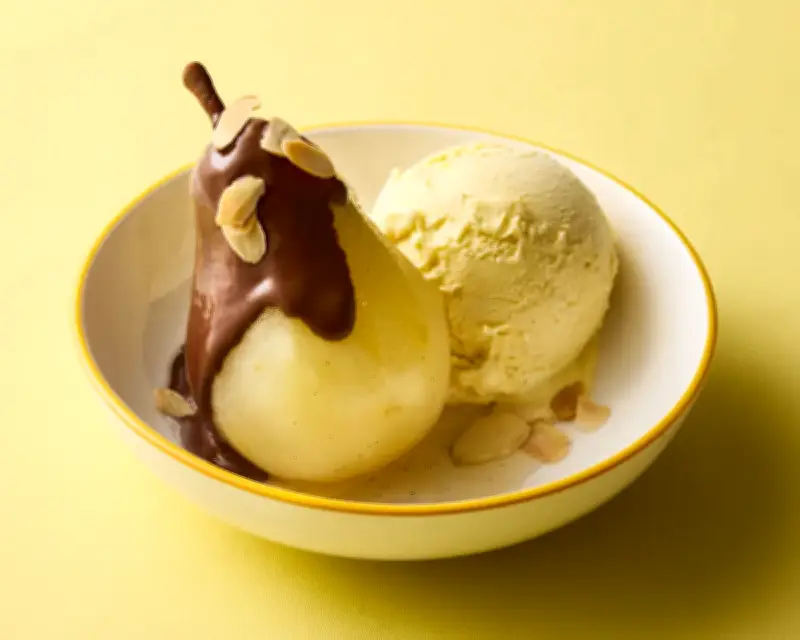
Felicity Cloake's perfect poires belle Hélène combines cool poached pears, cold ice-cream, hot chocolate sauce and a crunchy garnish – a pudding that has stood the test of time since Escoffier named it after Offenbach's 1864 operetta.
A dessert named after an operetta
Until recently, Felicity Cloake was unaware of Offenbach's 1864 operetta La Belle Hélène, after which the dish is named. The French chef Escoffier, moved by the work or its popularity among Parisian diners, named this simple dessert of vanilla-scented poached pears topped with hot chocolate sauce after its heroine, played by Hortense Schneider.
Though other homages – Escoffier includes five dishes with that name in his 1907 Guide Culinaire, none involving pears – may have faded, this pairing has endured. As Nigel Slater observes in Tender: Volume 2, “The marriage of pears and chocolate is extraordinary. It is as if they were made for each other.”
Choosing and poaching the pears
For best results, pears should be firm. As Nigella Lawson writes in How to Eat, “In fact, it is a positive advantage to use what would in other circumstances seem rebarbatively firm fruit.” Squidgy fruit will fall apart during cooking; turn those into cake instead.
Escoffier poached the fruit in a vanilla syrup, a tradition most versions honour. However, Max Rocha of Cafe Cecilia in London uses citrus zest (lemon and orange), rosemary and a stick of cinnamon instead. Rocha, like Slater, does not claim to be making poires belle helene, but simply poached pears with chocolate sauce. Cloake sticks with vanilla out of deference to the dessert's creator.
Under-ripe pears benefit from extra sugar, so Cloake dials up the sugar. She adds the juice of a whole lemon, as Jane Grigson and chef Alain Benech suggest, plus finely grated zest; the acidity helps the fruit retain its colour and brings out its perfume.
Cooking methods and the sauce
Cooking methods vary from a brief boil (Grigson's Fruit Book) to keeping the liquid at a very gentle heat throughout (Slater). What is key is to keep the pears submerged so they cook evenly – Benech recommends topping them with a cartouche of baking paper – and to leave them ever so slightly harder than desired, as they continue to cook as they cool in the syrup.
Grigson and Slater both halve their pears, which speeds up cooking but looks less fun on the plate. Cloake suggests removing a little of the stringy core from the base, making them easier to eat with decorum.
Grigson notes this dish “has had much criticism from some food writers, for the combination of delicate pears with chocolate sauce … the secret lies in taking very little sauce.” Cloake suggests moderating to an artful drip, or letting guests serve themselves.
Rocha is the only one to use cocoa powder and water rather than melted chocolate and dairy, resulting in an intensely flavoured but thin sauce. Cloake sticks with the traditional melted chocolate. Grigson and Slater both add black coffee, and Benech adds a dash of poire william; Cloake finds a dash of vanilla extract and a pinch of salt sufficient.
Gaudry makes the sauce with milk, Grigson and Slater with whipping cream, and Lawson and Benech with double cream. The fattier the dairy, the richer and thicker the result. Some double cream is so dense it forms an unattractive brown lump; give it a good stir first, and loosen the finished sauce with milk, water, or liqueur if necessary. For extra shine, stir in a knob of butter or a spoonful of golden syrup at the end. Serve the sauce warm and the pears cold.
The dairy and serving
Rocha and Slater serve the pear and chocolate sauce au naturel, but Cloake argues it is improved by an elegant scoop of vanilla ice-cream or a billowing spoonful of Benech's creme chantilly (cream whipped with sugar and vanilla seeds). A sprinkling of flaked almonds (Benech) or crystallised violets (Grigson) leaves you with cold ice-cream or cream, cool, juicy pears, hot chocolate sauce and a crunchy garnish.
For the recipe, prepare the pears some hours before eating. Find a wide, fairly deep pan and cut out a circle of greaseproof paper of the same diameter. Fold in half, then quarters, then eighths, and cut a small hole in the centre. Add lemon zest and juice to the pan. Split open the vanilla pod, scrape out the seeds, and add to the pan with the empty pod, sugar, and salt if using. Pour in a litre of water and bring to a simmer, stirring to dissolve the sugar.
Peel the pears, leaving stalks intact, and cut a small slice off their bottoms so they stand up straight. Scoop out some woody core from the bases, then lay the pears in the pan. Unfold the paper cartouche, cover the fruit, and leave to simmer gently for about 25 minutes until cooked through but not too soft. Take off the heat, leave to cool in the poaching liquid, then chill in the fridge.
When ready to eat, chop the chocolate. Put the cream in a small pan, heat to a bare simmer, then take off the heat and add the chocolate. Leave to sit for a couple of minutes, then stir until melted and smooth. Add salt if using, and if too thick, stir in a dash of milk, water, or liqueur. Drain the pears and pat dry with kitchen paper (the poaching liquid makes a lovely drink, or reduce it to a syrup). Divide the fruit between shallow bowls, standing upright. Pour a spoonful of chocolate sauce down one flank, or serve separately. Add a spoonful of ice-cream or chantilly cream, scatter with toasted nuts or violets, and serve immediately.