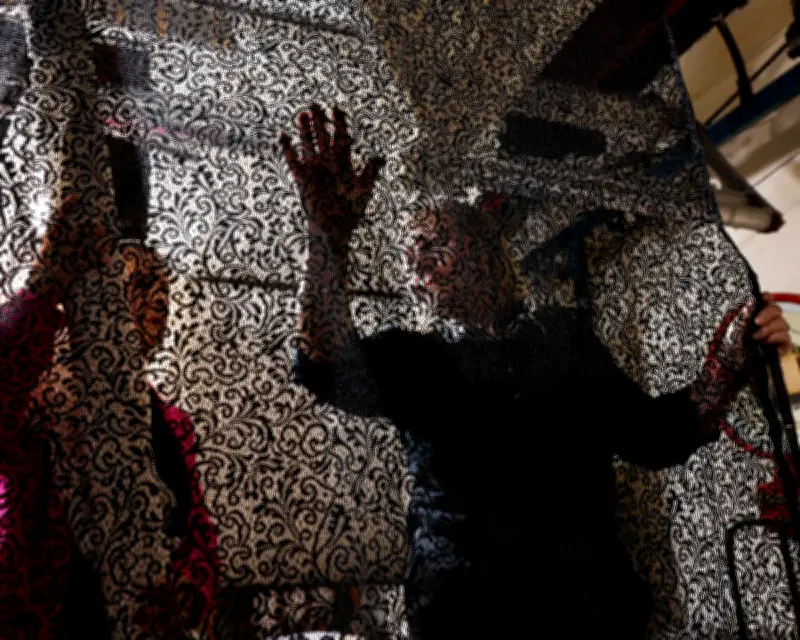
MYB Textiles Ltd is the last mill in the world weaving patterned Nottingham lace on traditional looms. Once there were 20 lace mills in the Irvine Valley towns of Newmilns and Darvel alone. The lace industry became the largest employer in the area for a time and flourished until the late 1970s when competition emerged from other European countries and Asia. Now the majority of their trade comes from the film, theatre, TV and entertainment industry.
A Century-Old Craft
The looms, mostly over a century in age, date from 1913. One loom requires 10,000 spools of thread to supply its warp as it weaves. MYB now employs 42 people and has fought to survive in recent years.
They are quietly famed for their Scottish Leno gauze weave (later known as Madras) and Nottingham lace. The former came to be called Madras because Scotland exported so much of it to India and to British colonies, because mosquitos could not get through the fine netting.
From Flemish Refugees to Modern Screens
Handloom weaving was brought to the Irvine Valley by Flemish refugees who settled in the area at the end of the 16th century. This was followed by the invention of the power loom in 1877.
Due to the antiquity of the looms, Thursday is set aside as a day for repairs and maintenance. The weavers stop the loom when a thread breaks and quickly remedy the problem.
High-Profile Collaborations
Despite challenges, MYB Textiles has maintained high-profile collaborations with designers, institutions, performers and artists. Projects in the past have involved translating metalwork to lace, recreating archive museum textiles and collaborations with design studios such as Timorous Beasties and Eley Kishimoto.
Working with the V&A Design Museum in Dundee, MYB Textiles featured in the Design in Motion exhibition in 2015. They supplied material for curtains in Spielberg’s film Lincoln, and their lace has been used on the sets of Martin Scorsese’s Boardwalk Empire. Lincoln’s 12 Oscar nominations in 2013 included one for best production design, which it won.
A Living Archive
A mill worker selects a pattern from a library of thousands of massive, finely punched cards. Hundreds of these lengthy, perforated cards – forerunners of computer programs – hang inside the entrance like an ancient library. There are 50,000 samples and 20,000 designs in the mill’s archive.
While they have recently sold fabric to historic houses and high-end hotels, and some to the fashion industry, the majority of MYB’s trade now comes from the film, theatre, TV and entertainment industry. Sheets of lace are used as backdrops, and scrims that can be painted with traditional patterned lace are much in demand for period drama. The company was badly affected by the US writers strike due to the effect this had on film and theatre production.