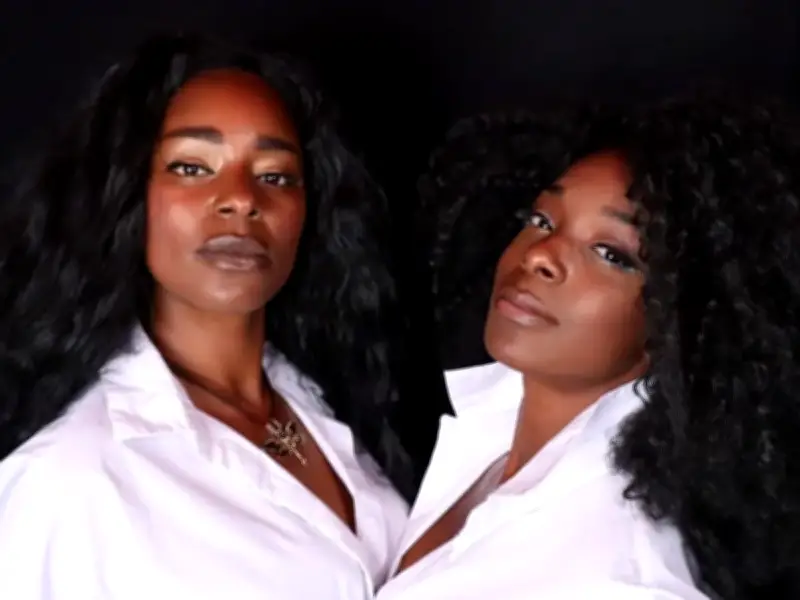
Cleopatra, the 90s pop trio of sisters Cleo, Yonah and Zainam, shot to global fame within weeks of their debut single Cleopatra’s Theme reaching the top five in 1998. Aged just 15, 17 and 18 at the time, they found themselves performing at American music awards, supporting the Spice Girls, starring in their own TV shows and fronting numerous Smash Hits covers.
But superstardom wasn’t always on the cards for the three siblings. Originally from Birmingham, the sisters moved to Manchester in the early 90s, where they initially spent part of their childhood hopping between hostels until their mother could secure them permanent housing.
Music as a Lifeline in Moss Side
Settling down in Moss Side, Cleopatra and Yonah — who still perform as the band today as well as working on their own solo music careers — said music was the one constant in their life at the time.

“When we first moved to Manchester, we were literally on our own - we had no friends, no community,” Cleo tells the Manchester Evening News. “Music was all we had really. We’d sit beside each other in the hostels listening to the radio, recording songs onto cassettes and then imitating what we heard.”
“It wasn’t like the Jackson Five where they were rehearsing and rehearsing from an early age with the idea of being famous. But I'm sure it was something that was already written in the stars for us.”
At the time, the girls started performing on the Manchester Carnival stage and entering singing and dancing competitions under the group name of Cleopatra and the Attractions, where Cleo would take the lead on vocals whilst Zainam and Yonah would dance. When they won one competition, called To Be The Best, and got a £500 prize (shared with a fellow winner), they saw the potential.
“We just wanted the money - that was the most important thing for us,” Yonah says. “Our mum was a single parent looking after four young children, we knew how much that could help her - it definitely went a long way.”
Signing with Warner and Meeting Madonna
With the win under their belts, they began to get the attention of big talent agents and music managers who saw their potential. “Our mum was quite protective of us and so we ignored the offers for a while, but they were quite persistent,” Cleo explains. “But eventually she allowed us to sign the contract, and they got me in the studio to record the songs I had already been writing.”
“I encouraged the girls to join me in the studio to add the harmonies and that’s what led us to become Cleopatra. We’d then end up knocking on the doors of every record label in the country, singing in the foyers and hallways until they’d meet us. We eventually signed with Warner.”
The same year as their debut single, the girls released their first album Comin’ Atcha. A top twenty hit, it spawned the top five singles Life Ain’t Easy and their cover of Jackson 5’s I Want You Back. They were also signed to Madonna’s label, Maverick, in the United States.
“We toured the bloomin’ world,” Cleo reflects. “It got us out of Moss Side and out of the country. We were literally famous. It was overwhelming - it all went very quickly for us.”
Yonah recalls: “We were in Milan and we believed we’d be safe to go to the shops one afternoon because we thought everyone would be having a siesta. All of a sudden, all these fans just appeared out of nowhere. We had to jump in a van as we were literally surrounded. It was insane - it was like something out of a zombie film. Not that I’m saying our fans were like zombies!”
Asked what it was like working with Madonna, Cleo said: “We already loved Madonna as an artist, we knew her songs by heart. The fact that she saw our potential and really rooted for us is something we’ll forever be grateful for.”
“I just remember that being introduced by her at the Kids Choice Awards was the first time it felt like we’d truly made it. She had mad faith in us, she taught us how to deal with the paparazzi and the press.”
“We were very fortunate that we were able to call her Auntie Madonna. It would be lovely to reconnect with her sometime. One thing about her is that she never stops and she doesn’t give a ****. She does what she wants to do and it works in her favour.”

TV Shows and the Industry's Changing Tides
Cleopatra also fronted their own CITV shows, Comin’ Atcha and In The House, which saw them appear on-screen alongside their mother and their younger sister Terri. “We actually got banned from appearing on the BBC for a while,” Cleo laughs.
“We were repeat offenders on Blue Peter and their shows, but ITV, who aired our show, would always have lower ratings whenever we appeared on the rival channels. It didn’t last too long as they knew we were good for them!”
For the group, the great heights of their first singles were never able to be truly replicated. The first single for their second album, which saw the band shift into a more grown-up sound, failed to reach the top 20 in the charts. Arriving at a time of changing label priorities, their second album did not even get an official release in the UK. Soon after, they separated from their label.
“We had a short space of time in the industry but we’ve still managed to remain a household name,” Cleo says. “If you say Cleopatra, people are going to respond with Comin’ Atcha. It’s something that people still recognise today!”
“I sometimes wonder how things could have been like for us because I believe we still had so much more to offer and I feel we were shut out of the industry. When I hit 18, things changed. I suddenly could do what I wanted, I could dress how I wanted. I wasn’t a young girl anymore.”
“And you still see how young people can be treated in the industry today. We just had the devastating news about Hayden Panettiere, who was a beautiful actress. And only a few years ago, we lost Aaron Carter. We got to work with him quite a bit - he was always great fun.”
“We always realise how lucky we were that we had each other at the time - we weren’t on our own. Things could have been very different for us. We also had a fiercely protective mother who looked after us - you could not break our mum. Maybe we were too conscious about the industry, we didn’t trust easy.”
Life Today and Manchester Pride Homecoming
Today, the sisters still both have lively careers in music. Cleo performs in her own shows and on cruise ships as Cleopatra Madonna, whilst Yonah has had an active career in house music under the stage name of It’s Yonah. Her recent single with Atari Safari, Boom Tat, went number one on the Beatport Funky House charts earlier this year.
They also continue to perform together as Cleopatra as a duo - but fans may be wondering where Zainam is. “We are family, and not everything is always so simple,” Cleo says. “We’re not glued to the hip. Zainam decided to go her separate ways in 2016 and we respect that. The door is always open for her to join us on stage again, but family matters come first.”
This weekend, Cleo and Yonah will be playing Manchester Village Pride. For what will be a big homecoming performance on Saturday (August 29), they have promised it will be a lot of fun and will feature some surprises along the way.
“The songs we released were always about uplifting and inspiring people, so being able to play events like Pride is always a great opportunity to just bring the fun,” Cleo says. “Manchester gave us so much love on the way up and they still support us now. So I think they deserve to have a party with us.”
“There’s going to be lots of surprises, and it’s just going to be a great time for everyone. We’re honestly so excited! My son TJ will also be joining us during our performance, under his stage name Xaylor, so it's going to be really special.”
But the significance of Cleopatra remains crucial today. Earlier this year, they were invited to perform at the Niamos Centre for the MOBOs Fringe, and are still honoured today for being one of the first Black girl groups of the 90s.
“It's great to still be acknowledged by the industry today,” Yonah says. “The fact that people still remember our songs or seeing us on Smash Hits always makes us feel grateful.”
“We were always three Black girls from the UK and a family. Our mum always made sure we never changed who we were as people. Our style was very afro-centric, we kept it to the streets wherever we grew up.”
“We had braids, we were unapologetically Black. Many people used to think we were American because it wasn’t really something you saw in Britain at the time. We have heard from so many people how we changed things for so many people growing up, it was a big thing for them.”
Yonah adds: “We’d get a lot of fan mail from people who would thank us for existing because, before us, they would be bullied for having braids. Then people at school wanted us to do their hair for them. It was lovely to see, but we were just being ourselves at the same time - we weren’t pretending to be something else.”
Both Cleo and Yonah are parents now, and they said their children ‘absolutely love’ hearing about their childhood music careers. “They love all the songs, they love the TV shows,” Yonah says. “They are so impressed that I’m still doing it - they’re very, very proud. And they don’t feel embarrassed about it either, which is a bonus!”