Seoul's BTS Comeback Concert Draws Far Fewer Fans Than Expected
South Korean authorities braced for approximately 260,000 fans to descend upon central Seoul for BTS's first full-group concert in nearly four years. However, official estimates reveal that less than half that number actually showed up, igniting a heated debate over the extensive deployment of public resources for a private event.
Logistical Preparations and Attendance Discrepancies
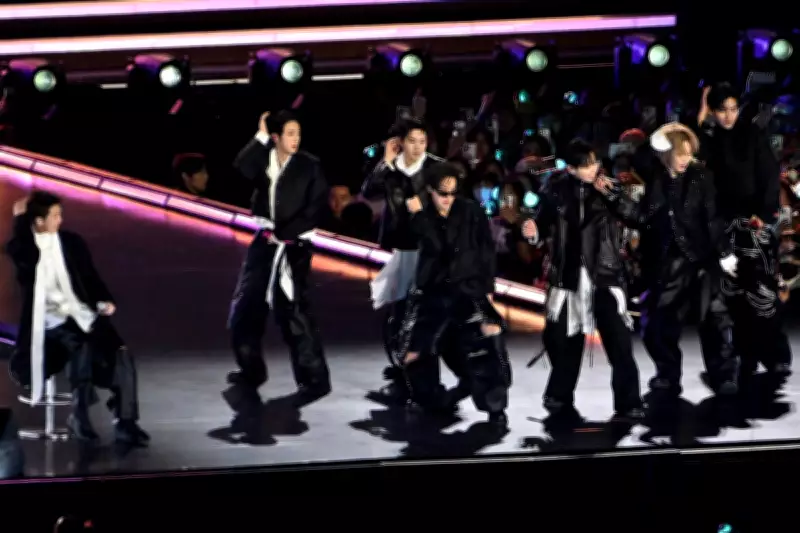
The performance at the historic Gwanghwamun Square on Saturday was promoted as a major cultural milestone, featuring a free concert to celebrate the release of the boy band's latest album, Arirang. Livestreamed on Netflix, the event was anticipated to be followed by a documentary chronicling the group's return to the studio and their concert preparations.
In the weeks leading up to the show, authorities prepared for what they believed would be one of the largest gatherings in the capital in years. Police forecasts predicted up to 260,000 fans converging on the historic plaza. While around 22,000 tickets were available for the main concert area, hundreds of thousands more were expected to watch on large screens set up at nearby locations.

Police treated the area as a "virtual stadium," deploying 6,700 officers and 10,000 public officials, in addition to the 4,800 safety personnel hired by Hybe, the conglomerate managing BTS. Authorities also elevated the terror alert level in certain areas of Seoul.
However, according to the Seoul metropolitan government, only about 48,000 people attended. The interior ministry placed the number at 62,000, police at 80,000, and Hybe at 104,000. This significant mismatch appears to stem from differing counting methods.
Counting Methods and Public Debate
According to Chosun Ilbo, the 48,000 figure was derived from real-time urban data that only accounted for connections to domestic telecom networks, excluding foreign attendees using roaming services or overseas SIM cards. The city administration restricted its estimate to Gwanghwamun Square, while police included nearby sites where fans gathered to watch the live broadcast. The interior ministry used aggregated base-station data, including people inside buildings, and Hybe analyzed ticketing and telecom data to arrive at its higher estimate.
Chosun Ilbo reported that foreign fans constituted 40-50 percent of the crowd at the performance. Regardless of the exact numbers, the substantial gap between expectation and reality promptly triggered a debate in South Korea over whether authorities overestimated the event's size in their logistics planning.
This overestimation reportedly caused losses to local businesses and forced residents to cancel or reschedule private events. Many critics questioned the use of public resources for what was ultimately a private concert. Hybe's shares fell by 14.5 percent on Monday following the lower-than-expected turnout.
Security Measures and Economic Impact
In the days leading up to the concert, central Seoul was effectively sealed off with steel barricades, designated entry gates, and a 1.2km "high-density control zone." Access could be denied if crowd density exceeded three people per square metre, according to The Korea Herald.
On the day of the event, access was further restricted with nearby subway stations bypassed or shut, and entry points equipped with metal detectors and subject to bag checks. This resulted in long queues and a slow inflow, as reported by Korea JoongAng Daily. An attendee named Lee Jung Yeon stated, "Everyone had to keep moving in one direction and many intersections were repeatedly blocked and reopened, which led many people to leave because of the inconvenience."
According to Chosun Ilbo, office workers commuting through Gwanghwamun were uncomfortable with the searches, while others complained about the level of screening imposed for a music event. Businesses in the area reported that the heavy controls dampened rather than boosted footfall.
A restaurant owner told the Korea JoongAng Daily, "I expected to see 20m won (£9,971) in sales but all I got was 1m won (£499) in the morning because of crowd controls." Another business owner said their sales reached only "70 to 80 percent of a typical Saturday," adding that police repeatedly moved people along, preventing them from stopping near shops.

Ben Chun, owner of The Pizza Peel, a restaurant about 10 minutes from Gwanghwamun Square, told the New York Times that sales were 20 percent lower than on a typical Saturday. "Foot traffic was down on Saturday," he said, adding that "people who live around here knew to avoid the area" because of traffic restrictions and expected crowds.
Safety Justifications and Fan Experiences
Authorities defended their approach, stating they had prepared for a crowd comparable to gatherings during the 2002 Fifa World Cup, often used as a benchmark for mass participation events in Seoul. They also adopted strict safety measures in the wake of the 2022 Itaewon crowd crush that killed 159 people.
Chun agreed with the safety measures, saying, "Lowering the safety measures to increase sales for us, that's definitely not something we'd take as a trade-off." Hybe acknowledged the disruption caused by the security measures, issuing a statement on Sunday that read, "We sincerely thank you for your warm support and consideration for the concert," adding that traffic controls, building restrictions, and security checks were "unavoidable for safety." The agency apologised for the impact, stating, "We deeply regret any inconvenience caused to your important schedules and daily lives."
Fans who attended the concert or watched from surrounding areas described it as an emotional and memorable experience. Bella Lai, 16, from Taiwan, told The Korea Times, "From the moment they said, 'We're back' at the very beginning, I was already getting emotional." Keira Scahill, 29, from England, said, "I cried during Mic Drop. I didn't expect them to perform older songs." Many fans had travelled without tickets to the main venue, with Emily Monro from Australia telling The Korea Herald, "I'll be happy just seeing any of the members."
The Gwanghwamun concert marks the beginning of BTS's return to large-scale touring. They are set to start their world tour with shows at Goyang Stadium in Gyeonggi from 9 to 12 April before embarking on an 82-concert tour covering 34 cities around the world until March 2027.