Another race down another classic circuit, in this case Spa-Francorchamps, left neutered for drivers and so their slow, dissonant discontent rumbles ever onward. In the wake of the Belgian Grand Prix, there was an overwhelming sense they wished to simply escape. Not so much from Spa but away from the numbers.
Russell's Fury
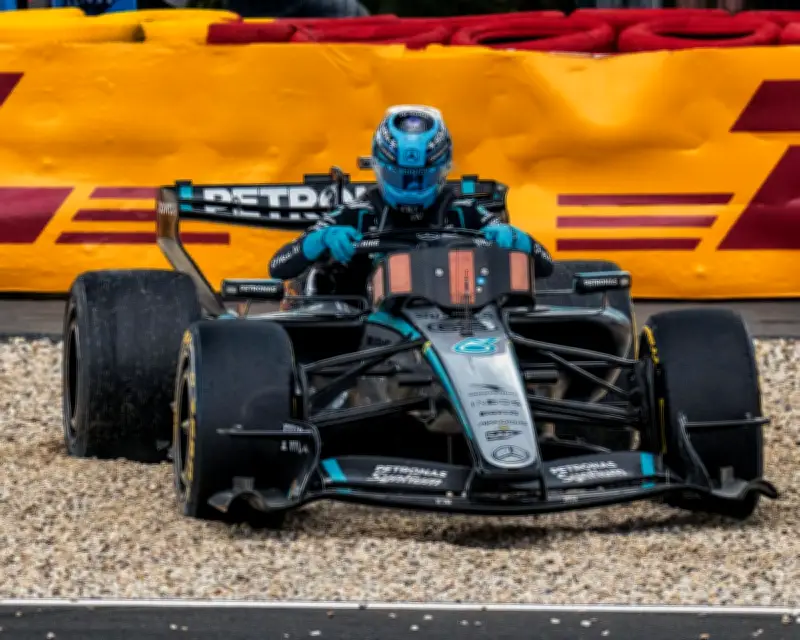
George Russell was at the centre of attention in Belgium, the Mercedes driver's championship hopes taking a severe blow as, inexplicably to him and his team, his engine did not recover energy through turn one and he was left with no electrical power to deploy. He was swallowed up by the Ferraris and vying with Lewis Hamilton, who clipped him through Les Combes, was pitched out of the race.
He was understandably furious. Not with Hamilton but that the energy issue meant he was in a fight with him at all. "I had no fucking battery down the straight. Guys, unacceptable," he told the team over the radio.

Energy Starved Cars
Nor was it a surprise, pre-race predictions from drivers proving all too prescient. With two sectors of long straights and little chance to harvest, the cars were energy starved, reducing the middle sector to internal combustion engine power only, effectively half of their potential output. It meant the cars were so down on power that corners such as Pouhon, an exquisite test of risk and reward, were now barely worth a consideration.
Cornering with the speed of an F3 car but with F1 downforce had emasculated one of Formula One's great tests, as Lando Norris noted: "It's not a corner any more, it was easy flat."
Drivers Speak Out
When asked about the importance of these algorithms and energy deployment in Spa, Max Verstappen gave an entertainingly blunt answer. "Welcome to F1 2026, sometimes it can be a jungle," he said.
McLaren's Oscar Piastri, ordinarily an even-handed observer – who notably was also suffering from an unfathomable deployment issue from his engine that was robbing him of time – had lost all patience with the AI overlords. "It sucks. I can't really say it any other way than that," he said. "George has had a lot of issues with that this weekend and maybe the last couple of weekends, and speaking to some others, it's a similar story. When you've got qualifying grids decided by computers behaving or misbehaving, it's a pretty crap way of going racing."
Race-winner Kimi Antonelli also weighed in: "Sometimes, especially on tracks like this that are very energy-demanding if you start driving differently, then for the system it's a bit crazy."
Dangerous Consequences
No one wants a crazy system, not least when unexpected changes in closing speed can be extraordinarily dangerous, as was demonstrated by the great sudden concentration of cars hurtling past one another on the Kemmel straight and into Les Combes on that opening lap.
Second-placed Charles Leclerc was part of it and came up like a rocket behind Verstappen. "These power units are so complex that there are some days when you scratch your head trying to understand why you are losing so much on the straights," he said. "It's just very difficult but also very frustrating sometimes for a driver because even when you are doing your best there are things in the background that change constantly and that's not so nice."