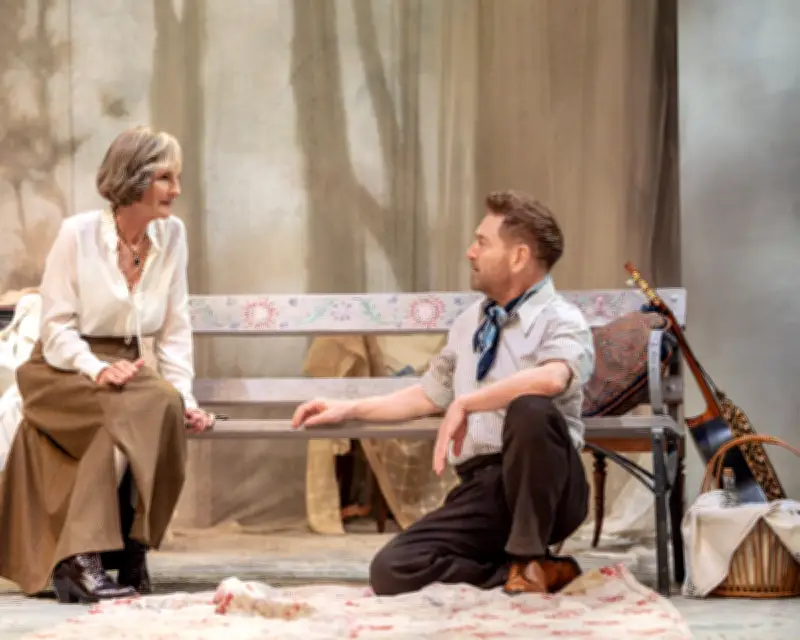
Laura Wade's reworking of Anton Chekhov's final play brings a dazzle of big names. Helen Hunt is the aristocratic matriarch Madame Ranyevskaya, Bill Pullman her brother, and Kenneth Branagh their nemesis, Lopakhin, a shopkeeper's son who takes over the family estate and represents the rising forces against Russia's old order.
Disappointing lack of sparkle
But for such a starry cast Tamara Harvey's production has a disappointing lack of sparkle. You do not feel the story's charge, its complications around love and its stinging losses. The tone is too soft-edged, almost endearing, and the cast such an ensemble that there is no magnetic centre to hold you.
Wade's new version, based on a translation by Helen Rappaport, seems less like a revisionist reimagining than an updating of language, comically benign and stranded in a pre-revolutionary Russia in which the two aristocratic siblings, Ranyevskaya and Gaev, speak in American accents, while Lopakhin and servant Yasha (Julian Moore-Cook) are Northern Irish. The point about the accents is unclear, and the production as a whole seems woolly in meaning.
Farce and emotional dimensions
The work was regarded by Chekhov as a comedy with farcical elements and Harvey brings out the farce in places, while ancient manservant Firs (Michael Elwyn) is a highlight with his doddering comedy. This does not make up for the lack of emotional and dramatic impact, although the storyline around Ranyevskaya's adopted daughter, Varya (Esther Smith), and her yearning for a marriage proposal from Lopakhin does develop some emotional dimensions.
Like Branagh's good-natured, sometimes joshing Prospero, his Lopakhin is amenable, lacking the sharp-pronged anger of Adeel Akhtar's in Benedict Andrews' astonishing version of the play at the Donmar Warehouse two years ago. When his class rage comes, after the auctioning of the estate, when he reveals that he is its owner, it is the most arresting moment of the night. But the drunken outburst melts away as abruptly after this scene, back to benign neutrality.
Performances and design
Hunt seems featureless and uncomplex as the entitled, passionate and grieving Ranyevskaya. She lacks personality in the early scenes and emanates generic concern in the later ones, when she feels the estate slipping away. Pullman, at least, brings charm and comic charisma, and you wish his role were not quite so minor.
Anna Fleischle's set design is full of faded grandeur, with chandelier and lace coverings across the furniture. There is a dash of expressionism in the bare branches twined around the room, which gesture at the cherry orchard beyond it. The sound design is subtle and effective, with birdsong and the grinding sound of trees being felled.
Political resonance
Written in 1903, when the Russian aristocracy was on the cusp of crumbling, points about social discontent and a rising peasant class are made, often through the play's eternal student and socialist, Trofimov (Alfred Enoch plays him as a likable prig rather than a straightforward firebrand). But they do not resonate in any significant way, either politically or dramatically.
There is so much bustling on stage too and not enough languor. No one seems to feel any Chekhovian longueurs or ennui – not on that side of the stage anyway.
Plays until 29 August.