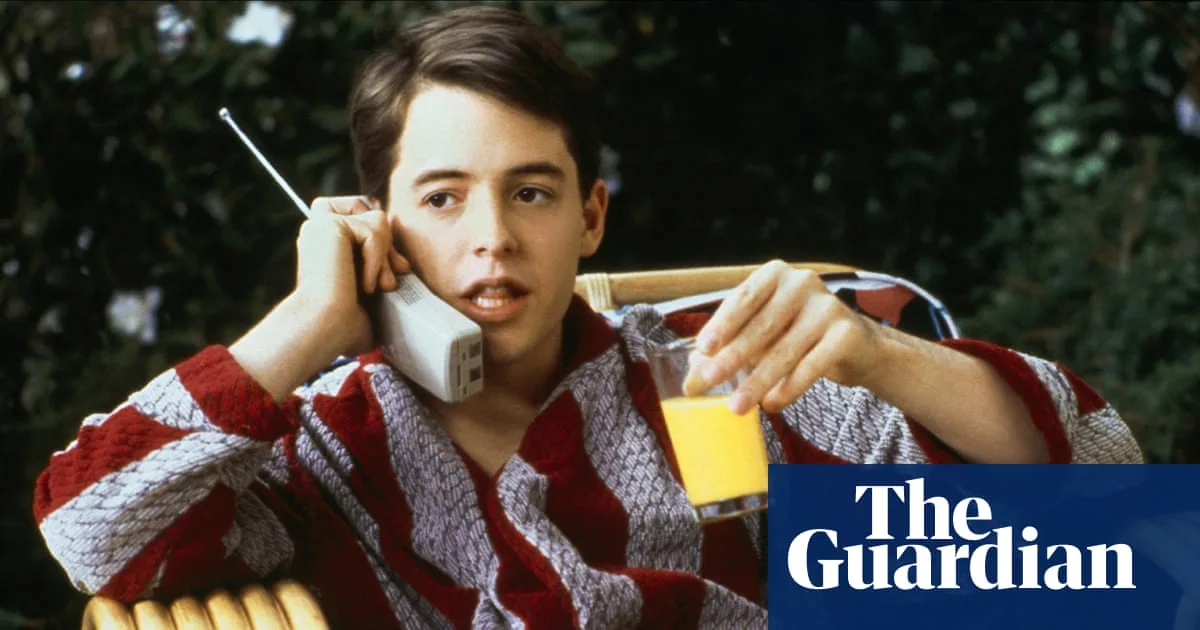
It’s hard to ignore a film’s message when the main character is addressing you directly down the barrel of the camera. Granted, the first time I watched the 1986 teen comedy Ferris Bueller’s Day Off, I was the impressionable age of 11 and “Look people in the eyes when they’re talking to you” was on constant rotation in my household. So my green eyes met Ferris’s brown ones and I took it all in.
Centred around Matthew Broderick’s playful turn as Ferris Bueller, a high school senior faking illness to skip school, Ferris Bueller’s Day Off is certainly a celebration of the carefree, though the story is by no means languid. Made frantic by doing the thing you’re not supposed to do with the aid of a red Ferrari, the day speeds by in comparison to the fictional days of other American teen films, such as American Graffiti and Dazed & Confused – which, to be fair, features a decent amount of marijuana.
The pace owes itself to the constant change in location. Once Ferris’s doting parents fall for a clammy-hands stunt (“lick your palms”), his day is well and truly off. With charm and, yes, a bit of verbal manipulation, he wrangles his best friend, Cameron Frye (Alan Ruck), and his girlfriend, Sloane Peterson (Mia Sara), out of the North Shore suburbs of Chicago to tour the city’s many offerings, all while escaping the clutches of a jealous sister and a wrathful dean of students.
These antagonists are mere personifications of the status quo – a signature of the film’s writer-director, John Hughes, who devoted much of his career to coming-of-age narratives. Through jokes, monologues and the occasional devastating remark about growing up, Hughes’s scripts expressed his contempt for adults masking capitalist values with maturity – just do what you’re told and smile. To Hughes, young people saw the world with a clarity deserving of attention.
A belief he underlines with a shot of Ferris, Sloane and Cameron, standing on railings while pressing their heads to the glass windows of the then-tallest building in the world, the Sears Tower (now named Willis Tower). Peering down, Sloane notes, “The city looks so peaceful from up here.” “Anything is peaceful from 1,353 feet,” Ferris muses. To wield perception is a strength, one honed by this titular character.
Known as the final line, the movie’s defining quote also makes an appearance at the very beginning as Ferris prepares for his day off: “Life moves pretty fast. If you don’t stop and look around once in a while, you could miss it.” A lesson I’m still attempting to grasp in adulthood – one I know I’m not alone in. Most of us aren’t making out in front of stained glass windows nearly enough.