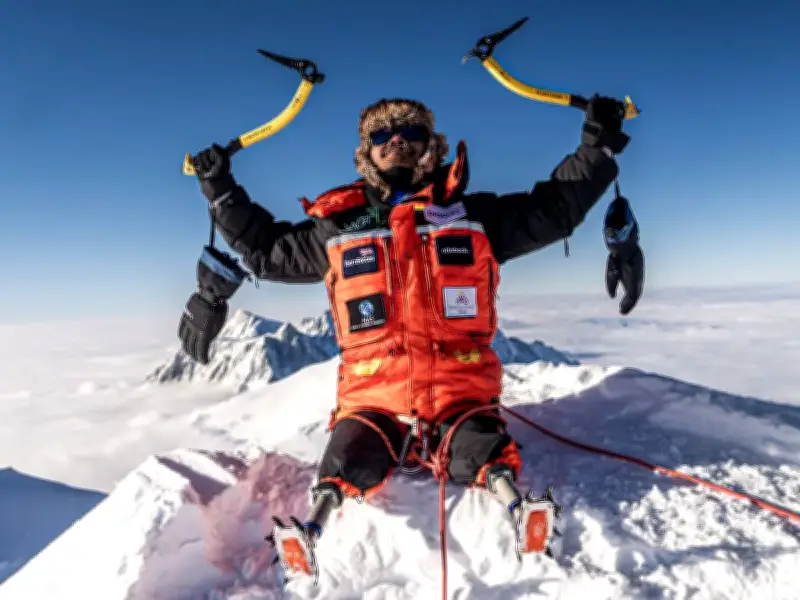
Hari Budha Magar, a double above-knee amputee, has become the first person with his disability to conquer the Seven Summits, including Mount Everest. His journey, marked by a near-fatal climb and a battle against a ban, has made him a symbol of determination.
A Misheard Call and a Fight for Survival
During his Everest ascent, a broken satellite call over a screaming wind was misheard, leading his team below to believe he was dead. They were already planning what to say, thinking he and his guide were lost. At over 8,000 metres without oxygen, Hari understood the gravity: "You can offer a man a million pounds for his oxygen at that altitude and he will refuse. Money is worthless when you are about to die."
From Cowshed to Gurkha
Born in a cowshed in a Nepali village on 30 July 1979, his birth was difficult, but the midwife predicted he would be a climber. His obsession with Everest began in a classroom when a teacher asked about Sagarmatha, the Nepali name for Everest. He joined the British Army in December 1998, serving as a Gurkha for over ten years.

The Day That Changed Everything
On 17 April 2010, in Helmand, Afghanistan, Hari stepped on an IED while on a patrol. The blast tore off both his legs. He was the tenth man in a single-file patrol, and it took 18 minutes for him to be carried to a rescue helicopter.
Struggling with PTSD and Alcoholism
Back in Britain, Hari faced months of surgery and rehabilitation, but PTSD took hold. He said, "I wake up in cold sweats. I hear the thunderous BANG! of the explosion, replaying again and again and again in my head." He fell into alcoholism, finding relief only in whisky. His turning point came in 2012 when he signed up for a skydive, thinking, "Half of my body is gone, if the other goes then it's the end of my story." But the jump gave him freedom: "The first time after my injury, I felt I was free like a bird."
Fighting the Ban and Reaching the Summit
After adaptive sports and skiing, Hari dreamed of Everest again, but Nepal had banned double amputees from attempting its peaks. He fought the ban in Nepal's Supreme Court and won. His climb was tougher, using three times as much energy as an able-bodied climber. At the Hillary Step, he nearly collapsed. He crawled the final stretch and reached the top on 19 May 2023. On the descent, oxygen ran out, but a Sherpa brought supplies, saving his life. The climb took 25 hours.
Recognition and Continuing Mission
In 2024, Hari received an MBE for services to disability awareness, won a Pride of Britain Award, and was invited to Downing Street. He has since completed the Seven Summits, including Antarctica, as the first double above-knee amputee to do so. He remains focused on inspiring others: "I might not change the whole world, but if I can help just one person change their life for the better, I will be happy."