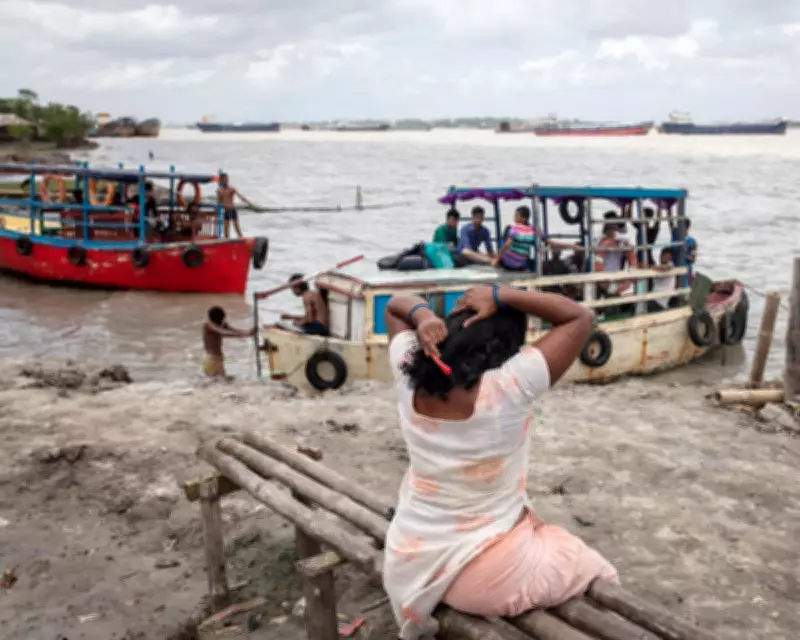
In Tahmima Anam's incantatory and fiery new novel, 'Uprising,' a chorus of child protagonists in a community of sex workers declares, 'Yes, you will leave this place.' This echoes a similar promise in Deepa Anappara's 'Djinn Patrol on the Purple Line,' where children on the margins were told, 'This story will save your life.' Anam's novel explores the distance between imagination and action, lived realities and dreams, and how solidarities can be forged in dire circumstances. It holds within its pages a deep conviction for a better life and a more just world, reaching out to fight for it.
The Setting: A Floating Brothel Island
As a journalist, Anam visited the infamous 'floating brothel' Banishanta in Bangladesh. Her novel is set on an isolated island 'at the end of the country, in the middle of a river that emptied into the sea,' fictionalizing the community's ecological precarity. Here, a generation of daughters grows up watching their mothers trapped in sex work, knowing that 'the work was something that was paid for in money, and also in bodies.' They wish for a different life. The women are controlled by the cruel Amma, who was once herself sold into sex trafficking. The victim becomes the perpetrator, and the children discern that their mothers are 'not here because they had done something bad, but because something bad had been done to them.' The first lesson of the island is that no one is coming to save you, and living there changes you as inexorably as the rising tides.
Life on the Island
The island is a prison. The mothers are ghosts of their former selves, and the children, witnessing the 'sexing,' are stripped of innocence. By the time they are born, their mothers' memories have faded 'like paint in the sun.' They live on the island 'tied to' their daughters. The question looms: What or who will break these chains?

When the waters rise, customers stay away. The mothers speculate that 'the swirling river was keeping the smaller boats from making the journey' or that 'the land was cursed.' In a last-ditch effort to lure men back, Amma sends for a new girl. She does not know that Kusum Khan's arrival will signal the beginning of the end. A girl from the city with a history of protesting against the Dictator, she does not acquiesce to the island's rules. Instead, she sows seeds for a life-altering act of resistance. The children begin to believe she is their saviour, perhaps even Bon Bibi, a legendary guardian of the forest. A different life seems graspable beyond the island's shore. When the titular uprising arrives, it summons an all-consuming storm, washing over the island. The reader, too, is ready to join the revolution, fist in the open air.
Themes and Impact
'Uprising' is a feminist novel, a protest novel, a coming-of-age story, and a response to the climate crisis. It explores sisterhood protecting and failing to protect, structural inequality, patriarchal corruption, and unlucky women in an unfair world. As the novel states, 'When the men came to reclaim the island, we stood rooted in place with our eyes closed, unable to watch. We stood rooted in place with our eyes open, unable to stop watching.' This observation applies to humanity: we are all watching, frozen and complicit, as injustices rise worldwide.
Through her unwaveringly political and forthright novel, Anam shows the power of rage and radical hope. A new world can burn bright from the fires of injustice, and here, it is the mothers who hold the match.
'Uprising' by Tahmima Anam is published by Canongate (£16.99).