An apparent friendship between Dracula writer Bram Stoker and a Daily Mail journalist may have helped play a key role in promoting the famous vampire novel, the author's family have revealed.
The Letter That Made a Difference
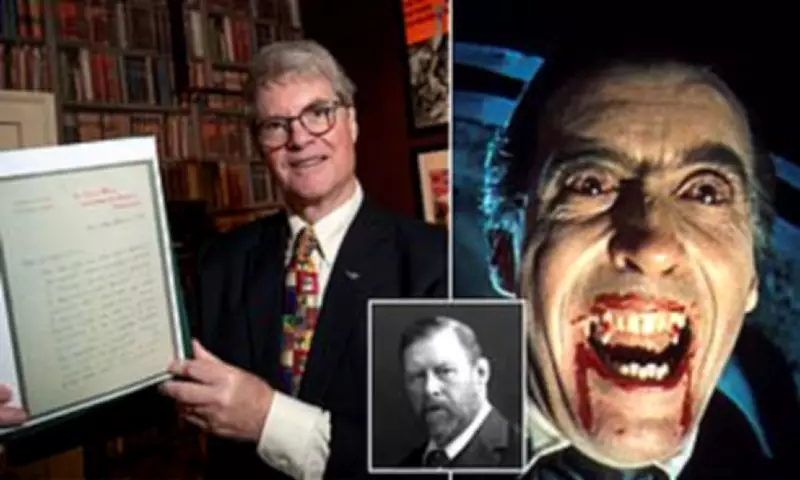
Robert Leighton, the newspaper's late 19th-century literary editor, sent a 'quite personal' letter to Stoker – highlighted as 'remarkable' by one of the Irish writer's relatives. Dacre Stoker, who has researched and written extensively about his great, great uncle, emphasized the correspondence from Leighton to Bram in late May 1897, just before Dracula was published.
In it, the journalist begins by asking Stoker to compare himself with the fictitious Count, requesting 'two personal paragraphs about yourself apropos Dracula?' for use in his 'Book Chat' column. Dacre, 67, appearing at a talk in Derby, where Dracula was first performed on stage in 1924, said: 'It's quite personal, beyond what a journalist might ask when discussing a book.'

Leighton's Promise to Promote
Leighton – who along with other journalists received an advance copy of the novel – went on to promise he will do 'what little I can' to promote the novel, telling Stoker: 'I express great admiration of the tremendous, fascinating force of the Dracula narrative'. He added: 'I congratulate you most sincerely on your achievement. The book is most remarkable in its originality, its grim, weird, almost terrible suggestion of fate and destiny. I shall be glad do what little I can to make it known.'
Leighton also reminds Stoker of a dinner party where the author had discussed a real-life incident involving a Russian ship sailing into Whitby with the scene in his book of Dracula sailing into the North Yorkshire town. Recalling the party – thrown by Hall Caine, one of the biggest authors of the late Victorian period – Leighton says 'you told us of some coincidence of the entrance of that Russian ship into Whitby harbour'. He asks Stoker for further information about the 'anecdote, or anything else you like' for his column – adding that his review of Dracula would be published the following week.
A Remarkable Insight
Dacre, who had come to Derby from his home in the US for the talk, said of the letter: 'It's a remarkable find because it gives us insight into how the novel was received by a very knowledgeable journalist before it went to the general public. I like it at the beginning when he effectively says 'tell us something about yourself' compared to Dracula. Leighton had that interest and depth into looking at Bram himself.'
The letter is among hundreds of items of Stoker's correspondence and manuscripts held by Leeds University's Brotherton Library. In his subsequent review of Dracula, published on June 1, 1897, Leighton told how while reading the novel, 'the story had so fastened itself on our attention that we could not pause even to light our pipe'. He went on: 'At midnight, the narrative had fairly got upon our nerves: a creepy terror had seized upon us'. Leighton recalled struggling to sleep 'in the anticipation of (a) nightmare', listening 'anxiously for the sound of bats' wings against the window'. He even wrote of feeling his throat 'in dread lest an actual vampire should have left there the two ghastly punctures which in Mr Stoker's book attested to the hellish operations of Dracula'.
Comparing Dracula to other novels from the era, the journalist said the 'weird, powerful and horrorful story' was 'even more appalling in its gloomy fascination' than the likes of Frankenstein and Wuthering Heights.
Derby's Dracula Legacy
Stoker's relative was giving a talk at Pickford House in Derby where an exhibition about Dracula – set up last year to mark 101 years since the first theatre performance – continues until mid-June, including costumes and props from the films, and the character's little-known links to the Midlands city. At the talk, Dacre also backed a campaign to preserve the former Derby theatre where Dracula was first performed on stage on May 15, 1924, watched by an audience including Stoker's widow, Florence.

Locals are seeking to have the former Grand Theatre, used in more recent years as a nightclub, then a restaurant and more recently an indoor golf venue, listed and for a blue plaque to be placed outside. The building, currently closed and undergoing renovations, still has the stage trapdoor from which the fanged count emerged to audiences dressed for the first time in his iconic cape costume. The red lining was eventually added during the later Hammer horror film productions starring Christopher Lee.
Dacre said: 'That building is the genesis of the story moving from book to stage and eventually to screen. It would be important if they could keep it and preserve it in some way.' Local figures backing the campaign to preserve the ex-theatre include Matthew Cheeseman, professor of writing and folklore at the University of Derby, who said: 'It should certainly be listed. There is not even a blue plaque on the building at present but within that theatre you had the first stage licencing of the most recognisable of horror characters.'
Dan Webber, of Derby Museums, said Dacre's visit was the 'culmination' of 'a fantastic response' to the 'Dracula Returns To Derby - 101 Years and Counting' exhibition. He said the display has led to a 'significant' jump in people coming to the museum over the last year, from 'across the country' and further afield.