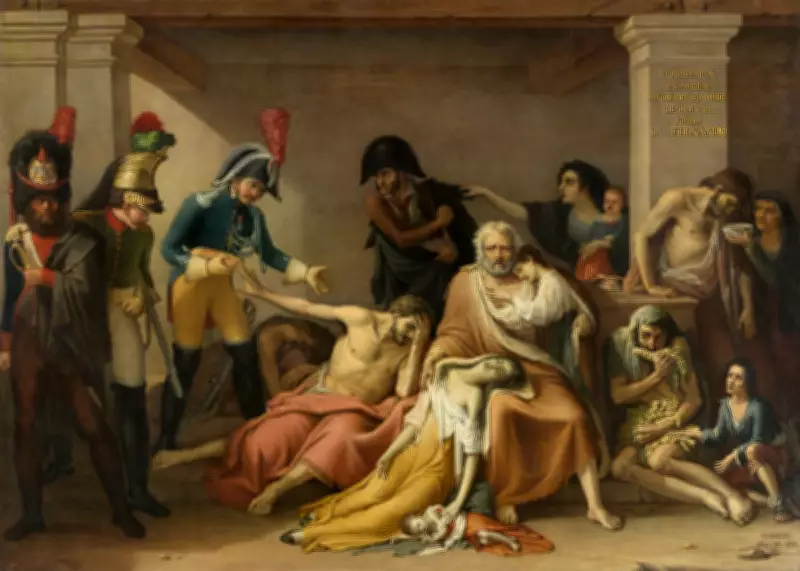
José Aparicio's The Year of the Famine in Madrid, a piece of political symbolism from the reign of Ferdinand VII, has returned to the Prado Museum after more than 150 years of itinerant exile. Once the museum's biggest draw, the painting fell out of favour for political and aesthetic reasons, spending decades in a government ministry, the senate, and another Madrid museum before coming home.
A Tale of Two Paintings
Today, no trip to the Prado is complete without visiting room 12, where Diego Velázquez's Las Meninas dominates. But two centuries ago, the must-see exhibit was Aparicio's gigantic allegorical work, which reminded Spaniards of their heroic resistance to the Napoleonic occupation and loyalty to King Ferdinand VII. Painted in 1818, the canvas shows emaciated madrileños nobly refusing bread offered by French soldiers, choosing death over occupiers' aid.
Rise and Fall
The painting's nakedly patriotic sentiment and tribute to the resilience of Madrid's people made it an instant hit. It was given pride of place in the Royal Museum of Painting and Sculpture, founded by Ferdinand and later the Prado. However, by the late 1860s, Ferdinand's absolutist reign had ended, and the new director, Antonio Gisbert Pérez, was no fan of Aparicio's work. The painting lost its meaning and became a joke, even used as a taste test in an 1879 book where liking it was a sign of tackiness.

Exile and Return
The painting's exile began in 1874. Now, it has been chosen as the inaugural work in a new series called A Work, a Story, which aims to help visitors consider paintings in a wider context. As Prado director Miguel Falomir said, the idea is to encourage viewers to reflect on aspects of art history that often go unnoticed. The exhibition invites visitors to consider the painting's propagandistic intent, social and political context, and how Francisco Goya's depictions of civilian suffering have since eclipsed Aparicio's canvas.
Shifting Tastes
Curators Celia Guilarte Calderón de la Barca and Carlos G Navarro note that the painting's history is bound up with Spain's changing political and artistic currents. Aparicio's knack was to associate it with a collective trauma of Madrid. But as tastes shifted, Goya's works, drawn from his experiences of the French occupation, became more celebrated. The curators hope the new initiative will make people think about how taste, politics, and context shift over time. The Year of the Famine in Madrid forms part of a long line of Spanish political and conflict painting, from Goya's The Third of May 1808 to Picasso's Guernica.
As Navarro said, this work went from being at the pinnacle of art history to being relegated to less important corridors, perfectly exemplifying how our idea of taste changes with each generation.