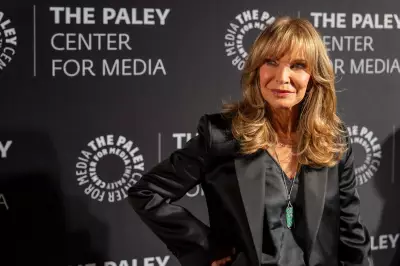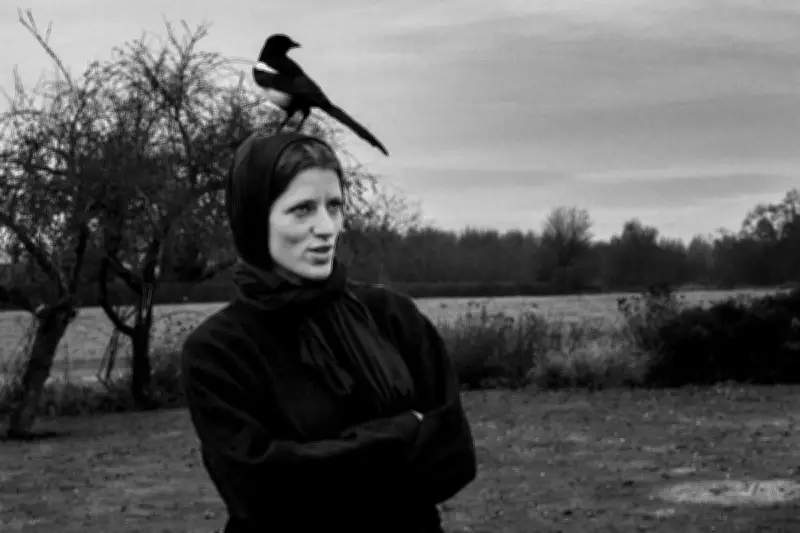
Polly Samson, a photographer and author, is showcasing her work at an exhibition in London. She shares insights into her creative process, her photography heroes, and how her home with husband David Gilmour, surrounded by water meadows, inspires her.
Documenting live shows for over 20 years
Samson has been documenting live performances from her unique perspective for more than two decades. Her sixth photography book, Luck and Strange Studio/Live, was released last year, offering an intimate look into the creative process of her husband, David Gilmour, and their long-standing artistic partnership. The book also serves as the foundation for her inaugural exhibition at the Leica gallery in London.
Light is central to Samson's work, whether it's candlelight casting a glow on the Pink Floyd legend during rehearsals, or the full moon reflecting with Gilmour and their dogs in a mirror placed in a misty field. Another striking image captures the play of light and shadow on Gilmour's hands, resting gently on a table instead of holding a guitar.

As the acclaimed author of novels like The Kindness (2015) and A Theatre for Dreamers (2025), Samson brings a narrative voice to her photography, prompting viewers to ponder the stories behind each subject.
How novel-writing informs her photography
Samson explains that it's usually the other way around, but her writing sometimes influences her more staged photographs, such as the image of Gilmour walking between giant inflatable balls and silver birches in the mist. She notes that it's rare for her to visualize a picture and then create it as a photograph. However, photography often serves her writing; for instance, her novel A Theatre for Dreamers was inspired by James Burke's photographs of the Bohemian community on Hydra in the 1960s, which she had pinned around her while writing.
Surprising photographs
Among the exhibition pieces, Samson highlights double exposures of David Gilmour and the late Rick Wright, taken in 2005 on the houseboat Astoria. She recalls messing up the film loading, which caused half-frame winding, but the resulting strip became an interesting print for the show.
Favorite photograph of David Gilmour
Samson points to a close-up of Gilmour's hands in the exhibition as one of her favorites.
One of her most personal images is a portrait with her husband and dogs taken in a small mirror outside. She envisioned it first, propping an old mirror among silver birches by a river, waiting for the full moon, and cheating the mist by lighting fires of leaves and twigs. She started with a selfie and then did the double portrait the next night.
The secret to a creative marriage
Samson believes the most important thing is for each partner to genuinely enjoy the other's work.
Memorable concerts
When David Gilmour's 2024 Luck and Strange tour ended, Samson felt she was hitting her stride as a live photographer and wanted more. She was fortunate that Paul McCartney allowed her to photograph his show at the O2 shortly after.
Photographing someone else's show is different; for David, she is up close on stage, hidden behind speaker cabinets or risers. For McCartney's show, she didn't know the cues, making it exhilarating, especially when flames erupted beside her. She captured a moment where McCartney saw her and stuck his fingers in his ears during extreme pyro.
Comfort in front of the camera
Samson is not comfortable being photographed by others, but she occasionally looks for shiny surfaces to insert herself into a photo. She no longer remembers what it's like to walk into a room without her camera.
Her home in West Sussex is surrounded by water meadows, which flood more now than when they moved there 32 years ago. She finds flooded fields lovely to photograph, with changing light, reflections, and extraordinary mists.

Cultural references
An image of her daughter Romany playing the harp was inspired by the 1975 film Barry Lyndon. Another photo of Romany, taken on the day she filmed the video for "Between Two Points" at Hammersmith, reminded photographer Misha Pedan of Tarkovsky's Stalker. When a local canal lock flooded, it recalled a scene from Stalker, and their dog Wesley resembles the dog in the film. Samson took the boat so David didn't get wet while she captured the image.
Admired photographers
Samson admires Jill Furmanovsky's rock and roll pictures, Alexander Bronfer's atmospheric work, and has a long-time crush on Saul Leiter.
Chance plays a huge role at the start of a tour, but after a few nights, she becomes more deliberate, working out what she wants and how to get it without obstructions like microphones.
Black and white vs. color
Samson initially shot only black and white film for the Luck and Strange project to sharpen her skills. She continued with black and white for studio shots using a Leica Monochrom digital camera. On tour, she switched to color for live shots but kept the Monochrom for backstage, finding it less intrusive.
Learning photography
Samson has learned by doing, encouraged by other photographers. When she became tour photographer for David in 2006, she shot 10,000 pictures with her first film Leica, a massive learning process.
Photography is an obsession; she can't imagine a day without a camera. However, to write another novel, she will need to limit herself, as it's hard to create an inner world while looking outward through a lens.
She hasn't gone a day without taking pictures in years. The secret to memorable images, she says, is light.
Samson notes that everyone now has a camera in their pocket thanks to mobile phones, which is a great plus. If she could have one original photographic image, it would be a Lee Miller self-printed self-portrait recently shown at the Tate, showing only a torso like a statue.
Polly Samson's show 'Between This Breath and Then' is at the Leica Gallery London until 7 May 2026; her book 'David Gilmour Luck and Strange Studio/Live' is published by Thames & Hudson.