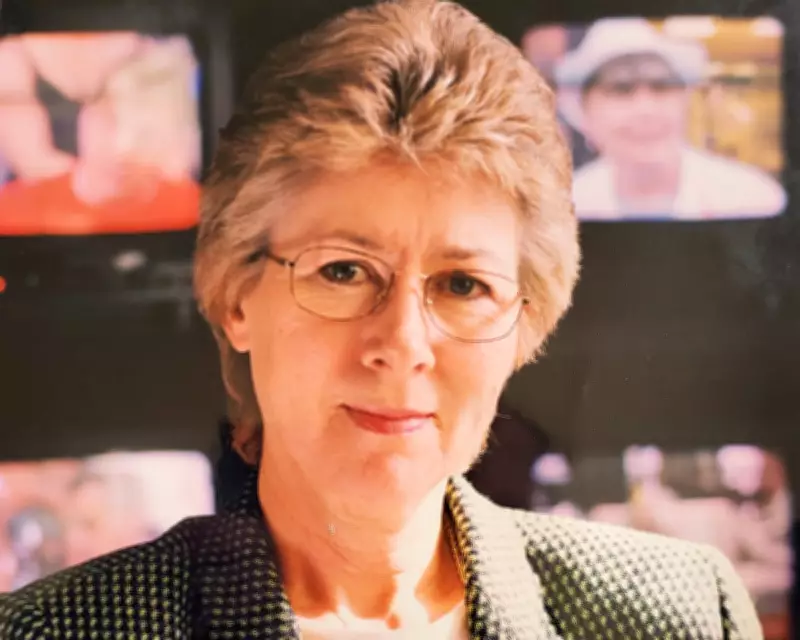
Pam Masters, the pioneering television executive who created Channel 4's iconic animated 'ident' and later became one of the most powerful women in British broadcasting, has died of cancer aged 82.
On Tuesday 2 November 1982, British television entered a new era with the launch of Channel 4. Unlike BBC One, BBC Two and ITV, it broke the mould by commissioning programmes from independent producers rather than making them itself, paving the way for the multichannel future. It also had a remit to broadcast an 'alternative' to existing channels.
Viewers were greeted by nine flying blocks in five colours forming a logo to make the figure 4, accompanied by David Dundas's Fourscore theme tune, before out-of-vision announcer Paul Coia said: 'Good afternoon. It's a pleasure to be able to say to you, welcome to Channel 4.'

The pioneer behind this concept of on-air branding was Pam Masters, the channel's first head of presentation. From pitches by three companies, she chose to develop the ideas of Martin Lambie-Nairn. Together, in a pre-digital age, they travelled to Los Angeles to work with Bo Gehring Aviation to generate computer-animated 35mm frames for seven-second animations. This work won the rarely awarded Black Pencil from D&AD for industry-defining work.
In 1988, Masters was lured back to the BBC, where she had begun her career as a secretary, to become head of presentation. She went on condition that she could bring a brand-focused attitude to its channels. In her signature high heels and shoulder pads, she became one of the most powerful women in what was then a man's world.
'As we move into the 1990s and enter a far more competitive broadcasting landscape, it is essential that the BBC's branding and corporate identity are strong, well-recognised, and present a unified image,' she said.
Collaborating with Lambie-Nairn's design agency in 1991, she was responsible for turning the static globe seen between programmes on BBC One into a mixed-media spinning version. At the same time, BBC Two's logo was declared 'unmemorable' by controller Alan Yentob, with audience research describing it as 'dull' and 'old-fashioned'. Masters oversaw Lambie-Nairn's witty new idents, including viridian paint splashing across a black and white number 2, a fluffy toy dog-style numeral, fireworks and a remote-controlled car. This creativity earned a D&AD Yellow Pencil and a Bafta Television Craft award for graphic design.
In 1997, Masters and Lambie-Nairn revisited BBC One's ident, replacing the spinning globe with a predominantly red hot-air balloon filmed flying over British landmarks from the Scottish Highlands to the Thames. The idea, part of a corporation-wide rebrand that restyled 'BBC1' as 'BBC One', was to convey the BBC as a trusted friend reaching all parts of the UK.
Masters, with Jane Frost, the BBC's head of corporate and brand marketing, took cultural storytelling further in 1997 with a promotion featuring Lou Reed and two dozen other singers performing Perfect Day. They fought management battles to get the four-minute video aimed at licence fee payers accepted. It ended with the caption: 'Whatever your musical taste, it is catered for by BBC Radio and Television. This is only possible thanks to the unique way the BBC is paid for by you. You make it what it is.' The promotion was so impactful that the recording was released as a charity single for Children in Need, reaching No 1 and selling over a million copies.
Pamela was born in Newlyn, Cornwall, to Gwen and Ken Masters, who owned china shops. When she was four, the family moved to Sidmouth, Devon, where she attended West Bank school. After a year at a Swiss finishing school, she joined the BBC's presentation department in 1962 as a secretary, soon becoming a continuity clerk. She rose to network director and editor overseeing transmissions and links.
In 1981, she joined Channel 4, where founding chief executive Jeremy Isaacs said she ruled with 'icy efficiency'. Then came her long stint at the BBC as head of presentation, later retitled head of broadcasting and presentation. She became managing director of BBC Broadcast in 2002, taking programmes from producers and assembling them into schedules. The business was sold to Macquarie in 2005 and renamed Red Bee Media, with Masters as chief executive. She retired to Northumberland in 2015.

In 2000, she received the Pinnacle award from Promax/BDA. She married television producer Alan Boyd in 1976, who survives her, along with her brother Peter.