The late great land artist Nancy Holt's alfresco metal and concrete works at Goodwood Art Foundation are richly engaging and elemental, but the gallery material indoors lacks some heft. It pays to think big if you're an artist. Zoom out and try to get away from the minutiae of life, the tedium of the everyday, and think on a more universal scale instead. Land artist Nancy Holt (1938-2014) was a master at using her work to place the body and wider humanity in a global, cosmic context. Holt and other land artists of her generation, such as Michael Heizer, Richard Long, and her partner Robert Smithson, wanted to break out of the restrictions of paint and canvas, stone and chisel, gallery and museum. Land, nature, and the world itself were the medium.
Goodwood Setting
Goodwood is a fine setting for the biggest UK exhibition of her work to date, an expansive, lush estate in the middle of the rolling West Sussex countryside. Two big sculptural installations are placed around the grounds: Ventilation System and Hydra's Head. In the first, a huge metallic mechanism pokes out of the vegetation around the main gallery, with big tubular aluminium pipes all interconnected, snaking their way around the place and back into the building.
Ventilation System
Holt wanted to expose the hidden structures of our built environment, but the work feels more bodily than that. It's like the building's lungs, a set of pulmonary ducts that bring in life and expel harmful gases. Ventilation is often hidden away in architecture because it vents out the noxious fumes of septic tanks or sewage systems, but here it's brought right out into the open. The building belches and breathes just like we do. There should be no shame in that. It's natural, the stuff of living.

Hydra's Head
Then you walk outside, head through the idyllic meadow, stumble down into the gleaming white chalk quarry, and find six little concrete pools filled with water, arranged like the head of the Hydra constellation. Seen from a viewing area above, they're darkened abysses, black holes that suck up the light, chasms that threaten to drag you in. But up close, suddenly, you see the trees reflecting back at you, birds flying past, the sky, your own face. It's outer space, distant stars, planet Earth, the birds and bees and trees all right here, in this exact moment. It's a portrait of you in the universe, a picture of its vastness and your own little place in it. Pretty good for some fetid, stagnant water.
Gallery Works
The rest of the works are in the main gallery space. There are photographs, diagrams, and poems, and as is so often the case with land artists, they struggle to match up to the imposing power of the big outdoor works. One series of photos documents waymarkers on stones and gates in the countryside, little coloured dots on rocks like tiny minimalist paintings in nature. Another series depicts an English forest where Holt buried a poem she wrote for Smithson, with instructions on how to find it. Except we don't get the poem or the instructions, just some photos of wet ferns.
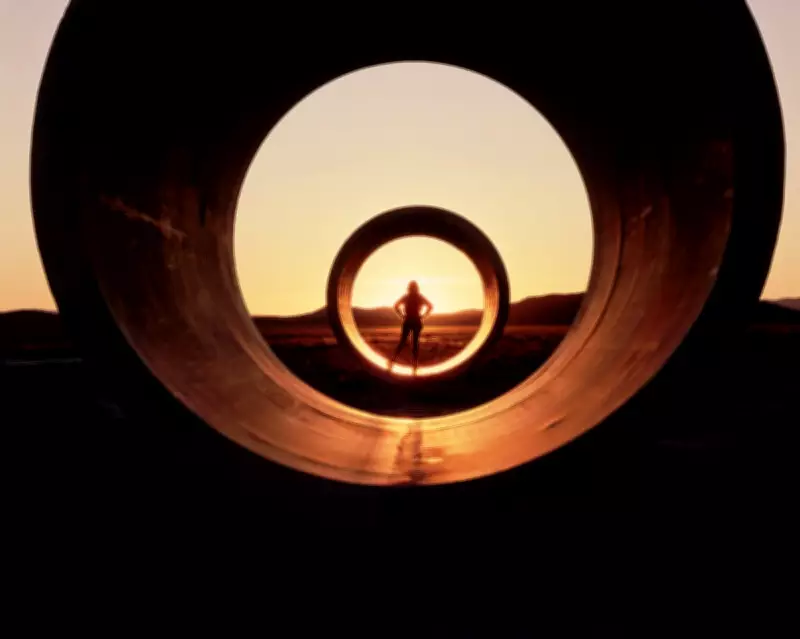
Other photos see Holt drawing with light and shadow, making black and white curves and lines with slits in paper. They're pretty but a little dull. A light installation shines a spotlight on mirrors, tracing elliptical reflections across the opposite wall. Her Sun Tunnels, massive concrete cylinders installed in the Utah desert channelling and corralling sunlight, is documented in a series of photos. They're all nice enough works, but they don't communicate her ideas of universal vastness and endless interconnectedness all that well.
Conclusion
Which is a shame, because if they could have been bolder and somehow filled the grounds with Holt works on the same scale as Hydra's Head or Ventilation System, this would be a stunning show. But as it is, it just doesn't think big enough. Nancy Holt is at Goodwood Art Foundation from 2 May until 1 November.