Linklater's Cinematic Homage to Godard's Breathless
Richard Linklater's latest film, Nouvelle Vague, presents a meticulously crafted period drama that delves into the creation of Jean-Luc Godard's groundbreaking 1960 classic, À Bout de Souffle, known internationally as Breathless. The movie, shot in elegant monochrome with French credits, recreates the Parisian setting where Jean Seberg and Jean-Paul Belmondo famously portrayed star-crossed lovers, capturing the essence of the French New Wave with a polished aesthetic that contrasts with the era's raw disruptiveness.
A Submissive Yet Intelligent Tribute
Linklater approaches the subject with an awestruck reverence, avoiding the jump-cuts and stylistic chaos that defined Godard's original work. Instead, he employs a smooth, Steadicam-driven narrative that introduces key figures through static portrait shots, each gazing at the camera with their names displayed—a technique that underscores the film's cinephile devotion. This tasteful approach, while intelligent and good-natured, arguably smooths over the revolutionary edges that made Breathless a landmark in film history.
Notably, Linklater's homage seems to align more with the accessible style of François Truffaut, who wrote the basic story for Breathless and facilitated its commercial success. Truffaut's influence is palpable, as the film explores the true-crime inspiration behind the plot: a tough guy who shoots a policeman and embarks on a fleeting romance with an American girlfriend, all while grappling with existential dread.

Portraying the Icons of French Cinema
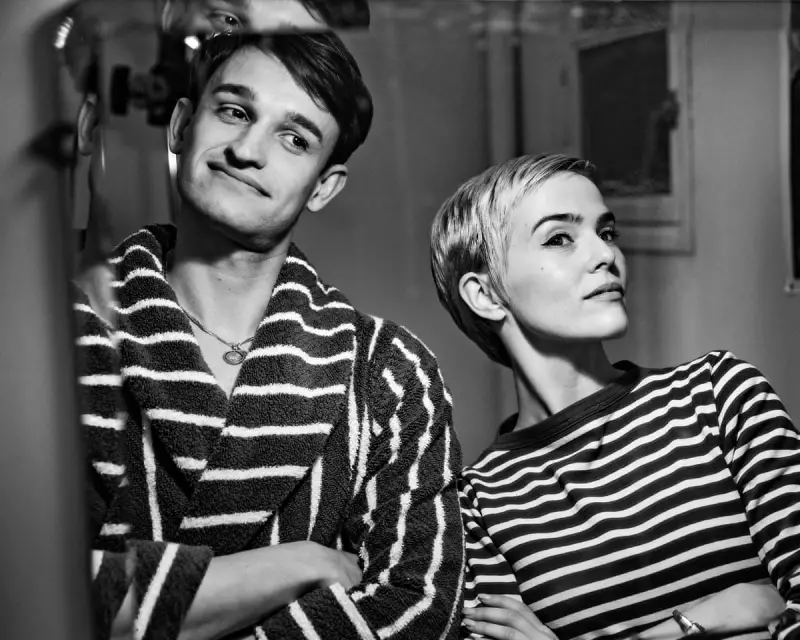
The cast brings to life the real-life personalities involved in the making of Breathless. Guillaume Marbeck portrays a young Godard, depicted as a Cahiers Du Cinéma critic-turned-filmmaker, constantly offering epigrams and dismissive pouts about cinema—a characterization that may reflect aspects of Godard's persona. Aubry Dullin embodies Jean-Paul Belmondo, while Zoey Deutch takes on the role of Jean Seberg, delivering lines in fluent, Ohio-accented French that adds a layer of authenticity to the period setting.
Supporting roles include Adrien Rouyard as François Truffaut, Matthieu Penchinat as cinematographer Raoul Coutard—whose news background in war coverage informed Godard's guerrilla filmmaking—and Bruno Dreyfürst as producer George "Beau Beau" Beauregard. The film doesn't shy away from depicting the tensions on set, such as Beauregard's financial disputes with Godard, which escalate into a physical scuffle in a Paris café.
Behind the Scenes of a Revolutionary Shoot
Nouvelle Vague vividly illustrates the chaotic production process of Breathless, highlighting Godard's capricious delays and improvisational methods. Actors are shown ad-libbing dialogue freely during takes, with the knowledge that everything would be dubbed later in the studio—a practice that challenged traditional filmmaking norms. Continuity supervisor Suzon Faye, played by Pauline Belle, confronts Godard about mismatched eyelines, hinting at the impending revolution in film grammar, though Linklater's version modestly acknowledges that Godard didn't invent jump-cuts.
By the film's conclusion, Godard remains an enigmatic figure, seething with competitive anguish over Truffaut's success with The 400 Blows at Cannes and struggling to gain access to exclusive parties and film sets. Linklater's portrayal, while arguably accurate, wraps this tumultuous historical moment in a sleek, cinematic package that prioritizes homage over disruption.
Nouvelle Vague premiered at the Cannes Film Festival and is set for release in UK and Irish cinemas from 30 January, offering audiences a polished journey through one of cinema's most iconic eras.