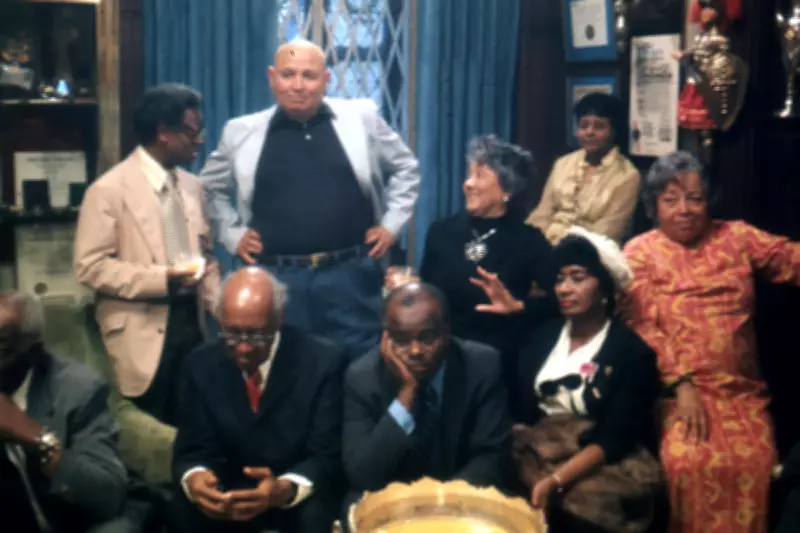
No movie at the Cannes Film Festival has had a longer journey to reach the screen than "Once Upon a Time in Harlem." Fifty-four years after it was shot, the documentary finally premiered this week on the Croisette.
A Historic Gathering in Harlem
In August 1972, pioneering filmmaker William Greaves assembled a remarkable group of artists, writers, poets, musicians, and organizers from the Harlem Renaissance. They gathered for a cocktail party at Duke Ellington's Harlem townhouse to discuss the seminal 1920s cultural movement: what they remembered, who should not be forgotten, and what it all meant. David Greaves, then 26, was one of four cameramen his father tasked with documenting the event. "My father would say, 'Capture the life that's happening,'" David recalls.
William Greaves died in 2014 at age 87, having never completed what he believed would be his most enduring work. His son David ultimately stepped in as director, guiding the project to completion with his family's support. "It's not the film he was thinking of in his mind," David Greaves said in Cannes. "But it's definitely the film he would have wanted."

A Long-Awaited Premiere
It was fitting that "Once Upon a Time in Harlem" had its moment at Cannes. William Greaves' 1968 opus, "Symbiopsychotaxiplasm: Take One," was rejected by the festival at the time but later became revered by filmmakers and was added to the National Film Registry in 2015. For David Greaves, bringing his father's work to cinema's global stage felt "magical" and "surreal."
The film is now poised to become a nonfiction event of the year. After its premiere, Neon acquired it and is planning an awards campaign. It will screen at major fall festivals. Richard Brody of The New Yorker, after seeing an unfinished cut, called it "a film for the ages."
Voices of the Harlem Renaissance
The gathering featured a spectrum of Harlem Renaissance luminaries, including poet and novelist Arna Bontemps, artist Romare Bearden, actor Leigh Whipper (then 96), Ida Mae Cullen (widow of poet Countee Cullen), musician Eubie Blake, poet and painter Richard Bruce Nugent, and scholar John Henrik Clarke. Together, they reminisce about the flourishing in Harlem—laughing, arguing, and celebrating their place in Black history. In the 1970s, this history was not as widely recognized. Now, the film arrives at a time when African American history is increasingly under scrutiny in America.
David Greaves defines the Harlem Renaissance simply: "It's the wellspring." He initially wanted to open the film with a history stretching back to Africa, but others urged him to focus on the party. Instead, the documentary opens with Langston Hughes' poem "The Negro Speaks of Rivers," which Greaves felt expressed it all.
A Family Legacy
William Greaves originally intended to use the 1972 footage for his 1974 film "From These Roots" but opted for archival photographs instead. He revisited the footage over the years but never shaped it into a film. After his death, his widow, Louise Archambault Greaves, took up the project. She died in 2023 but secured funding for restoration. "Louise was a lock protecting the footage," David Greaves says with a laugh. "She told the Smithsonian, who asked for a copy, 'No!"
Though he assisted on his father's films growing up, David Greaves did not remain in moviemaking. He co-founded and ran the progressive Brooklyn community newspaper Our Time Press. It was years before he stepped forward to direct. His daughter, Liani, is a producer. When asked who could direct the film, David initially hesitated. But after Louise's passing, adviser Marcia Smith asked, "Are you going to direct it?" He replied, "Yes. I couldn't imagine anyone else directing this film. I just couldn't."
David Greaves barely remembers what he shot in 1972. He appears fleetingly in a mirror in the film, but it was too long ago to recall clearly—longer than the span from the Harlem Renaissance to that townhouse meeting. "Once Upon a Time in Harlem" is a luminous artifact of the past, twice over. "Usually after seeing a movie, people say 'Congratulations,'" says Greaves. "Here they say, 'Thank you.'" He can hardly get the words out before the tears come streaming again. He wipes them away, lifts his head, and smiles.