The Festival of Britain officially opened on May 3, 1951, with King George VI proclaiming it a symbol of Britain's abiding courage and vitality. The ceremony began with a service of dedication at St Paul's Cathedral, followed by the king's broadcast speech from a dais outside. About 10,000 people gathered in the churchyard, braving rain to witness the historic moment.
King's Speech and Ceremony
In his speech, the king drew a contrast between the Victorian age and the hard experiences of the present. 'Peace has not endured,' he said, 'and much of the wealth our forebears created has been dissipated by fire and slaughter.' However, he urged against despondency, calling the festival an opportunity to look back with pride and forward with resolution. Trumpeters of the Household Cavalry sounded a fanfare as the king declared the festival open, marking its official beginning despite some delays and false starts.
Royal Festival Hall Dedication
That evening, the Royal Festival Hall was dedicated by the Archbishop of Canterbury in the presence of the royal family. The king unveiled a tablet on the main staircase to commemorate the occasion. The hall's interior was praised for its grace and dignity, though its exterior was considered less remarkable. An audience of distinguished guests filled the foyers and staircases, with women wearing quieter gowns appropriate for the religious ceremony.

Public Opening and Rain
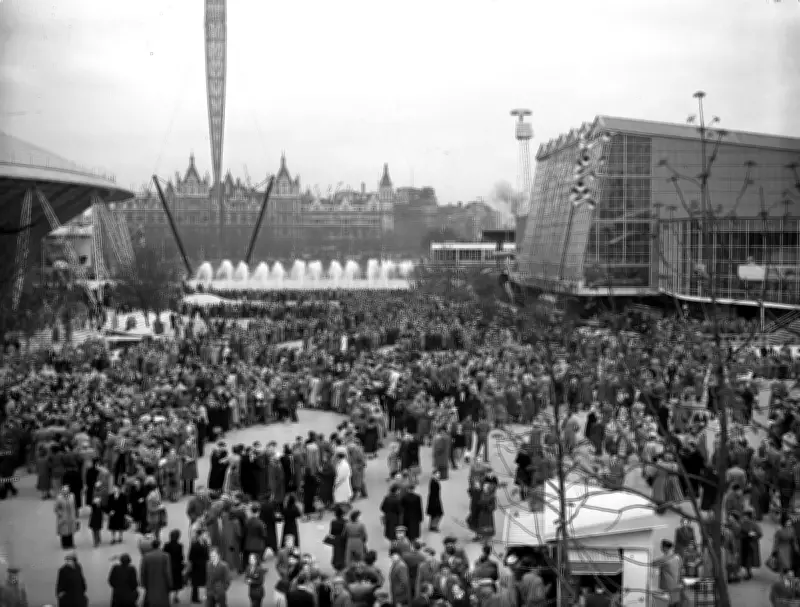
The public was admitted to the South Bank Exhibition on May 4, but heavy rain dampened attendance. Only 20,000 people had entered by 8 pm. The crowd was largely middle-class, with some ticket-holders and invited guests. Umbrellas at outdoor cafes were sodden, and waiters dashed to drain tables. Concrete paths had unevenly laid sections, creating pools of water. Despite the weather, visitors explored pavilions, though the sparse attendance meant most stayed indoors.
Evening Ambience and Dining
As night fell, the South Bank transformed into an enchanting scene. Multi-coloured fountains played, and yachts glided on a luminous blue lake. Restaurants were full despite low attendance, with diners enjoying sumptuous meals. However, the cafeterias served traditional English dishes, including battered plaice and marrowfat peas, which some found disappointingly unadventurous.
Concert at Royal Festival Hall
The first concert featured the BBC Symphony Orchestra and Choral Society under Sir Malcolm Sargent, performing Beethoven symphonies. The orchestra was not at its best, perhaps due to over-rehearsal. The hall's acoustics were still being refined, with woodwind sounding distant in the front stalls, but the deficiency was not considered serious.
Architectural Highlights
Among the exhibition buildings, the Dome of Discovery by Ralph Tubbs was outstanding for its spatial realism, though marred by cluttered exhibits. The Skylon was deemed a pointless tour de force. The Regatta Restaurant and Press Room were beautifully designed, despite repugnant cast bronze handles. The '51 Bar and Thameside Restaurant were perfunctory. The best group of buildings were those dedicated to countryside occupations, praised for their homogeneity and accessibility.
Overall, the exhibition was best appreciated as a story of brilliance and ebullience against great odds, rather than purely as architecture. The craftsmanship in applied arts was of outstanding merit for the age.