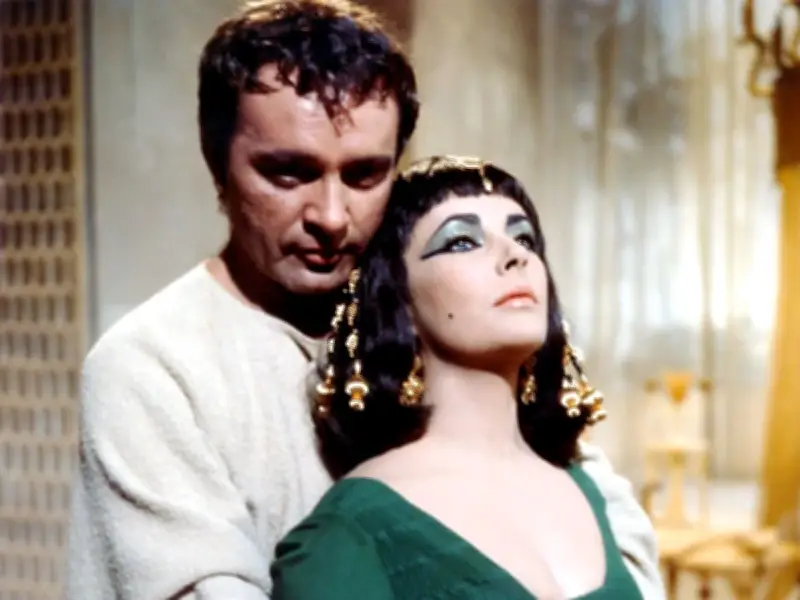
The 1963 biographical epic "Cleopatra," starring Elizabeth Taylor and Richard Burton, airs on Film4 this afternoon at 4:15 pm. The Oscar-winning film, a major box office success of its decade, chronicles the life of the Queen of Egypt.
The story follows Cleopatra from 48 BC, when Roman general Julius Caesar arrives in Alexandria and meets her. A relationship develops as she seeks his support in taking the throne from her brother Ptolemy XIII. With Caesar's backing, Cleopatra becomes the sole ruler of Egypt, and their relationship sparks political upheaval with far-reaching consequences. She later forms a political and romantic alliance with Mark Antony, enraging powerful figures in Rome and leading to conflict and bloodshed.
A Turbulent Production History
The film's production was as dramatic as its subject. Originally budgeted at $2 million, costs spiralled to $44 million (roughly $470 million today), making it one of the most expensive films ever made. Filming began in London, but Taylor contracted severe pneumonia and required an emergency tracheotomy. Production halted for months, and due to unsuitable English weather, the studio moved the entire production to Rome, starting afresh.
The escalating costs nearly bankrupted 20th Century Fox, forcing the studio to pause other productions and implement cost-cutting measures. Two lead actors were replaced due to the prolonged schedule, requiring scenes to be reshot. Taylor and Burton, who played Mark Antony, began a highly publicised affair while both were married to others. The media frenzy was so intense that the Vatican publicly condemned it.
Record-Breaking Contract and Awards
Taylor made history as the first actor to sign a $1 million contract for a single film. Due to delays and overtime clauses, she ultimately earned closer to $7 million. Despite the turmoil, the film received nine Academy Award nominations, including Best Picture, and won four: Best Art Direction, Best Cinematography, Best Costume Design, and Best Visual Effects.
The film's legacy includes ending the era of old-Hollywood big-budget historical epics, as studios became wary of allowing such enormous budgets for individual productions. Critics on Rotten Tomatoes call it "absolute cinema. It's four hours that pass in four minutes," and a "monumental spectacle, with a stirring performance by a radiant Elizabeth Taylor." One admirer wrote, "Beautiful sets, good acting, and a determination to make an excellent film, show in every scene." Wanda Hale of the New York Daily News described it as a "magnificent spectacle that gratifies our desire for perfection."