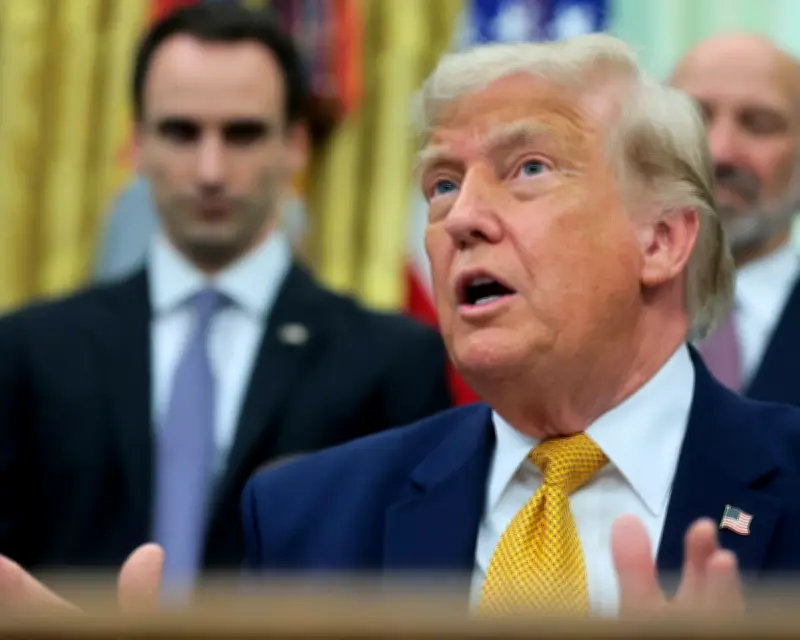
Maggie Haberman and Jonathan Swan, the journalists behind the new book Regime Change, have described the immense challenges they faced in uncovering secrets from Donald Trump's second-term White House, an administration they say is "very good at keeping secrets." In an interview, Haberman highlighted Trump's health as a particularly guarded topic, noting that "the number of people who actually know what is happening with his health … they've provided less and less information." She added that the last time the public received real information about Trump's health was in 2018, and that the administration was dishonest about his COVID-19 illness in 2020.
Health as a Lockbox
Haberman explained that Trump has always treated his health as a "very specific lockbox," viewing illness as a sign of weakness. His advisers are "very, very attuned" to this sensitivity. Despite visible signs of aging—slurred speech, shuffling steps, bruises on his hands, and swollen ankles—the administration has provided scant details. Trump's medical visits to Walter Reed National Military Medical Center have been shrouded in secrecy, with officials only saying he saw 22 specialists without naming them. Haberman doubted whether the public would learn more before the end of his term.
Secrecy Beyond Health
Swan echoed Haberman's assessment, stating that the administration is "incredibly good at keeping secrets." He pointed to the Memorandum of Understanding with Iran, signed recently, as an example: "One of the most important documents you could possibly imagine, to end the war … Almost no one inside the US government had seen that document until it was publicly announced." Even senior officials in the State Department and Pentagon were kept in the dark. The book also details how Trump chose to go to war with Iran, bombing nuclear facilities last summer and joining Israel in an all-out air assault this year. Swan noted that Treasury Secretary Scott Bessent and Energy Secretary Chris Wright were not in the meetings leading up to the war; they found out only the day before in the Situation Room.
Inside the Situation Room
Regime Change describes Situation Room discussions about the botched handling of the Jeffrey Epstein scandal, including Epstein's sexual abuse of underage girls and his ties to Trump. After The New York Times published an excerpt, White House officials worried about how the material was obtained. Haberman and Swan declined to reveal their sources but emphasized the extreme effort required. "We really nearly killed ourselves during this book," Haberman said. The book also captures Trump's mania for remodeling his surroundings, such as gluing gold appliques over the fire in the Oval Office and planning an arch and ballroom in Washington, D.C.
Trump's Self-Disclosures
Despite the secrecy, Trump often reveals himself. In a set-piece interview concluding Regime Change, Trump told the authors that a "historian"—later revealed to be golfer Gary Player's caddie—compared him to Alexander the Great, Julius Caesar, Napoleon, and other historical figures. Haberman noted that Trump's obsession with building projects stems from his success with the Wollman Rink in Central Park in 1986, which he has woven into his origin story. She said Trump "never really got over the fact that his name was being torn off of buildings in New York" after his first term.
Impact and Reception
Trump remains deeply unpopular, and the country is deeply fractured. The Iran talks continue, and the president's attempts to plaster his name across the capital remain mired in scandal. Haberman and Swan's book, Regime Change, is out now, offering a first draft of history on Trump's second term. Swan, a Washington D.C. reporter, and Haberman, based in New York, drew on her experience from Confidence Man, her book on Trump's first term. They acknowledged that much material did not make the cut due to lack of confirmation, but focused on the "unprecedented-in-our-lifetime" use of presidential power and how a small group prepared for it.