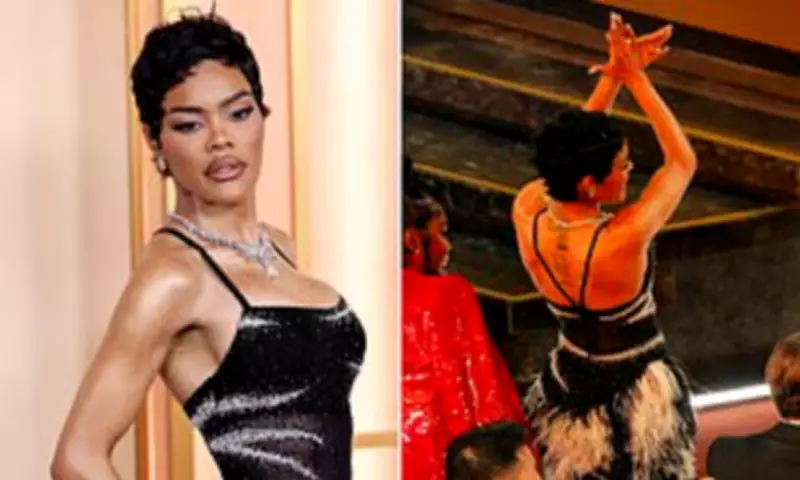
Teyana Taylor found herself at the centre of a significant social media controversy following her highly theatrical response to losing the Best Supporting Actress Oscar at the 2026 Academy Awards ceremony. The actress lost the coveted award to Amy Madigan, but her reaction, captured in vivid detail by television cameras, suggested anything but disappointment.
An Over-the-Top Display Captured on Camera
When Amy Madigan's name was announced as the winner, broadcast cameras immediately cut to a split-screen showing the reactions of the other nominees: Wunmi Mosaku for 'Sinners', Inga Ibsdotter Lilleaas for 'Sentimental Value', and Elle Fanning, also for 'Sentimental Value'. It was Taylor's response that immediately captured public attention and sparked widespread debate.
Taylor leapt dramatically from her seat, arms flailing wildly above her head as she engaged in what appeared to be excessively enthusiastic applause. The display seemed more appropriate for a personal victory than for congratulating a fellow nominee on their success, creating an immediate disconnect that viewers quickly noted.

Social Media Erupts with Criticism
The reaction on social media platforms was swift and largely critical. One viewer posted on X, formerly known as Twitter, 'Teyana Taylor faking the happiness, girl sit down and relax,' while another commented, 'Lmao that Teyana Taylor reaction, the fakest sh** ever.'
A more sympathetic fan questioned, 'Why is Teyana acting like she isn't crying inside?' highlighting the apparent contradiction between Taylor's outward display and what many assumed must be her genuine feelings of disappointment at missing out on one of cinema's highest honours.
Body Language Expert Weighs In
Body language expert Judi James provided exclusive analysis to the Daily Mail, describing both Taylor and Fanning's reactions as 'overkill performances of counter-intuitive emotions that should have won an award in a category of their own.'
James explained that both actresses engaged in what she termed 'wild rituals' typically reserved for winners, suggesting this was a deliberate strategy to mask their authentic disappointment. 'Both hid their actual disappointment by masking their authentic facial expressions,' James stated.
Detailed Analysis of the Reactions
Regarding Taylor's specific behaviour, James noted: 'Teyana dived forward from her seat as though she'd received an electric shock, her head lowering meaning she barely needed to compose a masked facial expression. When she came up, she was in full celebratory mode, clapping with her hands above her head.'
Fanning's response followed a similar pattern of exaggerated celebration. 'She immediately went into a winner's pose, shrugging her shoulders in delight, throwing her mouth wide open with brows raised in surprise and eyes squinting almost shut,' James continued. 'This was a mask of peak pleasure, which she then followed by falling back into her seat laughing with some excited seal-like clapping.'
The Psychology Behind the Performance
According to James's expert analysis, such dramatically over-the-top behaviours typically reveal a powerful underlying emotion—in this instance, natural disappointment—that can only be concealed by an equally intense display of the opposite feeling. The very extremity of the reaction suggests the strength of the emotion being suppressed.
The 2026 Oscars ceremony thus provided not only recognition for cinematic achievement but also a fascinating case study in public emotional management under intense pressure and scrutiny. Taylor's reaction, while criticised by many, represents a common psychological response to public disappointment, magnified by the global spotlight of Hollywood's most prestigious awards ceremony.